As a member of the Pa Co ethnic group, interwining her life with A Luoi, Ms. Le Thi Them has devoted all her passion to preserving the cultural essence of ethnic minority communities and breathing life from the mountains and forests into A Luoi tourism.
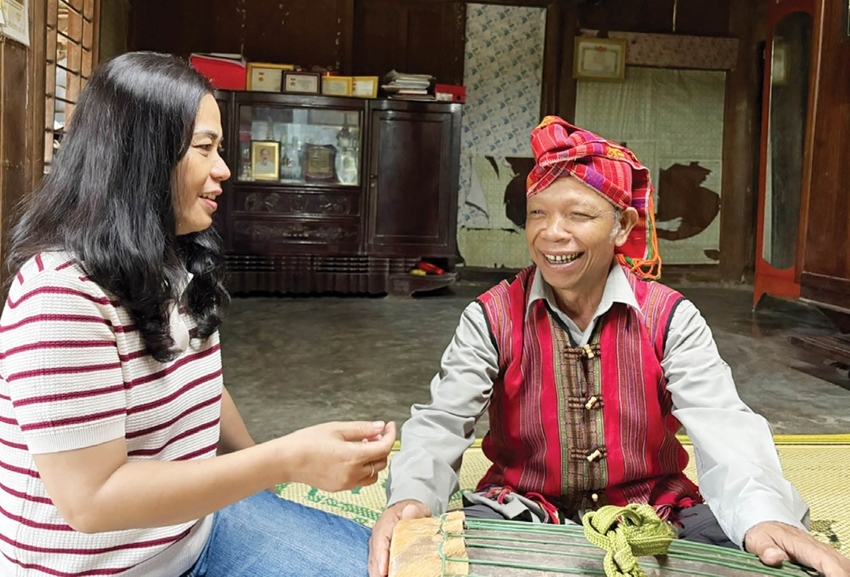 |
| Ms. Le Thi Them and artisan Ho Van Hanh |
Preserving for future generations
We still vividly remember her small figure, nimbly wading through streams and climbing slopes during field trips to Hong Ha, working alongside local officials to identify new tourism sites. Halfway up the mountain, under the scorching summer sun, sweat soaking through her shirt, and her face flushed red in the harsh sunlight, the eyes of this Pa Co woman still shone with joy and passion.
There were days when she traveled from A Dot and A Roang to Trung Son and Hong Thuy, sitting by the fire with village elders and helping them to evoke ancient memories. From their simple stories, love for culture and the village seemed to be rekindled.
“The culture of ethnic minorities has always been passed down orally. I used to think, if one day the elders return to the mountains, taking with them the songs, dances, forest rituals, land ceremonies... then what will future generations have to remember their roots?” From this concern, Ms. Them’s aspiration to preserve and transmit culture grew stronger each day. So when she had the opportunity to become a cultural officer, she clearly understood her responsibility: to serve as a bridge between state policies and village cultural life. Together with colleagues, Ms. Them conducted fieldwork, collecting, documenting, and restoring cultural values at risk of disappearing.
She sought out elderly artisans such as artisan Quynh Hoang, elder Ho Vien Pua, village elder Ho Van Hanh, village elder Ra Pat Trinh, and village elder Nguyen Hoai Nam. They are the “living chronicles” of the highlands, knowledgeable in everything from carving, weaving, and pottery to ancient dances and songs, sounds of the khen, gongs, and drums. Ms. Them recalls that there were times when everything seemed to have sunk into oblivion, yet with just a gentle reminder, a bit of encouragement, memories would awaken. They would enthusiastically tell stories, eagerly teaching the younger generation. “Those were moments that deeply moved us,” emotionally reflected the Pa Co woman.
Mr. Nguyen Manh Hung, the former Chairman of A Luoi District People’s Committee, now Party Secretary of A Luoi 2 commune, and village elder and respected figure among ethnic minorities, artisan Ho Van Hanh, affirmed: Thanks to the perseverance and dedication of cultural workers like Ms. Them, many traditional crafts such as weaving and zeng textile-making have been ‘awakened’ and are thriving again in stilt houses. Accordingly, the ancient pottery craft of the Pa Co people has been restored. Old dances and songs have been recorded. Village festivals have been collected and published in books. All of this creates invaluable heritage for the community, preserved for future generations.
With all her heart
“Culture only lives when practiced by the community and known to friends from all directions”. This is the constant concern of cultural workers. Ms. Them can no longer count how many trips north and south she made with artisan delegations, bringing the colors of A Luoi to introduce to friends at home and abroad.
To become part of Dong Mo Cultural Village (Hanoi), Pa Co, Co Tu, and Ta Oi artisans from various localities had to stay and commit year after year. On their first days at Dong Mo, artisans from the A Luoi highlands felt awkward and shy, only wishing to return home soon. Ms. Them patiently encouraged them: “If you don’t stay, who will know about the Pa Co, Ta Oi, and Co Tu people of A Luoi?” Gradually, their hesitation disappeared, replaced by pride in introducing their culture to tourists, contributing to bringing A Luoi’s image into the overall picture of the community of 54 ethnic groups at Dong Mo.
Ms. Them still clearly remembers the feeling of happiness during the “On the wharf, in the boat” event organized by Ho Chi Minh City in January 2025, when the A Luoi artisan delegation left an unforgettable impression. The small booth in a corner of the fair suddenly became a highlight with zeng weaving looms, brilliant traditional costumes, and the simple songs and dances of the highlands. The flavor of the mountains seemed to follow the footsteps of the Pa Co, Ta Oi, and Co Tu people, spreading through the city streets, delighting many tourists. Ms. Them shared that each such trip, in addition to promoting culture, is an opportunity to instill more confidence in the community, helping them proudly introduce their unique identity.
Almost all major cultural events take place during Tet. And so, year after year, this Pa Co woman packs her bags and sets off with the artisan delegation. She can’t count how many spring seasons she’s been away from home, unable to sit by the fire with her family to welcome the New Year. Yet, in Ms. Them’s heart, the joy of bringing highland culture to friends everywhere blooms as brilliantly as spring flowers on high mountains.
Revival and radiance
A Luoi nestles beside the majestic Truong Sơn mountain range, with a cool climate year-round. To attract tourists, this place needs pioneering hands and the community’s loving preservation.
“Tourism is the path for culture to connect with life, for people to have additional livelihoods,” confided Ms. Them, vividly recalling the early days of going to villages to encourage people to develop tourism. The concept of “community-based tourism” was still very unfamiliar then, so everyone was cautious, even evasive. Many times, when villagers saw Ms. Them’s figure from afar, they would “run away” to avoid conversation. Yet, she didn’t give up. Time after time, she persistently knocked on each door, showing them what to do hands-on. Through training sessions, with the support of commune officials and village heads, people’s hesitation gradually disappeared, replaced by excitement about tourism.
Stilt houses were renovated. Dances and songs that were familiar in daily life were now incorporated into tourism tours, becoming “specialties” that captivate visitors. Groups of tourists visiting A Luoi for the first time were often delighted to walk through the highlands during the day, then sit around the fire at night listening to village elders tell stories, enjoy bamboo-tube rice, and drink cần wine (fermented rice wine). In the amazed eyes of tourists, villagers were happy that their culture and way of life could also become “assets” for economic development.
“The early days of community-based tourism were very difficult. Infrastructure was lacking. Roads were remote. People’s mindsets were not unified. However, we always believed that each small step opens up a greater future,” smiled Ms. Them.
To date, community-based tourism villages such as A Nor, Hong Ha, and A Roang have become bright spots on the highland tourism map. A Nor community-based tourism village was even selected by the Vietnam Tourism Association as one of the 4 exemplary community-based tourism villages in Vietnam in 2019.
In recent years, the former A Luoi district has always strived to develop one new tourism site each year, while upgrading and improving service quality at existing sites to better serve tourists. Ms. Le Thi Them said joyfully: “In the old days, villagers were still hesitant when they saw tourists. Now, they boldly invite guests into their homes, confidently introducing their culture. That is the greatest change and also what makes me happiest.”
During a village festival night, amid the gentle sound of the khen and the lively dances of highland young men and women, Distinguished Artisan Ho Thi Tu, artisan Ka Ko, and artisan Ka Huu also shared with heartfelt appreciation that having people like Ms. Le Thi Them “keeping the flame alive” has helped many hearts in the A Luoi mountains burn with pride in their roots, allowing highland culture to be revived, cherished, and shine brightly.