 |
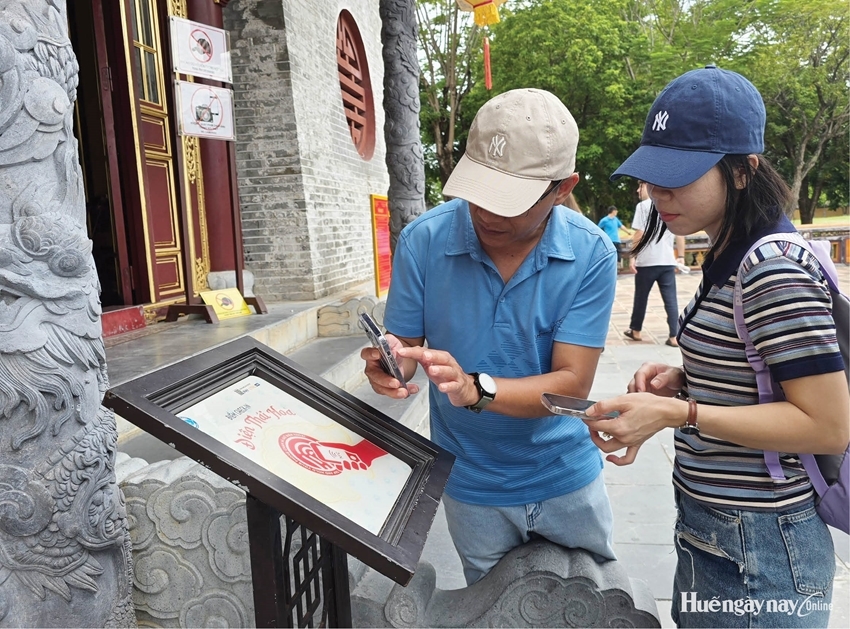
| Visitors experience a smart interactive station in Hue Imperial Citadel |
Convenient for visitors
On her first visit to Hue, Le Hoang Lan, a visitor from Ha Tinh, explored Hue Imperial Citadel and learned more about the history and image of Thai Hoa Palace through the TapQuest system. “This was my first time experiencing NFC technology, and I have to say I was very impressed. Instead of having to look for information from different sources, I could simply tap my phone on an interactive point and immediately access images, videos, 3D models, text and an AI-powered virtual guide,” Lan said enthusiastically.
TapQuest was first piloted at Hai Van Frontier Post and later introduced at Hue Imperial Citadel in November 2024. To date, another 70 interactive stations have been installed at 12 sites within the Complex of Hue Monuments, bringing the total number of stations across Hue to nearly 100.
For Truong Tu Lam, a visitor from Nha Trang, convenience begins with purchasing a ticket. Lam said he was able to book an electronic ticket in less than 30 seconds, with the system synchronizing the information quickly. Hue’s digital heritage application is also quite convenient, making visits easier.
After more than three years of operating the electronic ticketing system, visitors can purchase tickets online, make payments and use QR codes for ticket validation at the entrance to all attractions managed by Hue Monuments Conservation Center.
Cashless payments have also become part of the process, currently accounting for nearly 50 percent of transactions. The Center continues to upgrade its ticketing infrastructure, expand online ticketing options and study automated ticket sales and validation, as well as ways to verify the eligibility of visitors entitled to admission fee reductions.
Each transaction also generates data on visiting times, visitor numbers and destinations. These data help the Center monitor visitor flows, forecast demand and organize services more efficiently.
According to Deputy Chief of the Center’s Office Vo Quang Huy, electronic ticketing has transformed the traditional ticket-selling process while also supporting management, operations and the assessment of visitor satisfaction.
The system is also being designed to connect with new solutions. These include AI cameras for counting visitors and cross-checking the figures against ticket data, as well as AI applications for analyzing ticket-purchasing trends and forecasting visitor flows. Other options, such as Face ID, automated ticketing and ticket formats that make QR-code scanning more convenient, are also being studied.
Technology has also been introduced into heritage protection. Surveillance and anti-theft alarm cameras have been installed in key areas such as shrines and places displaying antiquities, with the systems connected to the control center at Ngu Tien Office. In areas with high visitor concentrations, AI-based recognition technology is used to support visitor flow management.
“Digital transformation is changing the way heritage is managed, researched and preserved, while also creating greater convenience for visitors,” confirmed Mr. Hoang Viet Trung, Director of Hue Monuments Conservation Centre.
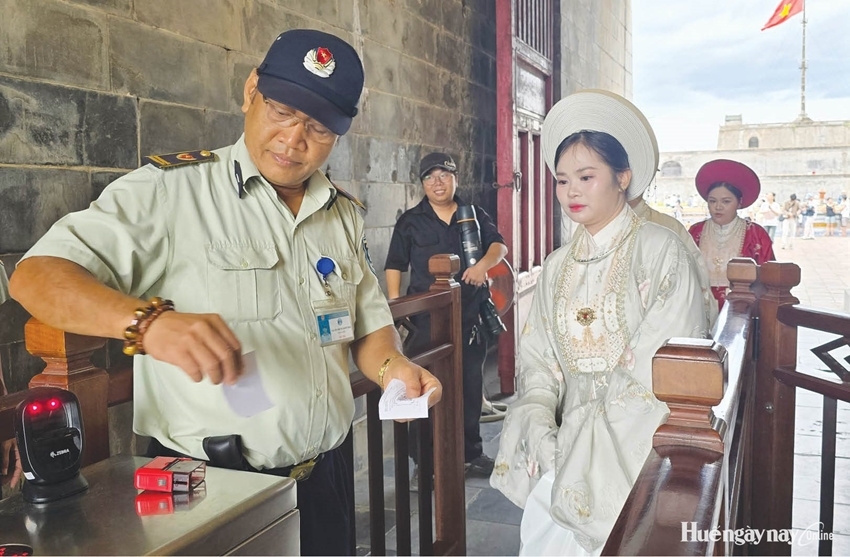 |
| Visitors purchase tickets online and use QR codes for ticket validation when entering heritage sites |
New layers of data
Behind the conveniences offered to visitors lies a vast body of documentation being processed and digitized. Nearly 1,400 archival records have been reorganized and systematized, while 14,872 pages of documents have been digitized, gradually forming a database for management, retrieval, use, and long-term preservation.
The Center is also operating database management software for tangible heritage, intangible heritage and trees. This provides a foundation for heritage information to be consolidated, updated and utilized rather than stored separately in disconnected collections.
Another approach is the direct digitization of artifacts. At the Museum of Royal Antiquities of Hue, 207 representative artifacts from the Nguyen Dynasty have been scanned and digitized in 3D; 108 artifacts have been digitally catalogued and incorporated into a digital exhibition.
Hue Imperial Citadel, Tang Tho Lau (Archive Pavilion) and several other heritage sites have also been digitized using 360-degree technology. The current digital archive contains 8,457 image files from the Archives Nationales d’Outre-Mer (ANOM), 957 files from the École française d’Extrême-Orient (EFEO), and 39 image files of Can Chanh Palace. The titles of French-language documents have also been translated into Vietnamese to facilitate searches.
At Thai Hoa Palace, Building Information Modeling (BIM) technology has been applied to store 3D data on structural components and support restoration and construction work. Data on the components have become part of the building’s documentation and can continue to be used for research and management after the project is completed. Data from scientific research projects, festivals and the annual Hue Festival are also gradually being integrated into the system.
A 3D tourism map and GIS system are continuing to be developed, incorporating layers of data on heritage, trees, waterways and landscapes. The tree database alone has recorded 7.830 trees, including 198 protected trees across 17 areas, as well as 15 green spaces and bodies of water and more than 100 roads within the Complex of Hue Monuments.
“In the field of archival management and digitization, the Center is stepping up the development of databases and the digitization of artifacts, archival materials, documents and heritage structures, gradually establishing a data platform to support heritage research, management and preservation,” Mr. Hoang Viet Trung said.
In the coming time, the Center will continue to improve its databases, apply AI and develop new experiential spaces. “The data accumulated through digitization will be utilized for research, management, conservation and the development of cultural industry products,” Mr. Trung said.
Technology is gradually creating new layers of data for Hue’s heritage. When properly connected and utilized, these data will become part of the process of managing, preserving and promoting the value of heritage in the digital environment.