 |
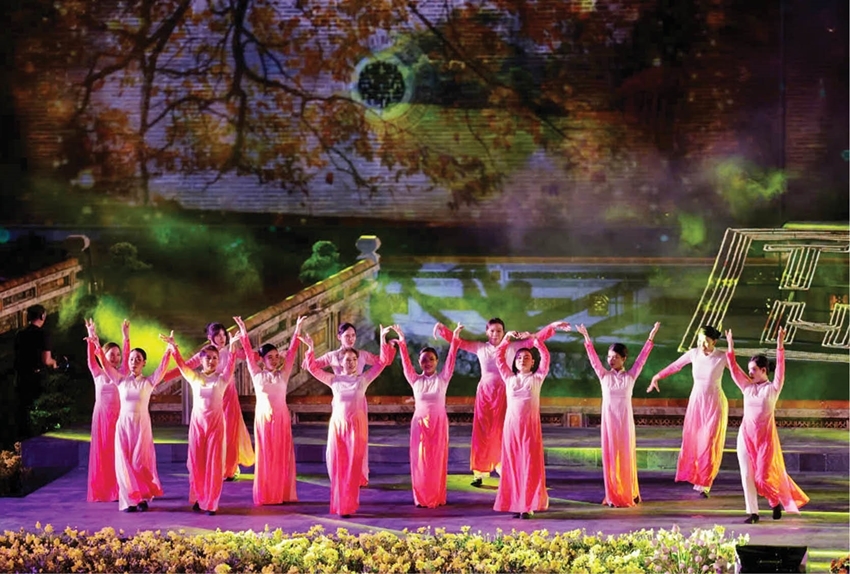
| Ao dai Vietnam on the stage of Hue Festival. Photo: Hue Festival |
From a local event to an international-scale event
Hue Festival “was born” in 2000, initially was a local cultural event aimed at honoring the heritage of the Imperial Capital and revitalizing the community spirit after the difficult years following the war and subsidy period. The first festival took place from April 8 to 19, 2000, under the name “Vietnam-France Festival”, focusing on cultural exchange between the two countries.
Despite of modest scale, the event attracted over 300,000 visitors, opening a hope for a new direction for Hue, a place where culture, not just now but from that time, has been identified as a driving force for the city’s development by local leaders. One of them, Mr. Le Viet Xe, former Vice Chairman of Thua Thien Hue Provincial People’s Committee (old), who was in charge of cultural and social affairs, stated to the writer that Hue Festival is the driven force for the city’s development.
Since then, Hue Festival has been held every two years, gradually expanding its influence. By the second edition in 2002, the event has been officially adopted under the name “Hue Festival” and began welcoming artistic troupes from many countries, such as Japan, South Korea, and Thailand. Subsequent editions saw the participation of dozens of countries from Asia, Europe, and the Americas, turning Hue festival into a truly international festival. By 2024, the latest festival edition marked a significant milestone by the participation of over 50 international artistic troupes and nearly 1.5 million visitors, affirming the global stature of the event.
It can be said that the development journey of Hue Festival is a story of perseverance and vision by local government leaders across different periods. From a local cultural event, it has exceeded the limits of space and time to become a symbol of international integration, not just for the locality but for the entire country. Through the path of culture, it has become “a stage” where many nations from around the world come to showcase their unique cultural beauties.
A bridge linking tradition and modernity
Mr. Nguyen Duy Hien, former Director of Hue Festival Center recalled: “Thanks to Hue festival, heritage sites like Hue Imperial Citadel, Flag Tower, Truong Tien Bridge, Thuong Thanh (the upper surface of the Citadel), and the banks of the Perfume River have become dynamic settings and stages, allowing the unique cultural values of Hue to shine before both domestic and international tourists. With each edition, Hue Festival has not only grown in scale but also in quality, becoming an essential “specialty” in the cultural map of Vietnam”.
One of the factors that make Hue Festival so captivating is the harmonious blend of traditional culture and modern art. It is the place where the smooth tunes of Hue Singing on the Perfume River merge with contemporary dances from the West, where the sounds of royal court music resonate alongside the vibrant beats of electronic music.
Notably, as Mr. Nguyen Duy Hien once said, Hue Festival, which was initially an arts event, has over time become a powerful driving force to boost the economy, tourism, as well as raising public awareness of cultural preservation. Statistics from the tourism sector show that each Hue Festival edition has contributed hundreds of billions of VND to local budget, from ticket sales and accommodation services to related commercial activities.
After nearly 25 years, although it has become an event held “year-round”, Hue Festival still continues to uphold its spirit and tradition, contributing to the ongoing development of the city. With its stature of a centrally-governed municipality, starting from January 1, 2025, Hue aims to elevate Hue Festival to new heights, making it a leading cultural event in the region, on par with major festivals such as the Gion Matsuri (Japan) or the Edinburgh Festival (Scotland).
Above all, Hue Festival is a testament to the city's ability to integrate and innovate, fostering international cooperation through culture in a city that once endured great losses after the war. Fifty years after the liberation, Hue has not only risen up but also affirmed its status as a distinctive heritage city of Vietnam, encapsulated in the 13 words “Identity, intelligence, adaptability, green, clean, beautiful, safe, sustainable”, as stated by Prime Minister Pham Minh Chinh. It now shines on the international stage, with the Hue Festival serving as a solid bridge.