 |
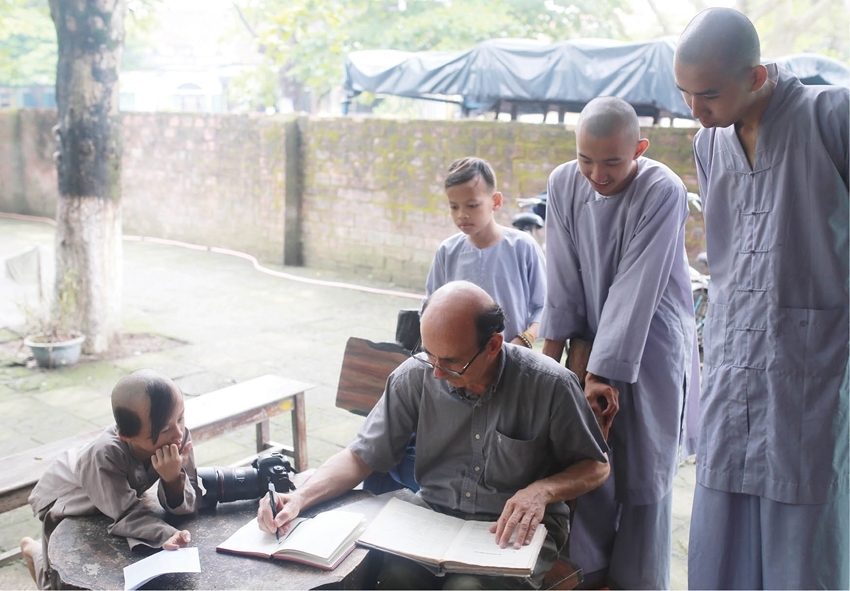
| French photographer Nicolas Cornet during one of his visits to a pagoda in Hue. Photo: Quoc Anh |
Nicholas Cornet’s photobook, named ‘Vietnamese Pagodas’, was recently republished. It invites viewers to connect with the emotion of a cultural space deeply rooted in the spiritual life of the Vietnamese people.
‘Vietnamese Pagodas’, available in both Vietnamese - French and Vietnamese - English bilingual editions, not only is a valuable documentary resource but also demonstrates the potential of documentary photography and Cornet's passion for pursuing cultural and historical values in order to tell the story of a land and its people.
Among all the places Cornet has visited, Hue holds a particularly special place in his heart. Any discussion of Buddhism and pagodas in Vietnam inevitably leads to the Ancient Capital, home to hundreds of pagodas, including many famous ancient ones that were established centuries ago and have been preserved to this day. Cornet has said that each pagoda in Hue captivated him in a unique way, and that every press of the shutter felt almost like an act of meditation.
Among the many photographs he chose to include in the book, viewers will immediately recognize celebrated Hue pagodas such as Thien Mu Pagoda, Bao Quoc Pagoda, Dieu De Pagoda, and Tu Hieu Pagoda. Rather than approaching them as a passing tourist, Cornet spent considerable time at each site, immersing himself in the place and its community. As a result, his photographs capture the quiet, contemplative atmosphere of monastic life in the Ancient Capital with remarkable authenticity.
Cornet acknowledges that Hue is an unmissable destination for anyone wishing to understand Buddhism in Vietnam.
Each pagoda possesses its own distinctive character, from its history and architecture to its landscape and daily activities. Together, these elements flow into Hue's cultural fabric, forming an inseparable part of the city's heritage, where Buddhism remains a vital component. Whenever arriving at a pagoda, Cornet often chooses a spot, sits quietly for a while, and only then begins to take photographs.
Viewing Cornet's images of Hue's pagodas reveals a meditative quality not only in the photographs themselves but also within the photographer. Regardless of the setting or moment, the people appearing in his frame seem to move with extraordinary calm. Whether depicting scenes at a temple gate, moments during religious ceremonies, or ordinary daily life within the pagoda, his photographs present Hue's temple world with a gentle and distinctive perspective.
One thing that brings Cornet great joy is the feeling that he becomes part of the life of the places he visits.
To mark the republication of Vietnamese Pagodas, Cornet has also organized an exhibition in Ho Chi Minh City. Through the photographs, visitors can better understand that pagodas are not merely places of worship but also centers of community life. Within that flow, the boundary between spiritual practice and everyday life appears to exist in a constant state of interaction.
Vu Khoi Nguyen, a curator who selected the photographs for exhibition, observed that many of Cornet's images of Vietnamese pagodas in general, and Hue's pagodas in particular, focus on recurring relationships: between people and temple spaces, between religious practice and daily life, and between architecture and the presence of the community.
Rather than treating pagodas simply as geographic landmarks or emphasizing differences among Buddhist traditions in Vietnam, Cornet presents them as cultural spaces where ritual, memory, and social activities coexist and shape one another.
What is perhaps most fascinating is that many of the pagodas Cornet photographed have since changed due to urbanization, restoration, or reconstruction. His photographs have therefore become visual records of a period of transformation in Vietnam's cultural and architectural landscape.