



 |
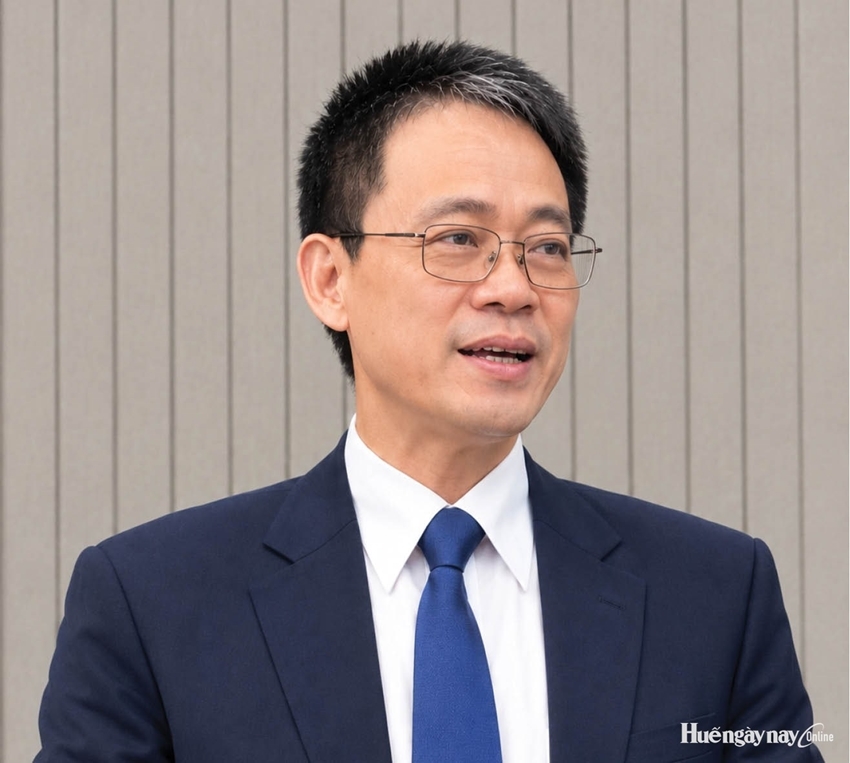
| Professor Tran Dang Hoa, PhD, Vice President of Hue University. |
Professor, with efforts to attract FDI into high-tech sectors gaining momentum, how does Hue University define its role and mission in training and supplying a high-quality workforce?
Hue University does more than supply personnel for investment projects. We also contribute to strengthening the region's capacity for research, technology adoption, mastery, and innovation across Central Vietnam, the Central Highlands, and the country as a whole. Building on our multidisciplinary university foundation, we focus on developing human resources in artificial intelligence, semiconductor integrated circuits, automation, data science, and digital technology. We also promote the application of technology in medicine and pharmaceuticals, agriculture, the environment, culture, and services.
The establishment of the School of Engineering and Technology at Hue University in late September 2026 marks an important step forward. It provides a focal point for training, research, and business cooperation in engineering, AI, electrical and electronic engineering, automation, and semiconductor technology. We are pursuing three main objectives: training engineers and specialists with the capabilities required for international integration; advancing research, practical applications, and technology transfer; and developing a local workforce that can help attract and support high-tech investment projects.
As Hue University pursues its roadmap toward becoming a National University, how are its flagship training disciplines, particularly those addressing the workforce needs of major technology corporations, being positioned?
The development of advanced engineering and technology disciplines is a key driver in Hue University's strategy to become a multidisciplinary, multi-field research university, with the long-term goal of attaining National University status. Priority fields include AI, data science, integrated circuit design, automation, robotics, and digital technology. Their development is based on workforce demand, the capabilities of our academic staff, and available investment conditions.
Each member institution can leverage its own strengths while participating in joint programs. For example, the University of Sciences has a strong foundation in information technology, electronics, and the basic sciences. The University of Agriculture and Forestry has strengths in mechanical engineering, mechatronics, and technologies serving production. The University of Medicine and Pharmacy has considerable potential to develop digital medicine and AI applications in healthcare.
Hue University is developing and updating training programs in information technology, data science, artificial intelligence, robotics, automation, automotive engineering, semiconductor technology, and integrated circuit design, following a roadmap that takes into account quality assurance requirements and current regulations. At the School of Engineering and Technology, notable training fields include data science and AI; control engineering and automation; electrical engineering; electrical and electronic engineering technology, including integrated circuit design; computer engineering; and automotive engineering technology, including electric vehicle technology.
The curricula emphasize project-based learning, hands-on practice with modern tools, internships with businesses, and the integration of AI, data, foreign languages, and digital skills. Students are encouraged to participate in research, product development, and innovative entrepreneurship.
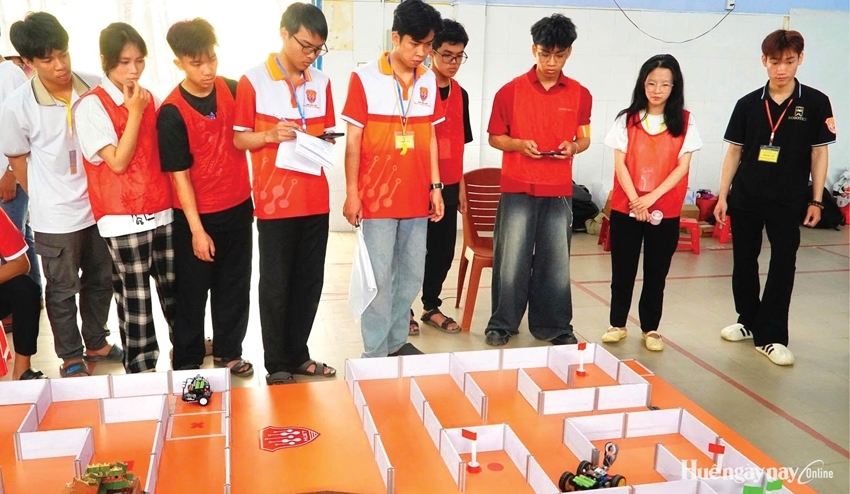 |
| Students at the School of Engineering and Technology practice operating a Robocon robot. Photo: Hai Le. |
What is Hue University's strategy for attracting experts, developing its academic workforce, and investing in infrastructure to support high-tech education and training?
Academic staff and research infrastructure are two essential conditions for delivering high-quality training in advanced technology. Hue University prioritizes developing highly qualified lecturers, attracting experts from businesses and international institutions, encouraging interdisciplinary research, strengthening English-language teaching capabilities, and keeping up with emerging technologies. Young lecturers are encouraged to establish research groups, participate in scientific projects, and collaborate with businesses.
In terms of infrastructure, our strategy is to make targeted investments in laboratories, computing platforms, design and simulation software, and equipment for practical training in robotics, automation, and integrated circuit technology. At the same time, we are strengthening the sharing of facilities among our member institutions and expanding partnerships with businesses to make effective use of available resources. Our guiding principle is to develop people, training programs, and infrastructure in a coordinated manner while avoiding scattered, inefficient investment.
Business and international cooperation are also essential to improving the quality of education and scientific research while expanding students' career opportunities. Hue University prioritizes partners capable of making substantive contributions to curriculum development, hosting interns, supervising research, providing software and equipment, and supporting technology product development.
In the long term, how will the high-tech workforce trained at Hue University contribute to the innovation ecosystem in Hue and Central Vietnam, as well as the region's attractiveness to FDI?
A high-tech workforce will help improve productivity and businesses' innovation capacity. It will also contribute to developing a pool of engineers, researchers, and technology entrepreneurs who can participate in domestic and international value chains, thereby strengthening Hue's and Central Vietnam's appeal to investors. At the same time, these skilled professionals will promote the application of technology in healthcare, agriculture, heritage conservation, tourism, culture, and urban management.
However, FDI attraction does not depend solely on human resources; it is also closely linked to infrastructure, the investment environment, and the business ecosystem. Therefore, Hue University hopes to work closely with local authorities, ministries, relevant agencies, and businesses to align training with actual development needs. We expect Hue University to gradually establish itself as a center for education, research, and technology transfer, contributing to innovation and enhancing the standing of Hue and Central Vietnam on Vietnam's technology and investment map.
Thank you, Professor.