



 |
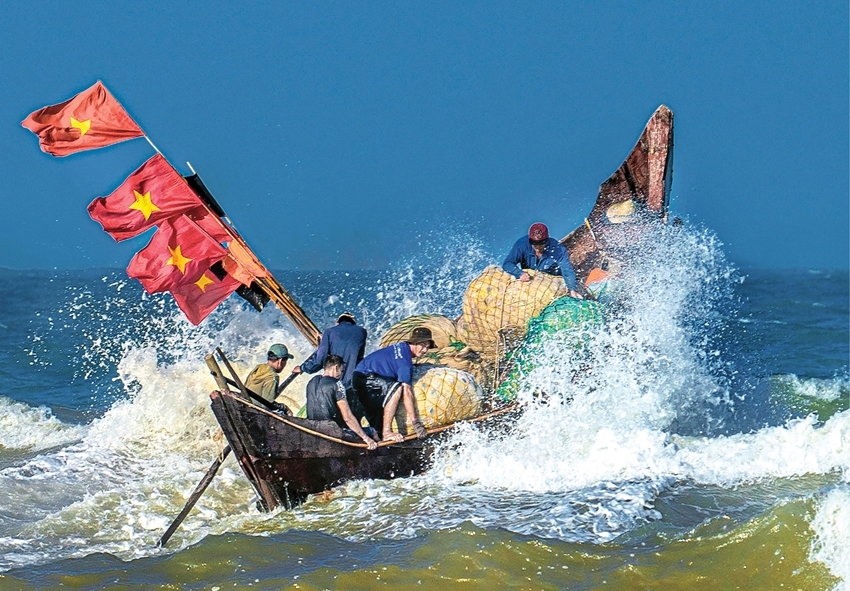
| During their journeys out to sea, fishermen are also paying greater attention to protecting the marine environment. Photo: Hoang Phuoc |
From small-scale, spontaneous individual actions in its early days, the initiative has gradually expanded and is helping change fishermen's habits by encouraging them to work together to protect marine ecosystems.
Starting with mesh bags
Fishing has always been a demanding livelihood. However, at the Vinh Thanh Offshore Fishing Fleet in Phu Vinh Commune, Hue City, few people have ever abandoned the profession. Through determination and perseverance, these people of the sea continue to remain committed to their fishing grounds. The fleet comprises 27 vessels with engine capacities ranging from 400 to 800 horsepower, 136 members and approximately 300 workers. On average, each vessel carries 14–15 crew members who undertake extended fishing trips at sea.
Each offshore trip using bottom-set trammel nets typically lasts 12–15 days and generates revenue of approximately VND 180 - 200 million. Solidarity and a shared responsibility between vessel owners and crew members have created a strong collective spirit, enabling the fleet to overcome countless difficulties, particularly during periods of rough seas and strong winds.
Mr. Duong Chi Son, Vice Chairman of the Phu Vinh Commune People's Committee, said that although weather conditions in 2025 were unfavourable and fuel prices fluctuated, the commune's fishing output reached 7,950 tonnes. This was thanks to the fishermen's extensive experience and innovative fishing practices. Of this total, offshore fishing accounted for 3,500 tonnes. In the first nine months of 2026 alone, fishing output reached 7,060 tonnes, including 2,950 tonnes from offshore fishing, accounting for 42% of the total.
According to Nguyen Thanh Phat, a fisherman, (born in 1964), head of the Vinh Thanh Offshore Fisheries Association branch, who has spent more than 40 years in the fishing industry, the sea is both a source of livelihood and a place to which generations of fishermen have maintained a deep connection. However, amid the continuous stream of fishing ships heading out to sea, plastic waste is becoming an increasingly serious threat to the marine environment and seafood resources.
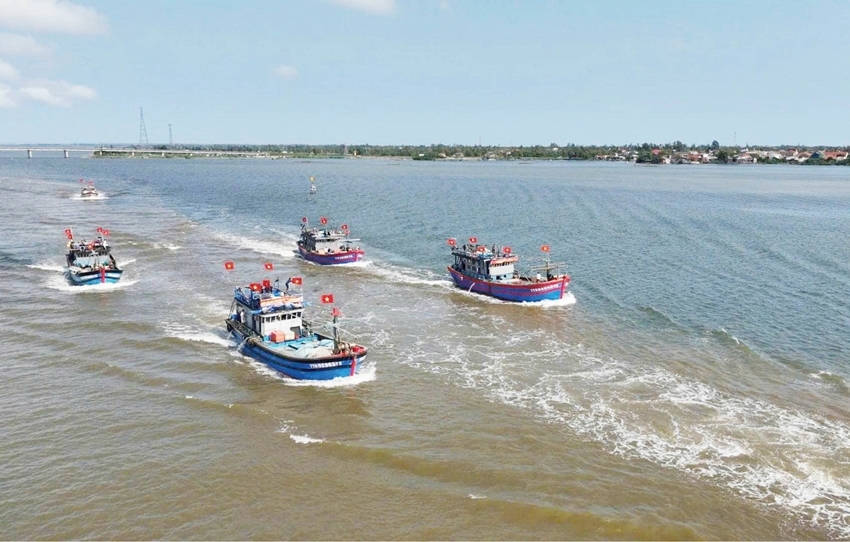 |
| The Vinh Thanh offshore fishing fleet sets off on a fishing expedition. |
Faced with this reality, many fishermen have proactively changed their habits, beginning by collecting waste generated during daily activities, as well as rubbish encountered at sea, and bringing it back to shore for disposal. In particular, alongside fishing gear and essential supplies, mesh bags for collecting rubbish have now become familiar items in fishermen's equipment when heading out to sea. Nguyen Thanh Phat explained: "On average, each fishing trip generates between 5 and 7 kilograms of household waste, including plastic bottles and aluminium cans. In addition, whenever we encounter hazardous waste floating at sea during fishing operations, the crew collect it and bring it back to shore."
Mr. Phat noted that plastic waste not only spoils the appearance of the marine environment and causes pollution but also threatens the sustainability of marine ecosystems and aquatic resources. If individual fishermen do not begin changing their behaviour, even though the smallest actions, the long-term consequences will directly affect the livelihoods of fishing communities.
Gradually changing habits
Achieving a collective commitment among fishermen to collect waste at sea has required a long process of changing established habits. Young fisherman Tran Van Cuong (born in 1991), captain of vessel TTH 94166 in Thuan An Ward, was one of the pioneers who initiated the marine rubbish collection model in 2020.
Initially, the initiative was limited to his own vessel and a few relatives. Whenever he went out to sea, Mr. Cuong brought homemade scooping nets and large sacks in addition to his fishing equipment. Whenever he spotted rubbish floating on the water's surface, he collected it and brought it aboard. Some crew members initially considered this unnecessary or a waste of effort. However, he did not become discouraged. Instead, he patiently explained the harmful effects of plastic waste. Through persistent efforts, the crew members gradually began joining him voluntarily in collecting rubbish and bringing it back to shore.
Mr. Cuong shared: "Sometimes, as much as 60% of each net haul consists of plastic waste and nylon bags, while fish and squid account for just over 30%. This makes fishing much more difficult. The waste brought back to shore is carefully sorted. Non-recyclable rubbish is taken to designated disposal sites, while recyclable plastic waste is collected and sold. The money is then used to buy books and school supplies for disadvantaged students in the neighbourhood."
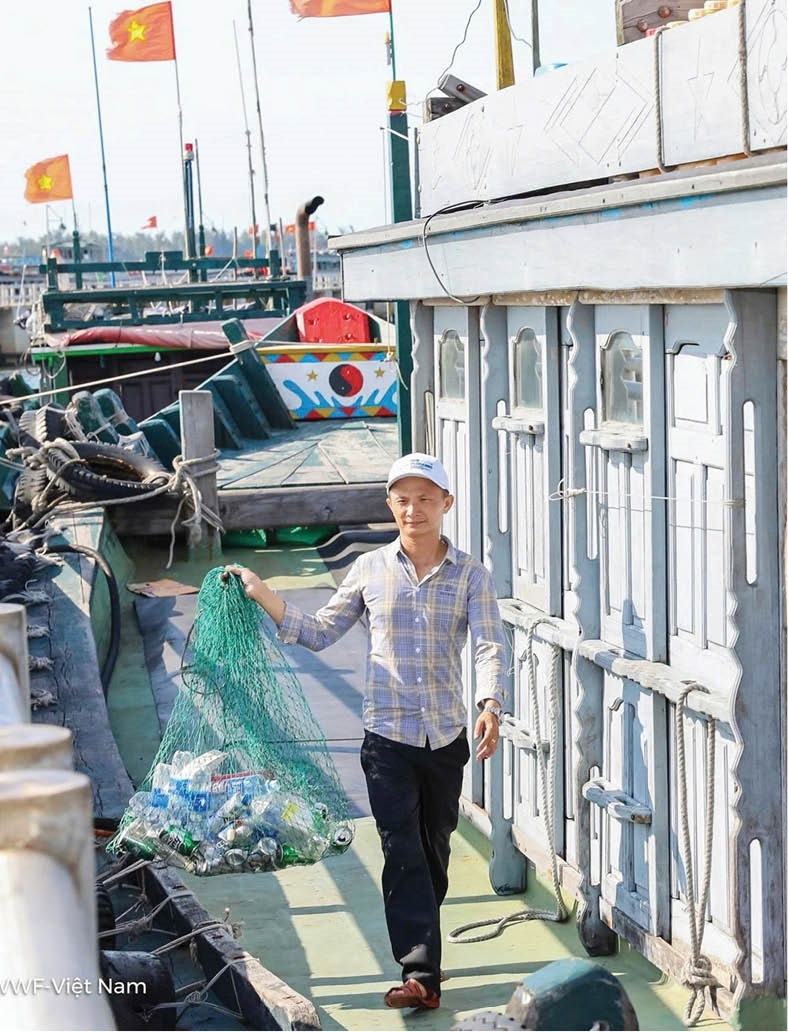 |
| Tran Van Cuong brings waste from his vessel back to shore |
The perseverance of people such as Mr. Phat and Mr. Cuong, together with extensive awareness-raising campaigns led by the Director of Hue City Agricultural Services Center, local authorities and mass organizations, has gradually transformed fishermen's attitudes and significantly increased their awareness of the dangers posed by plastic waste.
According to representatives of the project ‘Hue – A Plastic-Reduced City in Central Vietnam’, marine plastic pollution originates largely from people's waste disposal habits during fishing voyages. In response to this situation, the project ‘Hue – A Plastic-Reduced City in Central Vietnam’ has supported the expansion of the ‘Model of fishing vessel bringing waste back to shore at Thuan An Fishing Port’, with assistance from WWF-Vietnam.
From its initial pioneers, the pioneering fishing fleet model for collecting plastic waste in Hue has gradually expanded. Starting with 27 pilot fishing vessels belonging to the Vinh Thanh Offshore Fisheries Association in 2023, the initiative has now grown to include 150 fishing vessels and hundreds of participating fishermen throughout Hue City. In 2025, the initiative received enthusiastic support from the fishing associations in Thuan An, Vinh Thanh, Phu Hai and Phu Thuan, localities that have substantial core offshore fishing fleets.
It is estimated that participating fishing vessels collect and bring back approximately 70 tonnes of plastic waste each year. 100% of participating vessels have signed commitments to implement 12 plastic-reduction actions, including sorting waste at source and collecting recyclable materials in mesh bags; reusing packaging and foam boxes while limiting the use of single-use plastic bags; assigning the captain or a designated crew group responsibility for waste management; and actively participating in community initiatives such as ‘Green Sundays’.
Notably, fishermen are not only bringing valuable recyclable materials back to shore. They are also collecting plastics that are difficult to recycle or have little commercial value, such as PE ice bags, food packaging, instant noodle wrappers, foam boxes and damaged fishing nets and equipment. This demonstrates a fundamental change in their approach to environmental protection.
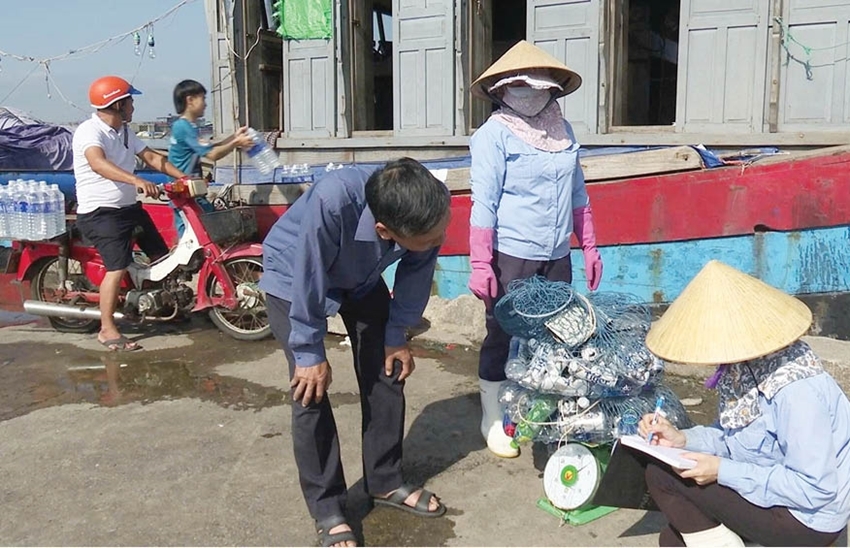 |
| Plastic waste is weighed by staff at Thuan An Fishing Port |
Restoring a clean and healthy environment to the ocean
Close cooperation between the Director of Hue City Agricultural Services Center, relevant stakeholders and vessel owners has helped establish a complete waste-management process, from the sea to the shore. The Fishing Port Management Board does more than distribute mesh bags and provide guidance on recording waste logs in accordance with the International Convention for the Prevention of Pollution from Ships (MARPOL). It has also invested in waste-sorting bins and waste-treatment equipment at the port, while introducing an initiative called ‘Exchange waste for gifts’.
Mr. Ngo Trung Nhat Quang, Director of Hue City Agricultural Services Center, affirmed: “With the goal of developing green ports, we have coordinated our efforts to raise fishermen's awareness and promote compliance with the international MARPOL Convention. Providing mesh bags for use at sea and establishing waste-sorting systems at fishing port facilities help ensure that waste is handled according to proper standards and prevent pollution risks at their source.”
However, observations show that the amount of single-use plastic waste generated at sea, such as PE bags and food packaging, remains high. On average, each fishing trip generates approximately 32 kilograms of waste per vessel, including 14 kilograms of plastic waste. This is equivalent to 1.5 kilograms of plastic per fisherman per trip. In the coming period, Hue City will continue expanding the initiative to cover all offshore fishing vessels in the city. At the same time, it will standardise a set of practical tools based on the six-action principle known as the ‘6Ts’: Refuse, Reduce, Recycle, Reuse, Replace and Collect. The ultimate goal is to ensure that every fishing vessel returning to port brings back not only a heavy catch of fish and shrimp but also bags of collected plastic waste, helping restore the cleanliness and health of the ocean.