



 |
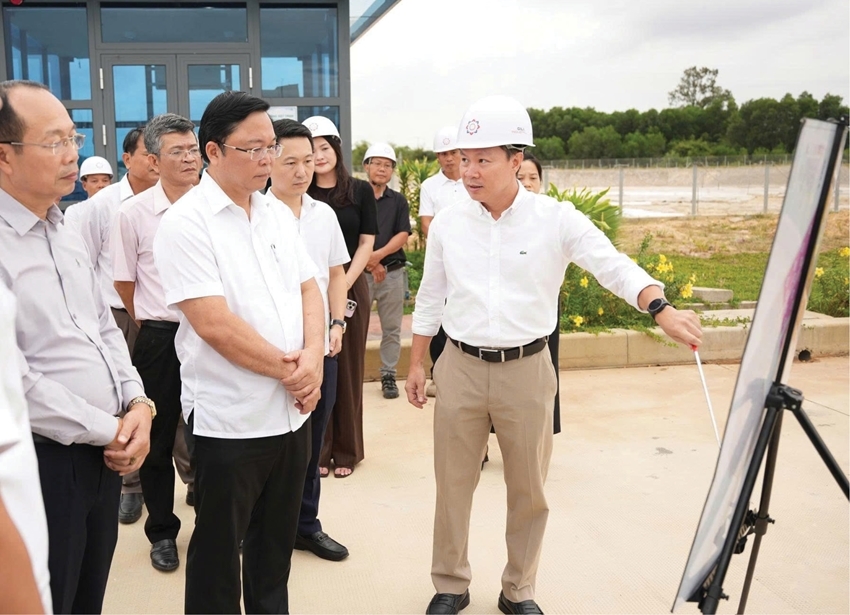
| City leaders inspect infrastructure completion works at Gilimex Industrial Park |
Creating greater value
In September 2026, a shipment of electric buses manufactured by Kim Long Motor in Hue was exported to Thailand, marking a new milestone in the company's efforts to expand its markets and participate in the automotive manufacturing supply chain. At the Kim Long Motor Hue Automobile Manufacturing Industrial Park, the company is developing facilities for vehicle manufacturing and assembly, engines, components, spare parts and mechanical products. Cooperation with foreign partners also opens up opportunities to access new technologies and increase localization rates. Earlier this year, Kim Long Motor established a strategic partnership with BYD Battery and broke ground on a battery manufacturing plant with a total investment of USD 130 million.
Mr. Dao Viet Anh, General Director of Kim Long Motor Hue, said that developing electric vehicles was the company's long-term strategy, aimed at strengthening technological self-reliance and mastering core technologies rather than limiting its operations to assembly and contract manufacturing. “Kim Long Motor sees electric vehicle development not merely as an inevitable trend, but as a long-term strategy closely linked to the technological autonomy of the national industry. The battery plant will meet Kim Long Motor's production needs while helping complete the value chain, from vehicles to components and spare parts,” Mr. Anh said.
Carlsberg is another example of an investor with a long-standing commitment to Hue. At the Phu Bai Brewery, the company continues to invest in expanding production capacity to meet market demand. Mr. Andrew Khan, Managing Director of Carlsberg Vietnam, said Hue was not only where the company had built its Huda brand but also an important contributor to its overall development strategy. “Hue is where we have built a strong brand like Huda, while also making an important contribution to our company's overall growth. Expanding production capacity in Hue will help meet consumer demand, create opportunities to develop other brands in the group's portfolio and expand into new markets,” Mr. Andrew Khan shared.
The continued investment and production expansion by these companies demonstrate that Hue's appeal lies not only in its ability to attract new projects, but also in the long-term development conditions it can offer investors.
Under the city's FDI Attraction Scheme for the 2026 - 2030 period, issued on October 2nd, 2026, Hue aims to attract USD 1.2 - 1.4 billion in registered investment capital, with realized investment reaching USD 800 million to USD 1 billion. The FDI sector is expected to contribute 12 - 15% of the city's gross regional domestic product (GRDP), while the proportion of workers who have received vocational or professional training is targeted to exceed 80%. Priority will be given to projects involving high technology, innovation, digital transformation, green industries and high-quality services. Investment promotion will also focus on multinational corporations, lead firms in supply chains and strategic investors capable of building links with domestic businesses, rather than spreading resources too thinly.
Removing bottlenecks to attract investment
Currently, economic zones and industrial parks across the city host 203 active projects, with total registered capital of VND 152,779 billion. Of these, 57 are FDI projects with total registered capital of 76,519.4 billion VND.
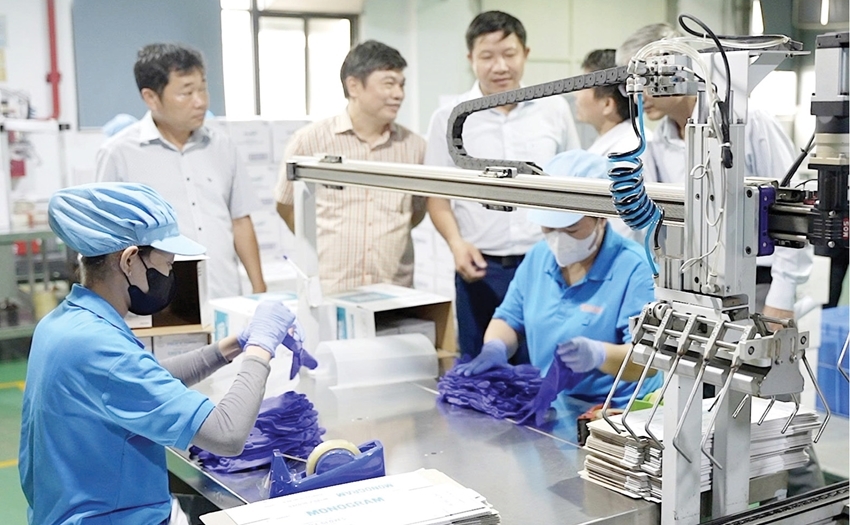 |
| FDI enterprises help create jobs for many local workers |
According to the FDI Attraction Scheme, achieving the goal of attracting higher-value investment will require the city to address challenges related to infrastructure, logistics, technical manpower and investment procedures. Hue will find it difficult to compete with major industrial centers if it relies solely on available land and general labor. The city has Chan May Port, Phu Bai International Airport, a network of economic zones and industrial parks, and a source of skilled workers from Hue University. However, these advantages can only be fully realized when supported by integrated infrastructure, a workforce that meets manufacturing requirements and a favorable investment environment.
A recent inspection by Mr. Le Tri Thanh, Deputy Secretary of Hue City Party Committee and Chairman of Hue City People's Committee, at Saigon-Chan May Industrial Park, Kim Long Motor, Carlsberg and Gilimex Industrial Park has highlighted the need to develop infrastructure and create favorable conditions for businesses to operate and expand their investments.
At Saigon - Chan May Industrial Park, the project covers approximately 322,3 hectares. To date, 225,51 hectares have been cleared, 207 hectares have been leased, and 16 projects have been attracted. Technical infrastructure across the allocated area is approximately 80% complete.
Cleared land and infrastructure are essential prerequisites for attracting investors. However, for projects to proceed on schedule, begin operations and expand production, businesses also need reliable electricity and water supplies, environmental treatment systems, logistics services, skilled workers and clear administrative procedures. As production scales up, demand for suppliers and support services also increases. The city's FDI Attraction Scheme identifies seven groups of tasks and solutions, focusing on investment promotion; institutional reform and procedural simplification; workforce development and sustainable transformation; linking FDI with value chains and the business ecosystem; infrastructure upgrades; improved dialogue mechanisms and post-investment support; and financial oversight, national defence and security, and the prevention of fraud in foreign investment.