



 |
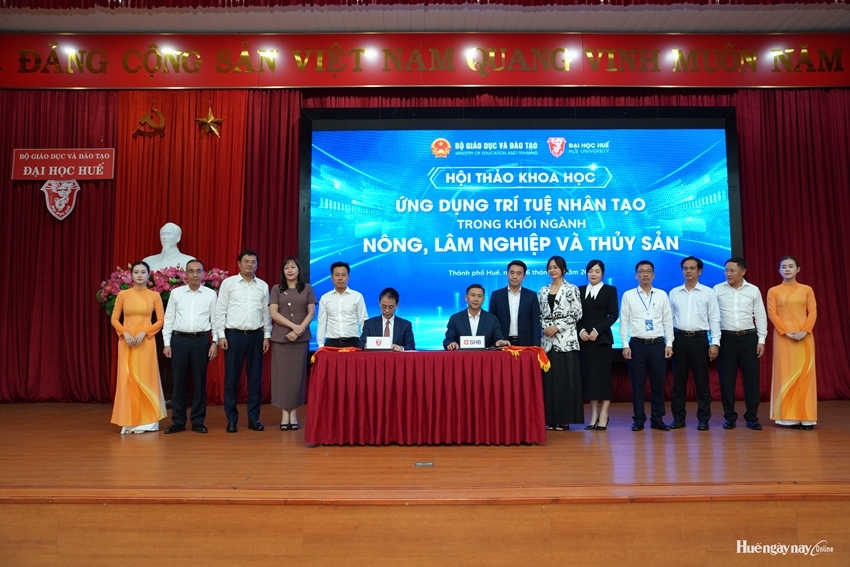
| Higher education institutions sign cooperation agreement with SHB Bank on training, scientific research, and AI applications |
The seminar focused on exploring ways to integrate artificial intelligence (AI) into academic curricula, modernize teaching methods, and improve university governance. Furthermore, the discussions also highlighted the need to enhance students’ digital and AI skills to better meet the labor market’s demands.
Prof. Dr. Tran Dang Hoa, Deputy Secretary of the Party Committee and Deputy Director of Hue University, emphasized that the demands for higher productivity and quality, more efficient resource use, and adaptation to climate change are posing significant challenges to the agriculture, forestry, and fisheries sectors. Therefore, innovation in training, research, and production is urgently needed, with AI offering practical solutions.
According to Prof. Dr. Tran Dang Hoa, AI adoption should not be the sole responsibility of the information technology sector but requires collaboration among scientists, technology experts, businesses, and producers. Such cooperation should address real-world challenges, provide students with hands-on learning opportunities, and promote the validation and transfer of research outcomes.
In his remarks at the seminar, Prof. Dr. Le Quan, Deputy Minister of Education and Training, noted that AI offers significant opportunities for agriculture, forestry, and fisheries. This technology could transform production practices from experience-based methods to data-driven and science-based approaches. However, effective AI adoption depends on reliable data, suitable infrastructure, a capable workforce, and clearly defined real-world applications.
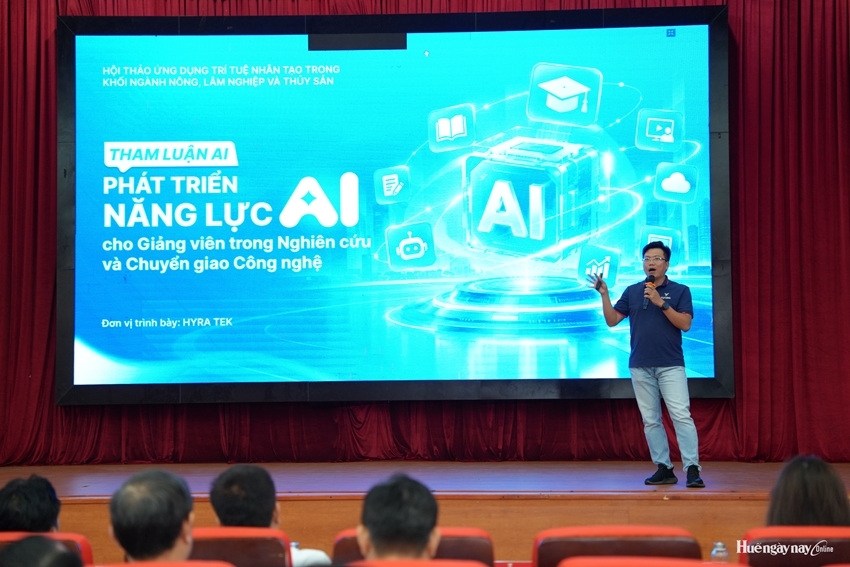 |
| The experts present their presentations at the seminar |
Prof. Dr. Le Quan urged educational institutions to assess labor market competency requirements, identify occupations likely to be affected by AI, and pinpoint gaps between academic curricula and real-world practice. He stressed that AI integration should be tied to learning outcomes, hands-on training, and students’ ability to solve discipline-specific problems, rather than pursued simply to keep up with technological trends or add AI courses for form’s sake.
For students, AI competency goes beyond the ability to use AI tools; it also encompasses data literacy, critical thinking, information verification, and professional ethics. Lecturers, meanwhile, need further training in applying AI to research, assessing the reliability of AI-generated results, protecting data, and transferring technology.
The seminar featured presentations examining the opportunities and challenges of integrating AI into education, the development of an AI competency framework for students, as well as ways to strengthen lecturers’ AI skills in research and technology transfer, and the incorporation of AI into training programs in agriculture, forestry, and fisheries.
As part of the seminar, higher education institutions signed cooperation agreements with SHB Bank and businesses to strengthen collaboration in training, scientific research, and AI applications. The partnerships aim to align university activities more closely with practical needs and improve workforce quality.