



 |
| Vice Chairman of Hue City People’s Committee Tran Huu Thuy Giang |
Sir, at the 22nd National Conference on Foreign Affairs held recently, Hue’s message on ‘cultural diplomacy’ drew considerable attention. As Hue enters a new phase of development as a centrally governed municipality, how are external relations and cultural diplomacy being positioned in the city’s development strategy?
Becoming a centrally governed municipality has opened up major opportunities for Hue, while also presenting a key challenge: how can the city preserve the essence of its heritage as the former imperial capital, while pursuing modern economic growth?
To address this challenge, Hue has identified a clear path forward: heritage as a distinctive competitive advantage; culture as a source of soft power; international integration as a driving force; and cultural diplomacy as the bridge that turns this soft power into tangible resources for development.
For Hue, cultural diplomacy extends well beyond cultural exchanges, image promotion, or artistic performances. We regard it as an important means of socio-economic development. It is used to connect and mobilize international resources to support heritage conservation, foster the heritage economy and cultural industries, and promote sustainable tourism.
This is also how Hue is putting the Party and State’s major policy directions into practice. These include Politburo Resolution No. 54-NQ/TW on the development of Thua Thien Hue (now Hue City); Resolution No. 57-NQ/TW on science, technology and innovation; Resolution No. 59-NQ/TW on international integration; and, most recently, National Assembly Resolution No. 28/2026/QH16 on cultural development. Cultural diplomacy is playing a key role in opening up new development space in the former imperial capital.
Hue has emerged as a notable example in Vietnam of how to attract the support of the international community for heritage preservation. From your perspective, what tangible results has cultural diplomacy contributed to in the restoration, preservation, and revitalization of Hue’s heritage?
Hue is proud to be home to eight UNESCO-recognized heritage titles, seven museums, 35 national treasures, and thousands of valuable historical sites. Recognizing heritage as an invaluable asset, the city has in recent years proactively taken advantage of the support and cooperation of UNESCO, international organizations, and development agencies around the world.
To date, Hue has received support from over 10 governments and around 40 international organizations, mobilizing tens of millions of US dollars for restoration, human resource training, and scientific research. With this funding and advanced technologies, a number of key heritage sites have been remarkably restored, including the Ngo Mon Gate, Thai Hoa Palace, Kien Trung Palace, Hai Van Frontier Post, Khai Tuong Lau in An Dinh Palace, and Duyet Thi Duong Royal Theatre.
At the same time, Hue has actively engaged in prestigious international networks, including the Organization of World Heritage Cities (OWHC) and the International Association of Francophone Mayors (AIMF), while strengthening cooperation with Kyoto, Nara, Gifu, and Shizuoka in Japan, as well as Gyeongju in South Korea…
The value of cultural diplomacy goes far beyond the material resources it brings. More importantly, it provides opportunities to exchange knowledge, access advanced restoration technologies, learn from modern management practices and green transformation models. Furthermore, cultural diplomacy paves the way to build long-term trust and cooperation between Hue and the international community.
“Conservation for development and development for conservation” has always been a guiding principle for Hue. What specific figures and practical models demonstrate how the city has turned its heritage values into a ‘heritage economy’ and ‘sustainable tourism’?
We firmly believe that heritage should not simply be ‘frozen’ for people to admire. It must remain a living part of contemporary life, creating economic value that can, in turn, sustain and preserve the heritage itself.
Hue has gradually turned its cultural heritage into economic value through the brand name of Hue Festival, with the Four Seasons Festival serving as an upscale platform for cultural exchange and people-to-people diplomacy. The city has also expanded its range of in-depth tourism experiences, from Hue Imperial City at Night and Royal Court Arts to the Changing-of-the-guard Ceremony, Royal Court Music, Ao-Dai Festival, and Hue Culinary Festival…
The economic efficiency is clearly reflected in the figures. From 2021 to 2025, Hue’s heritage sites attracted an average of 9.84 million visitors, accounting for over 60.1% of all visitors to Hue. In the first seven months of 2026, more than 2.14 million visitors visited the heritage sites, including nearly 850,000 international visitors. Revenue from admissions and services totaled over VND 310 billion, of which ticket sales accounted for over VND 267 billion, up around 20% year-on-year.
These figures show that traditional cultural heritage is truly becoming a key driver of economic growth, creating jobs, and supporting the sustainable development of tourism.
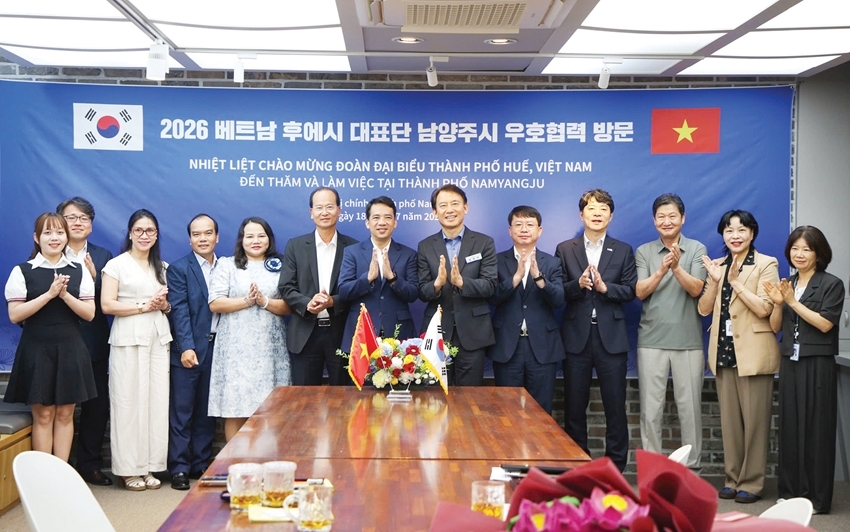 |
| Hue City delegation introduces Hue’s culture, tourism, cuisine, and traditional crafts in South Korea |
In the digital era, how has Hue leveraged digital transformation and innovation to bring the heritage closer to the audience around the world?
In implementing Resolution No. 57-NQ/TW, Hue considers technology an ‘extended arm’ of cultural diplomacy. We are stepping up the digitization of heritage, applying 3D scanning, virtual and augmented reality (VR/AR), automated multilingual interpretation, and smart tourism solutions through the Hue-S digital citizen platform.
Digital transformation helps bridge geographical distances. A visitor in Europe or the Americas can experience Kien Trung Palace or listen to Hue royal court music in a virtual space before ever setting foot in Vietnam. Technology not only improves the efficiency of heritage management and conservation, but also brings Hue’s heritage to life on the global digital map, attracting younger generations of visitors and investors.
At the recent National Conference on Foreign Affairs, Hue proposed establishing an annual international forum held in the Ancient Capital. Could you elaborate on the city’s vision and expectations for this initiative?
In addition to calling on the Ministry of Foreign Affairs and other central ministries and agencies to strengthen inter-agency coordination and facilitate connections with international networks, Hue City has officially proposed the establishment of an ‘International Forum on Cultural Diplomacy, Heritage Economy and Sustainable Tourism’, which is scheduled to be held annually in Hue.
We envision the forum as a regular platform bringing together heritage localities across Vietnam and World Heritage Cities around the world. It will provide a space for policy dialogue and the exchange of governance experience and knowledge, while also mobilizing international financial resources to support sustainable development.
Through the forum, Hue can both affirm its role as a hub for cultural exchange and international cooperation and contribute to the promotion of Vietnam as a country rich in cultural identity and actively engaged with the world. With a spirit of innovation, the authorities and people of Hue are determined to turn heritage into a source of strength and realize the goal of making Hue a distinctive heritage city and a leading cultural and tourism destination in Southeast Asia by 2030.
Thank you for your sharing!