



 |
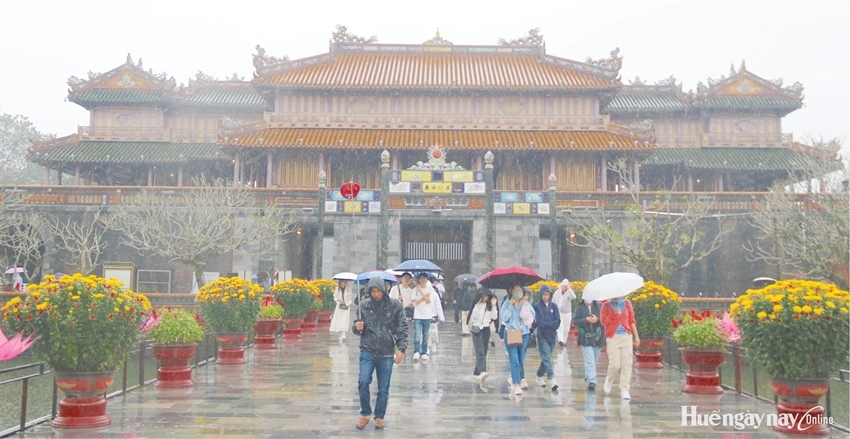
| Rainy weather can affect visitors’ travel experiences to some extent |
Changing the perception that the rainy season is the low season
From early September 2026, forecasts of the first spells of heavy rain and flooding began to emerge; at the same time, some businesses started worrying about attracting visitors during the rainy season. After the September 2 holiday, Hue tourism in particular, and tourism nationwide in general, moved past the peak season for domestic tourists and entered the international tourist season, which typically runs from September or October to March or April of the following year. However, unfavorable weather conditions can also have some impact on visitor numbers.
“The rainy and typhoon season not only affects flights, but also visitors’ motivation to travel,” said Ms. Duong Thi Cong Ly, Director of Vietnam - Hanoi Tourism Joint Stock Company, Hue Branch.
In reality, whenever Hue enters the rainy season, a familiar issue arises: businesses anxiously monitor weather forecasts, while visitors consider canceling or postponing their itineraries. Some travel businesses and destinations regard the rainy season as the ‘low season’. This perception turns the rainy season into a ‘gap’ in tourism activities.
There have been proposals to turn Hue’s rain into a tourism ‘specialty’. On some days, light but prolonged rain casts a distinctive charm over heritage sites and streets. However, there are also periods of heavy rain accompanied by flooding and localized inundation, affecting transportation and the safety of residents and visitors. During extreme weather, suspending or adjusting tourism activities is necessary to ensure safety. However, on ordinary rainy days, if visitors to Hue ‘end up staying’ in their hotels or coffee shops without interesting experiences, it will be difficult to achieve long-term goals.
Looking at Hue’s tourism product system over the years, it is clear that Hue offers a diverse range of products. However, many tourism products in Hue still depend heavily on favorable weather conditions. For example, heritage tours, cycling trips to rural areas, garden-house experiences, community-based tourism activities, and river routes can all be affected by rainy weather.
Last rainy season, I met a group of visitors from Hanoi traveling to Hue, who were wearing raincoats as they followed a pre-designed tour itinerary. Ms. Hoai An, one of the visitors, said: “I had already booked the tour, so it would be a waste not to go, but I still wished the travel businesses could adjust the itinerary to offer us experiences more suited to the weather. I think Hue cannot change the rainy season. But Hue can certainly change the way tourism is organized during the rainy season.”
Attracting visitors in every season
In fact, visitors to Hue during the rainy season do not necessarily expect the same itinerary as they would have during the dry season. They may be willing to adjust their schedules, travel more slowly and visit fewer places; but what they need is clear information and suitable options. For example, what can they do if it rains? Are there arts performances, culinary experiences, handicraft workshops, or short tours that they can join? What alternatives are available if a destination is flooded or deemed unsafe?... These questions still do not have clear answers, or travel businesses only make last-minute adjustments based on weather conditions. Meanwhile, visitors naturally want to know what they will be able to do the following day.
Recently, at the Vietnam Private Economic Forum 2026 - Local round in Hue, the third dialogue session, themed ‘Enhancing Hue’s brand name - A destination of heritage, festivals and distinctive experiences’, also addressed rainy-season tourism, with proposed solutions. Among the solutions proposed was a shift from ‘waiting for the weather’ to proactively developing indoor products (craft village workshops, culinary experiences, museums, arts, and wellness activities), combined with a system of covered pedestrian streets, and incentive policies to stimulate demand.
There is no denying that rain can significantly affect a travel itinerary. However, developing rainy-season tourism first requires a change in the way tourism products are designed. A dry-season tour cannot simply be turned into a rainy-season tour by removing a few sightseeing stops. A product designed for the rainy season needs to be developed from the outset based on weather conditions, mobility, visitors’ need for rest, and their mindset.
One of the directions that the tourism sector and travel businesses could explore is the development of indoor products or experiences that are less dependent on weather conditions. These may include themed tours focusing on heritage, architecture, antiquities, royal costumes, decorative arts, ruong houses, phu de (princes’ and princesses’ residences), and urban life in Hue in the past. Instead of taking visitors through numerous sites in a short period, such products could focus on a single theme, supported by in-depth storytelling, visual materials, and interactive activities.
Visitors today do not simply want to see the artifacts or visit places just to pose for check-in photos. They want to know the stories behind them, take part in experiences, and come away with a specific memory. Therefore, creating immersive experiences, such as exploring patterns on the royal court ao-dai, the art of tea drinking and calligraphy, making paper flowers, phap lam, or conical hats, or preparing Hue dishes, could also be quite appealing if professionally organized.
Programs such as court music, Hue-singing, ao-dai performances, solo performances of traditional musical instruments, historical storytelling, reciting poetry, and enjoying Hue music could become evening activities, providing visitors with additional options after daytime sightseeing.
Unfavorable weather may reduce visitors’ mobility, but it does not reduce their desire for experiences. Wellness packages combining tea, meditation, yoga, herbal foot soaks, massage, reading, music listening, and light cuisine would suit the advantages of Hue’s spaces and pace of life.
Tourism and services have been identified by the city as a spearhead economic sector. That spearhead sector cannot thrive only during the dry season while losing momentum in the rainy season. Likewise, a destination should not have to wait for sunny weather to develop tourism. Hue tourism needs to explore a new approach: treating weather as a factor in product design. If products can be developed that are sufficiently attractive and showcase the depth of Hue’s culture, pace of life, and distinctive identity, the rainy season could even become a competitive advantage of Hue tourism.