



 |
|
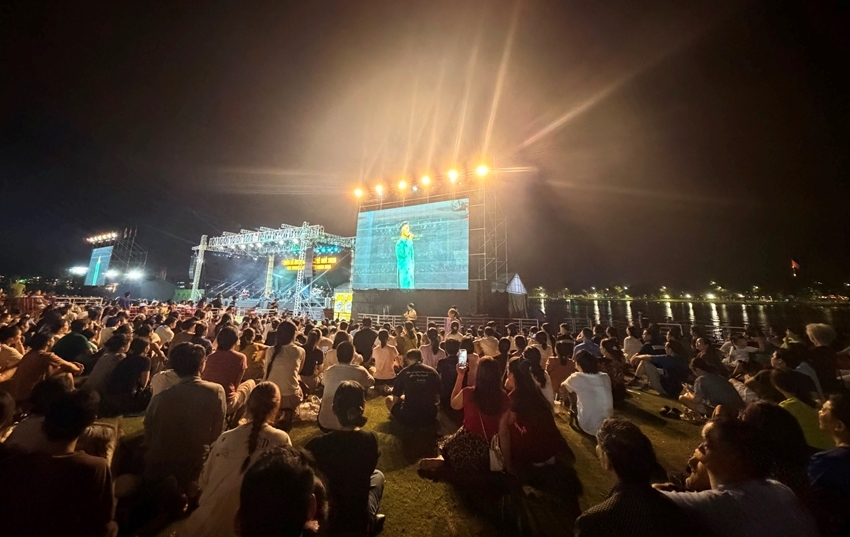
As part of Hue International Music Week, the concert “25 Years Remembering Trinh Cong Son”, held on the banks of the Perfume River, offered audiences a blend of nostalgic reflection and fresh artistic expression. Photo: KO |
Filmed against the backdrop of Hue Imperial Citadel, within less than a week of its release, ‘Cong Tu Van Tho’ has been widely praised by commentators for its striking pieces of footage. Featuring iconic settings such as Ngo Mon Gate, the Palace Courtyard, the long corridors, alongside images of ao-dai and dan nguyet (moon lute), together with MONO’s influence, the music video has brought Hue’s cultural heritage closer to the public, particularly younger audiences.
While it may not rival the phenomenon of “Bac Bling” by Hoa Minzy, Tuan Cry, and Xuan Hinh, music videos are increasingly emerging as an effective medium for promoting destinations and attracting visitors, and with MONO’s latest project, Hue is also experimenting with a new approach of ‘Bringing new blood into its heritage promotion’. More notably, at the launch event for ‘Cong Tu Van Tho’, MONO was officially invited to be Hue’s ‘Heritage Promotion Ambassador’.
The announcement came as a big surprise, as MONO’s youthful and contemporary image seemed to stand in stark contrast to the timeless grandeur of Hue Ancient Capital. How effectively Mono will leverage his influence to promote both his personal brand and Hue’s heritage in his role as the city’s ‘Heritage Promotion Ambassador’ remains to be seen. Yet Hue’s willingness to break through in its traditional mindset has already sent a clear message: preserving and promoting cultural heritage requires the joining of hands among generations.
MONO’s appearance in Hue was part of Hue International Music Week, a series of performances held on an open-air stage along the Perfume River. Bringing together emerging artists from contemporary and traditional music scenes in Vietnam, South Korea, France, and other countries, the event was designed to ‘breathe new life’ into the 2026 Hue Festival through a renewed approach to the festival.
Amid the breezy riverside setting of the Perfume River, audiences sat on the grass, immersed in nature, illuminating the night with their phone flashlights as Ha Le performed a rap-inspired version of Mua Hong (Pink Rain). For those who have long cherished Trinh Cong Son’s music, forever associated with the singer Khanh Ly in her signature ao-dai, the idea of reimagining his songs once raised concerns and skepticism. Yet Tan Son’s bold reinterpretations, together with Bui Lan Huong’s youthful warmth and sweetness,… have breathed new life into the late musician’s deeply contemplative works. Performed against the backdrop of Hue’s ancient monuments reflected on the water surface of the Perfume River, these fresh renditions have resonated with audiences.
Like Trinh Cong Son’s music, Hue’s heritage needs to reach beyond its traditional boundaries and connect with the world through younger generations, and Mono’s decision to film his music video in Hue clearly reflects that message. But a symbolic first step alone is not enough. It must be backed by a clear vision and a long-term strategy to ensure that heritage remains in balance between the old and the new, between preservation and innovation. As responsibility for safeguarding Hue’s cultural legacy inevitably passes to younger generations, striking that balance will become more important than ever.