



The event is held in response to the 5th Vietnam Book and Reading Culture Day 2026, aiming to promote reading habits and foster new approaches to engaging with cultural heritage within the community.
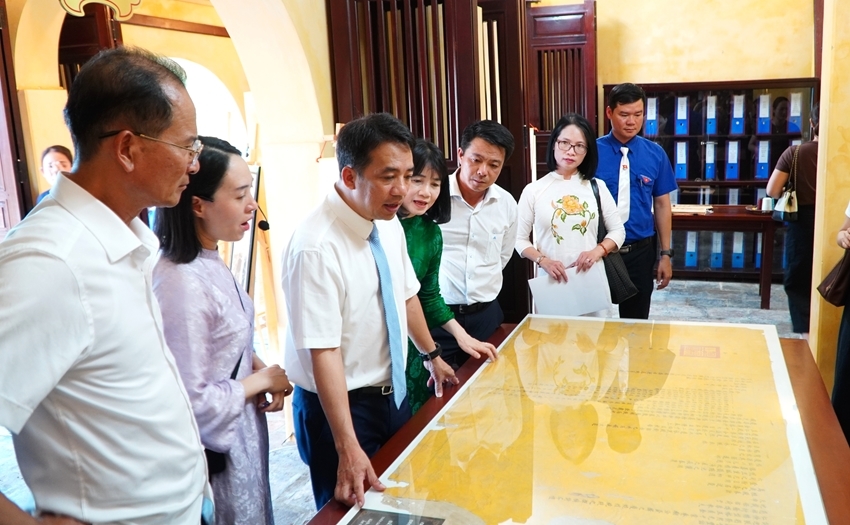 |
| On display at the exhibition is an imperial decree issued by Emperor Minh Mang to the Holy Empress Dowager in the 8th year of his reign (1827) |
Speaking at the opening ceremony, Mr. Hoang Viet Trung, Director of Hue Monuments Conservation Center, noted that hosting the exhibition at Tang Tho Pavilion carries special significance. The site once served as a repository for books and documents of the Nguyen Dynasty, closely associated with the memory and knowledge of a historical period. “From a space of storage, the exhibition opens up a new journey - taking knowledge closer to the public and connecting the past with the present,” he noted.
A notable highlight of the exhibition lies in its approach. Rather than merely displaying archival documents, the organizing committee has designed a range of experiential activities that allow visitors, especially students, to directly interact with the heritage such as “decoding” the motifs on the Nine Urns, engaging with digital data, practicing calligraphy, and printing woodblock artworks. These make the experience more vivid and engaging. Participants can both observe and explore on their own, thereby gaining a more natural understanding and retention of the information.
Vice Chairman of Hue City People’s Committee Tran Huu Thuy Giang highly appreciated this approach in the context of accelerating digital transformation. The integration of archival documents with digital technology is seen as a timely move, contributing to enhancing the effectiveness of heritage education. In addition, the development of specialized digital data systems is considered a crucial foundation for broadening access to heritage, particularly among younger generations.
 |
| Students are eager to experience the calligraphy activity |
According to the organizing committee, the exhibition aims to promote the unique documentary value of the Nguyen Dynasty’s Nine Urns through a system of images and archival documents, while bringing the heritage closer to the public through more visual and accessible formats. It also serves as an opportunity to advance the application of technology in conservation, gradually building a digital database on the Nine Urns and heading toward a digital museum model to be constructed in the future.
At the exhibition venue, several rare documents related to the Nine Urns, including those written in Han script, French, and the Nguyen Dynasty’s imperial documents (Chau ban), are being showcased. Visual representations and engraved patterns on the bronze urns are also recreated for display.
Another highlight is the digital experience zone, where visitors can explore in detail the motifs on the Nine Urns through multimedia presentations and hands-on interaction, offering fresh perspectives on the artistic and philosophical values embedded in each design.
Alongside this, a hands-on workshop area enables visitors to try calligraphy and produce embossed prints of motifs on do paper using traditional methods. These activities allow audiences to “touch” the heritage, creating a link between time-honored techniques and contemporary creative expression.