



 |
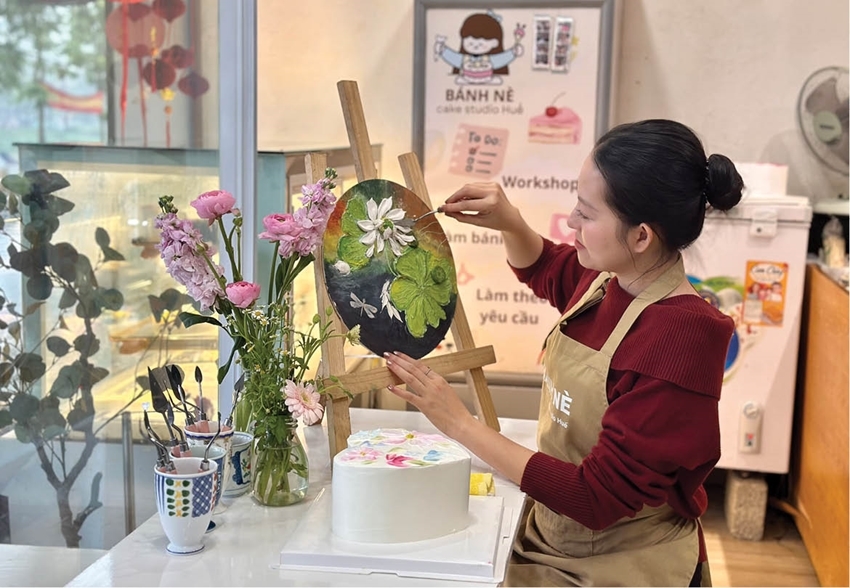
| Quynh Nhu practices the palette knife flower painting technique |
Mastery
At Banh Ne - Cake Studio on Phan Chu Trinh Street (An Cuu Ward), after more than five hours of meticulous work, Quynh Nhu completes a two-tier cake made to order.
On a blended light blue base, white petals with a shade of light pink stand out against deep yellow stamens and light green leaves in harmonious composition. The flower appears to bloom gently, with delicate veins and softly curved lines, creating the impression that it is emerging from the cake’s creamy surface.
Sharing about the technique used on the cake, Quynh Nhu said: “For this cake, I used a palette knife smoothing technique to retain subtle textures on the surface, creating a base that resembles a canvas in painting. From this foundation, shaping helps highlight the beauty of the petals”.
Four years ago, Quynh Nhu became acquainted with the palette knife flower painting technique. This is a highly demanding technique, in which the use of palette knives allows pastry chefs to freely express their imagination on the cake surface, turning each cake into a unique work of art.
Globally, this technique has existed for more than a decade and quickly gained popularity. In Vietnam, palette knife flowers were introduced around 2019, and generally come in two forms: embedded (subsurface) and raised (three-dimensional). Compared to the embedded form, the palette knife flower painting technique requires significantly higher skill and is much more complex.
To create palette knife flowers, pastry chefs use creams such as topping cream, buttercream, or whipped cream mixed with food coloring. In Hue’s climate, topping cream is often preferred for being light, airy, and more heat-resistant. After coloring the cream, chefs use specialized palette knives to shape stamens, pistils, petals, and leaves. Each type of flower or leaf requires different tools, along with techniques such as sweeping, pressing, smoothing, and lifting the knife to carefully build each layer of the design.
Precision
“Not just require a strong sense of aesthetics, color coordination skills, and smooth handling of palette knives, the palette knife flower painting technique also demands patience and meticulous attention to detail. Even a slight excess or moment of distraction can damage a petal or leaf, affecting the entire composition,” Quynh Nhu added. This is also why, in Hue at present, the number of bakers proficient in this technique remains limited.
Typically, cakes with embedded flowers cost about 20% more than regular cakes, depending on size. However, raised flowers are usually priced from at least 600,000 VND per cake, with some reaching several million dongs depending on complexity and number of cake tiers.
Tran Huyen Trang, a customer from Thuan Hoa District, shared: “When I first saw the cake, I was truly surprised. Each petal and leaf is delicate, soft, and visually striking. The cake is not just a dessert but resembles a vivid painting. Although the price is quite high, I find it completely worthwhile for special occasions like birthdays”.
Amid the diversity of Hue’s pastry market, Quynh Nhu’s palette knife flowers retain a distinctive value through the refined interplay between culinary art and visual art.
Beyond creating one-of-a-kind works, the young pastry chef is also planning to organize workshop sessions on the palette knife flower painting technique in Hue. “I want to spread the beauty of these flowers and create a space where people who appreciate this form of cake decoration can connect. Participants will not only be able to ‘paint’ flowers on cakes themselves but also experience the meticulousness and sense of calm that this art form brings,” Quynh Nhu shared.