



 |
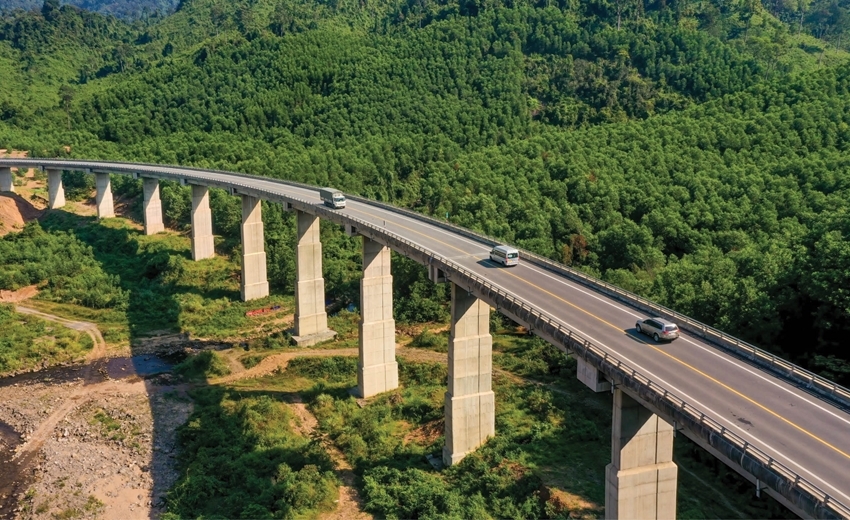
| La Son–Tuy Loan Expressway helps narrow regional gaps and spur economic development. Photo: Anh Le |
Modern and expansive
Among hundreds of projects inaugurated or launched, Hue has commenced the investment project to expand the eastern North–South Expressway, Cam Lo - La Son section, with expectations that it will enhance traffic safety, ease congestion on National Highway 1, and contribute to regional connectivity and socio-economic development.
Since being put into operation in late 2022, the Cam Lo - La Son Expressway has opened up a new development path for Hue. In the localities it traverses, services have expanded and residents’ living standards have improved. As the first expressway project to traverse the area, it has further enhanced Hue’s overall transport infrastructure.
However, after a period of use, the Cam Lo - La Son Expressway has shown shortcomings. Therefore, the Prime Minister approved the policy to expand it to four lanes and undertake other necessary works, aiming to remove bottlenecks and spur new development momentum in the central key economic region, including Hue and Quang Tri, where the expressway passes.
Together with the road project, the North-South high-speed railway is among the projects expected to drive major change and reshape Hue’s urban landscape in the near future, with the city expediting land clearance and resettlement construction. The project’s impact is extensive, involving 825 hectares of land in 12 communes and wards, affecting over 8,100 households and necessitating the relocation of more than 6,800 tombs and graves.
Nevertheless, thanks to the involvement of the entire political system - particularly city leaders in outreach, consultation, and dialogue with affected households—strong consensus has been reached. So far, boundary markers have been installed along the entire route, and 22 resettlement areas as well as six new cemeteries have been planned. The projected cost of land clearance is more than VND 1,419 billion.
To ensure that all construction is completed and cleared land is handed over for the project by the end of 2026, city leaders have assigned specific responsibilities to relevant localities and units. Notably, the railway line will feature a modern Phu My Station, which is expected to open up new development space for Hue, along with a range of supporting services.
In terms of maritime transport, with its unique gateway position to the East Sea, Chan May Deep-Sea Port—since being planned and invested in—has enabled stronger links along the East–West Economic Corridor. The port also serves as a bridge between central Vietnam and the Central and Lower Laos region, Myanmar, and northeastern Thailand. Moreover, Chan May is a major port on the sea route connecting the Philippines, Singapore, and Hong Kong (China). Positioned between the two centrally governed cities of Da Nang and Hue, it offers favorable conditions for trade, cargo transshipment, and economic growth.
Chan May Port is now the largest-capacity seaport in central Vietnam, able to receive vessels of up to 30,000 DWT and cruise ships of up to 100,000 GRT. Since it began operations, the port has handled over 12 million tons of cargo and welcomed hundreds of thousands of cruise passengers, many of them high-end visitors, with import-export turnover estimated at more than USD 1.05 billion. Since the establishment of Chan May Port, the once-untouched Chan May - Lang Co area has risen to become a Class I multipurpose seaport of Vietnam, fully equipped to accommodate new-generation and the world’s largest cargo and cruise ships.
Berths No. 4 and No. 5, currently being finalized and scheduled to come into operation soon, are expected to enhance the standing of the city’s southern gateway, especially as the Chan May – Lang Co Economic Zone is being positioned as a non-tariff zone and a logistics hub for Central Vietnam and the country as a whole.
In addition, Phu Bai International Airport has been upgraded with the launch of Terminal T2, which has a designed capacity of 5 million passengers annually and features a unique royal-inspired architectural style, contributing to elevating Phu Bai Airport’s standing to be on par with other major airports nationwide.
Paving the way for development
Back to the North–South high-speed railway, with a maximum speed of 350 km/h, many believe that once in service, passengers could be in Hanoi in the morning, dine in Hue at midday, and spend the night in Ho Chi Minh City. This reflects the project’s objective of reducing regional distances and adding a new travel option for passengers, aside from airplanes, coaches, and current train services.
Undoubtedly, high-speed rail, as seen in developed countries, represents an optimal transport option for passengers over other modes in terms of safety, cost, and convenience. More broadly, the project seeks to spur new growth momentum for localities, since greater travel convenience will facilitate goods circulation, commercial exchange, the signing of business contracts far more effective.
Transport projects, once implemented, do more than strengthen urban infrastructure - they unlock a wide range of development opportunities. For example, after Nguyen Hoang Bridge was inaugurated and put into operation, the accelerated construction of Nguyen Hoang Street created a new growth pole for the southwestern area of Hue. Subsequently, its connection with the expanded Ring Road 3 and the Tu Duc – Thuy Duong axis has fostered more balanced development in the city center.
In the coastal zone, a series of estuary-crossing bridges - including Truong Ha, Tam Giang, and most recently the Thuan An Sea Gate Bridge—have been invested in, with Vinh Tu and Phu Vinh bridges set to break ground during 2026-2030, contributing to the completion of Hue’s transport network.
It can be said that wherever roads extend, prosperity follows. My hometown of Ngu Dien was once fragmented, its communities separated for lack of bridges spanning the estuaries. Today, with the development of National Highway 49B, the Dien Loc–Phong Dien rescue and relief route, and Tam Giang Bridge, the region has undergone a remarkable transformation. Returning to the former Ngu Dien - now Phong Phu Ward and part of Phong Quang - one finds urban life within easy reach, from electronics and home appliances to a full range of daily necessities.
Such is how transport paves the way for development!