



 |
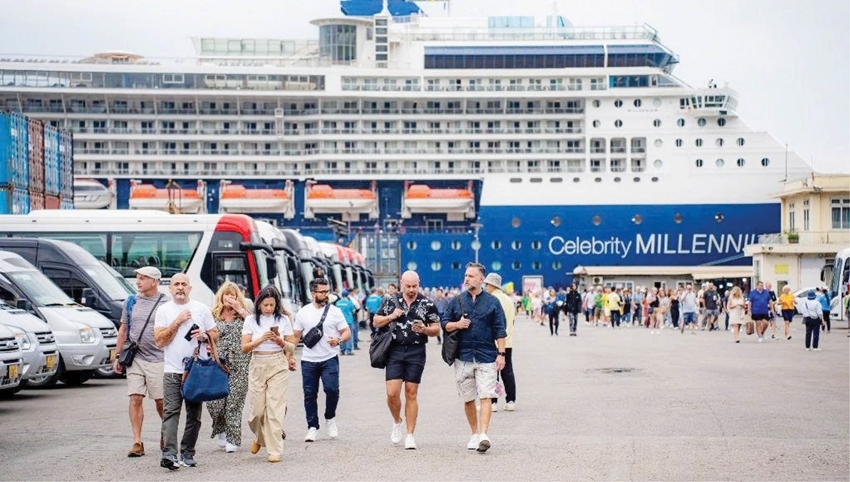
| International visitors arriving in Hue by sea |
Advantages
Hue occupies a central position in the Central region, serving as a connection point between the two ends of the country, and an important gateway to the East - West Economic Corridor. This position provides an advantage for the city to develop trade, logistics, and cargo transit services…
In recent years, with investment from both Central and local governments, Hue's transportation infrastructure has been continuously improved, creating an essential foundation for commercial development. Major transport routes such as the National Highway 1, the Ho Chi Minh Road, the Cam Lo - La Son and the La Son - Tuy Loan expressways have shortened travel time and enhanced connectivity between Hue and economic centers across the region and the country. In addition, the expansion and upgrading of Phu Bai International Airport and Chan May deep-water port have met the demand for passenger and cargo transport, as well as import, export and logistics activities.
Along with transport infrastructure, Hue’s commercial infrastructure has also grown steadily. Shopping centers, supermarkets, wholesale markets, and commercial streets are being developed in a modern and civilized direction. Notably, Aeon Mall Hue Commercial Center, and GO! Huong Tra Supermarket, which began operation in late 2024, have contributed to forming a diverse goods distribution network that meets the increasing shopping demand of residents and visitors. The development of digital infrastructure, e-commerce, and logistics services is also opening new space for commercial activities, helping Hue gradually approach a modern commercial center model in the region.
A standout advantage of Hue is the system of specific mechanisms and policies issued by the Central government, creating strong momentum for commercial economic development. Hue's transition to a centrally-governed municipality not only is an administrative milestone, but also opens new opportunities in investment attraction, resource allocation, and long-term policy planning.
The Party and State’s policies clearly define the direction of building Hue into a major national center for culture, tourism, specialized healthcare, science - technology, and education - training, while developing the economy in a sustainable and modern direction. Within this framework, trade and services are considered a vital pillar with spillover effects that support other sectors.
Hue is also benefiting from numerous incentives in attracting investment into economic zones, industrial parks, and commercial - service zones, particularly the Chan May - Lang Co Economic Zone. Policies on administrative reform, business support, private-sector development, startup encouragement, and innovation have created a more open, transparent, and attractive investment and business environment for both domestic and foreign investors.
The city also emphasizes commercial development linked with preserving and promoting traditional cultural values, an important distinction from many other localities. Pedestrian streets, commercial spaces combining culture and tourism, traditional craft villages, and OCOP products are being promoted, generating livelihoods for people while contributing to promoting the image of Hue, and increasing added value in commercial activities.
Towards a modern commercial center
According to the draft adjustment of Hue’s urban planning for the period 2021 - 2030, with a vision to 2050, the city aims to develop trade in a modern and synchronized direction with strong application of digital technology and e-commerce, aligned with the development trends of the digital economy and the requirements of international integration. Trade is positioned as one of the key growth drivers, contributing to the development of other sectors.
The focus of this planning orientation is the formation of leading commercial enterprises and corporations in the city center to serve as nuclei for retail markets, distribution systems, and professional commercial services. At the same time, the city also focuses on supporting the development of a network of small businesses and household businesses, especially in rural areas, to ensure balanced development between urban and rural zones, expand consumption space, and improve residents’ incomes.
Currently, the city is accelerating investment in building and upgrading wholesale markets, supermarkets, shopping centers, logistics warehouses, and digital trading platforms. Commercial infrastructure projects are being planned in connection with the North - South Economic Corridor, and the East - West axis through the Hong Van - Co Tai border gate, meeting the needs of intra-regional and inter-regional goods circulation, as well as import and export activities.
In its long-term development orientation, the city is researching and shaping the establishment of a free trade zone within the Chan May - Lang Co Economic Zone, aiming to develop free trade models, logistics, cargo transit, and value-added services, enhancing Hue's competitiveness within regional and global supply chains.
Hue’s trade development orientation by 2030 is also set within the context of specific socio-economic development goals. Accordingly, the city strives to achieve an average gross regional domestic product (GRDP) growth rate of 10 - 11% per year. The economic structure is shifting towards modernization, with the trade and services sector accounting for 47 - 49%, industry and construction for 36 - 38%, and agriculture for 7 - 8%... Along with this, the average growth of realized investment capital is targeted at 10 - 11% per year, budget revenue to increase by 14 - 15% per year, and export turnover to grow by an average of 10 - 12% per year.
Attending a workshop on the adjustment of Hue’s urban planning by 2030 with a vision to 2050, held in mid-January 2026, Assoc. Prof. Dr. Tran Dinh Thien, former Director of the Vietnam Institute of Economics, noted that these targets highlight the increasingly significant role of trade, import, export, and logistics services in Hue’s economic development strategy. He expected that with its strategic geographical location, increasingly synchronized infrastructure, specific mechanisms and policies, and clear planning orientation by 2030, Hue will realize its goal of becoming the commercial hub of the Central region, deeply participating in the national and international trade networks, generating new momentum for the city’s sustainable socio-economic development.