



 |
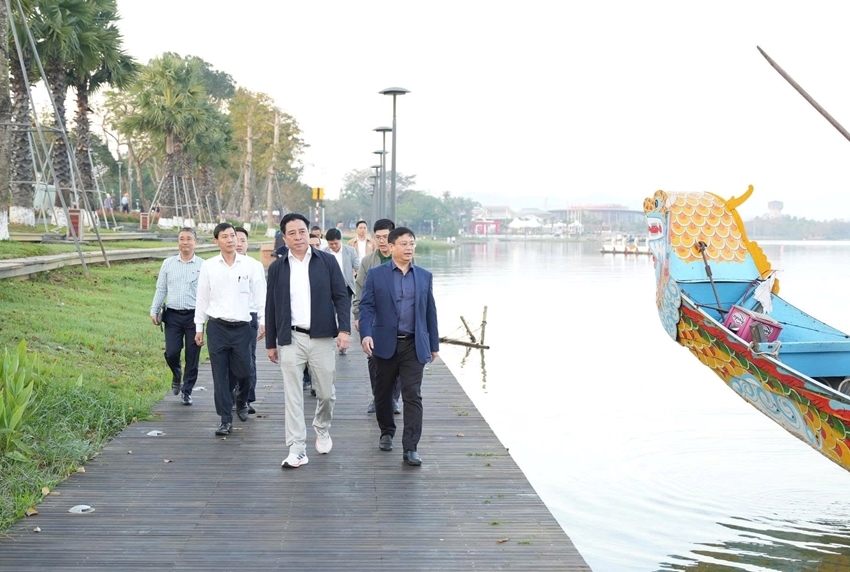
| City leaders conducting a field survey of the inland waterway tourism route |
Joining the delegation were Mr. Nguyen Thanh Binh, Standing Vice Chairman of the City People’s Committee and Member of the Standing Board of the City Party Committee, along with representatives of relevant departments and agencies.
The delegation surveyed the inland waterway tourism route starting from Boat Wharf No. 16 on Le Loi Street, extending along the Dong Ba – Bao Vinh river route, and connecting with the old quarter along Bach Dang, Huynh Thuc Khang, and Bao Vinh streets. This route has been identified as strategically significant in expanding the city’s tourism space, leveraging riverine landscapes in association with spiritual, historical, and urban cultural life.
Field observations indicated that the Ngu Ha – Dong Ba – Bao Vinh river corridor holds considerable potential for developing experiential and sightseeing waterway tourism products, helping to connect Hue’s distinctive destinations. Along the journey, visitors can explore Dieu De Pagoda, access riverside culinary spaces, wander through the Bach Dang old quarter, and experience traditional activities that reflect the unique character of river-based urban life.
Particularly, Bao Vinh Old Town with its system of ancient houses, communal spaces, and long-standing historical value, has been identified as a key highlight. Once systematically connected through waterway tourism routes, the area offers strong potential for the development of distinctive, culturally rich community-based tourism products.
According to the city’s orientation, waterway tourism should go beyond simple sightseeing to develop thematic experiential routes, each telling its own story and closely linked to local people, products, and riverside cultural spaces. Such an approach is expected to create differentiation and ensure sustainable appeal.
During the survey, Chairman Nguyen Khac Toan highly appreciated the proposed ideas for waterway tourism development, emphasizing that tourism products must have clear highlights and distinctive spatial identities for each route.
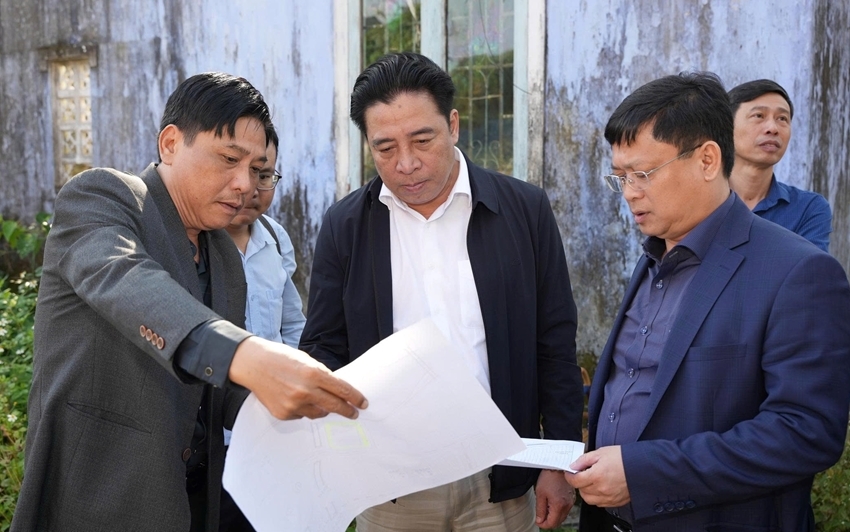 |
| City leaders reviewing the layout plan of public land and housing areas designated for tourism development |
He also underscored the need to strengthen public communication and mobilize local residents to participate in tourism activities, creating a unified and coordinated whole. This, he noted, would enhance the value of destinations, improve the urban image, and maximize the inherent strengths of each area.
The Chairman further required that stopping points and wharves be integrated with accompanying service systems and spaces for introducing Hue’s signature products. Investment in essential infrastructure, particularly public restrooms, must be prioritized to ensure convenience and civility for visitors. Tourism development, he stressed, should be implemented in a methodical and in-depth manner, demonstrating dedication to each specific site and space.
Following the river route inspection, the delegation continued to survey public properties at 15 Le Loi Street and 148 Bui Thi Xuan Street to assess their current condition and development potential. The findings will serve as a basis for proposing investment plans and developing appropriate tourism and service products, thereby ensuring the effective use of public land assets and creating highlights within the city’s urban tourism landscape.
Based on the field survey, Chairman Nguyen Khac Toan requested relevant departments and local authorities to conduct a comprehensive review to clarify legal status, technical infrastructure, and connectivity potential among destinations. On that basis, they are to research and propose appropriate and effective exploitation solutions aligned with the city’s sustainable tourism development strategy, while also facilitating business participation, specifically projects and initiatives that are well-structured and product-oriented.