



 |
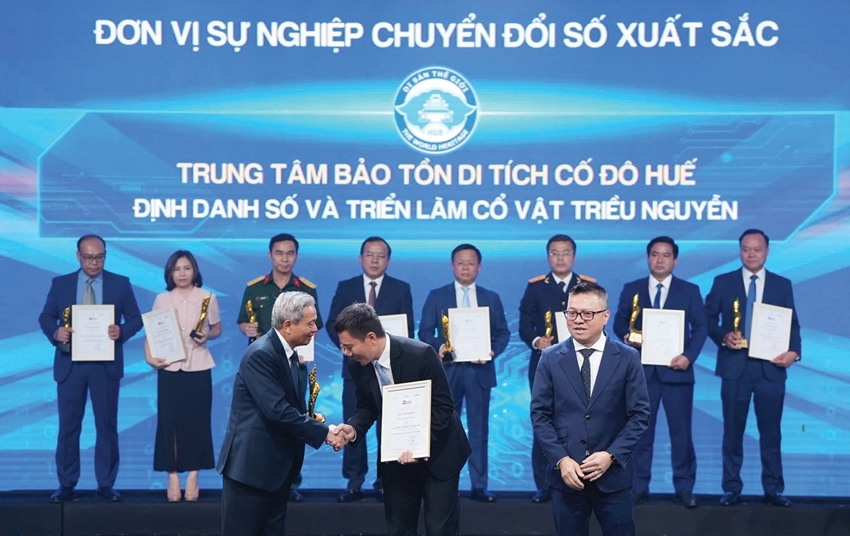
| Hue Monuments Conservation Center received the Vietnam Digital Awards 2025. Photo: TTDT |
Antiquities are given identities
Recently, Hue Monuments Conservation Center (thenceforth, the Center) was honored at the Vietnam Digital Awards (VDA) 2025 in the category of “Outstanding digital transformation enterprise/organization”. The winning solution, “Digital identification and Exhibition of Nguyen Dynasty antiquities”, not only is a technical advancement, but also opens a completely new approach to heritage preservation.
Previously, in 2024, the Centre was awarded the VDA for its solution on applying digital technology in preserving and promoting Hue's cultural heritage values. Being honored for the second consecutive year demonstrates the sustainable direction of Hue Ancient Capital in the process of digital transformation of heritage.
Mr. Vo Quang Huy, Deputy Chief of the Center's Office, stated that the digital identification solution provides each artifact with a unique ID code, managed based on 3D digitized data, and stored on a blockchain platform to ensure the authenticity, transparency, and anti-counterfeiting.
“From 10 pilot artifacts in 2024, we have now expanded to 98 artifacts, displayed in 10 digital exhibition rooms. In the future, we aim for fee-based services to enrich information regarding related artifacts, users can access the digital exhibition at museehue.vn instead of visiting in person. Simultaneously, we are developing a model for trading digital artifacts (F1) based on the identified originals,” informed Mr. Huy.
Notably, Hue City People's Committee has approved a plan to identify nearly 1,000 artifacts in the 2025 - 2027 period, aiming to form a comprehensive digital heritage ecosystem, one of Hue's key digital transformation goals.
Beyond mere image displays, the artifacts are integrated into VR/AR and metaverse environments. Viewers can “step into” the exhibition space, rotate, interact, and explore every detail of the artifacts, which is sometimes difficult to access even during an in-person visit.
“We hope that each artifact will not just be kept in storage or behind a glass cabinet, but will truly come alive in the digital space so that the public from anywhere can access them,” said Mr. Hoang Viet Trung, Director of the Center.
From core technology to digital experience
The solution is built on modern technological infrastructure: data stored on a cloud computing platform; security system powered by blockchain; RFID/NFC chips attached directly to artifacts; high-quality 3D models; and glTF and Draco compression technology that optimize file size while maintaining sharpness. Blockchain technology combined with NFC creates a “one-to-one” connection between the physical artifact and the digital version (NFT). This ensures the uniqueness, easy traceability, and the protection of intellectual property rights for the heritage.
3D digitization helps recreate artifacts with high detail, from the smallest carvings on thrones and palanquins to the textures of wood, metal, or precious gems. From there, the digital exhibition is built into virtual galleries, allowing viewers to interact as if they were standing in a museum.
Furthermore, the open data system allows researchers, schools, tour guides, and tourism businesses to use information of the artifacts for education and promotion.
According to experts, converting artifacts into digital assets (NFTs) does not only stop at conservation; but also opens a direction for cultural economic development. Digital copies (F1), with clear origins derived from physical artifacts (F0), and authenticated by specialized agencies, create conditions to form a transparent digital asset market serving collection, research, education, or content creation.
From this artifact identification system, the Center has begun to build a “digital market” for cultural products. An example is the “De do khao co ky” set in the form of a blind box, a model that combines culture with creative economy.
“We expect the digital heritage ecosystem to create a new value chain: from exhibition, education, and data mining, to creative products and digital economy,” said Mr. Trung.
For the first time in Vietnam, a unit managing antiquities has simultaneously applied NFC chips, blockchain, 3D scanning, and VR/AR exhibitions to identify and display artifacts. This not only helps preserve heritage in a more modern and secure way, but also makes Hue a pioneer in the digital transformation of cultural heritage.
“Previously, artifact preservation and management relied mainly on paper records, fragmented data, and physical displays, limited by museum space and opening hours. Now, heritage can exist simultaneously in two “worlds”: physical and digital,” informed Mr. Trung.
From these pioneering steps in digital transformation, Hue is opening a new path for heritage: not only to be preserved, but also to be “revived”, reaching deeper into the community and integrating into the global digital culture network.