



The triumph of the August Revolution of 1945 brought an end to the colonial and feudal regime, ushering in an era of national independence and freedom.
 |
Seizing the opportunity
On the night of March 9, 1945, Japanese fascists staged a coup, toppling the French colonial regime in Indochina. In Hue, at 9:15 p.m. that day, Japanese troops launched simultaneous assaults on French positions across key sites. By the afternoon of March 10, French forces had collapsed, and the Japanese held full control of Thua Thien Province. From that point on, the people’s main enemy was no longer the French but the Japanese.
In response to the new situation, on March 12, 1945, the Party Central Committee issued the Directive “The Japanese and the French Are Fighting Each Other and Our Course of Action.” The Thua Thien Provincial Party Committee promptly grasped this policy and set out specific tasks for the provincial revolution.
On May 23, 1945, the Provisional Thua Thien Provincial Party Committee convened an expanded conference at Cau Hai Lagoon to review the national situation, assess the timing for an uprising, and outline urgent tasks to strengthen the revolutionary movement across the province. The conference also resolved to establish the Thua Thien Viet Minh (League for the Independence of Vietnam ) Front, codenamed Viet Minh Nguyen Tri Phuong, and to expand Viet Minh organizations to the district and commune levels.
In late June 1945, the two Viet Minh organizations in the province—Viet Minh Nguyen Tri Phuong and Viet Minh Thuan Hoa—merged to establish the Executive Committee of the Thua Thien Viet Minh Front. A five-member Unified Leadership Committee was formed, headed by Comrade Hoang Anh as Secretary.
On August 10, 1945, upon hearing news of Japan’s imminent surrender, the Standing Committee of the Thua Thien Provincial Party Committee convened an urgent meeting to review preparations and approve the plan for an uprising to seize power. Concurrently, intensive preparations were made in Hue, designating Phu Loc and Phong Dien—two districts with the most vigorous movements—as the starting points of the provincial uprising.
On August 14, 1945, Japan’s Supreme War Council and Cabinet declared the nation’s unconditional surrender to the Allies. That very day, the Viet Minh General Headquarters released its appeal, stating that the Japanese fascists had surrendered, the Allies were about to enter Indochina, and the hour for the General Uprising had struck.
At that time, Comrade Nguyen Vinh was attending the Tan Trao Conference, where he met leader Nguyen Ai Quoc, was appointed to the Central Committee of the Indochinese Communist Party, and was assigned to serve as Secretary of the Central Region Party Committee as well as representative of the Viet Minh General Headquarters in Central Vietnam.
On August 15, 1945, the Thua Thien Viet Minh (League for the Independence of Vietnam) received momentous news: fascist Japan had formally surrendered to the Allies, Allied troops were on their way into Indochina to disarm the Japanese, and the Central Committee had issued the order for a general uprising. An extraordinary conference was immediately convened to address urgent matters concerning the seizure of power. The conference instructed Viet Minh organizations in six districts and Hue City to intensify propaganda, enabling the masses to grasp the favorable moment to rise up, topple the reactionary administration, and establish revolutionary authority. Simultaneously, two delegations were dispatched to seek directives from the Central Committee and the Interprovincial Committee.
The Standing Committee of the provincial Viet Minh (League for the Independence of Vietnam) strove to isolate and divide the enemy by sending letters to members of the Tran Trong Kim Government, the provincial governor of Thua Thien, the mayor of Hue, the chiefs of six districts, and those in charge of pro-Japanese organizations and local administrations. The letters made clear the Viet Minh’s policy of uniting all social strata for national liberation, while calling upon everyone to join the cause of national salvation.
Regarding Emperor Bao Dai, the Viet Minh Front assigned Pham Khac Hoe, Chief of the Royal Secretariat, to persuade the monarch to abdicate. On August 17, 1945, the Tran Trong Kim Cabinet convened, after which Emperor Bao Dai issued Edict No. 105 with two key provisions: first, the emperor declared his readiness to transfer power to the Viet Minh—the organization that had fought most steadfastly for the people’s interests—and invited Viet Minh leaders to Hue to form a Cabinet; second, he affirmed that the political system would be determined by the people, and pledged to abide by their will.
On August 20, 1945, the Provincial Uprising Committee, chaired by comrade To Huu, was established and resolved to launch the General Uprising to seize power in Hue on August 23, 1945.
At 2 p.m. on August 21, 1945, Dang Van Viet and Cao Pha (Nguyen The Luong), under orders from the Uprising Committee, lowered the Ly trigram flag at the Flagpole and hoisted the red flag with a yellow star.
At about 6:00 p.m. on August 22, 1945, Hue Radio broadcast King Bao Dai's proclamation: "I would rather be a citizen of an independent country than a king of an enslaved one. I am sure that the entire nation is as willing to sacrifice as I am.
Throughout the night of August 22, 1945, Hue’s people buzzed with excitement, readying weapons, pasting slogans, and sewing flags for the uprising. Self-defense teams hunted down Vietnamese traitors, secret agents, and key henchmen of the French colonialists and Japanese fascists, who continued to resist.
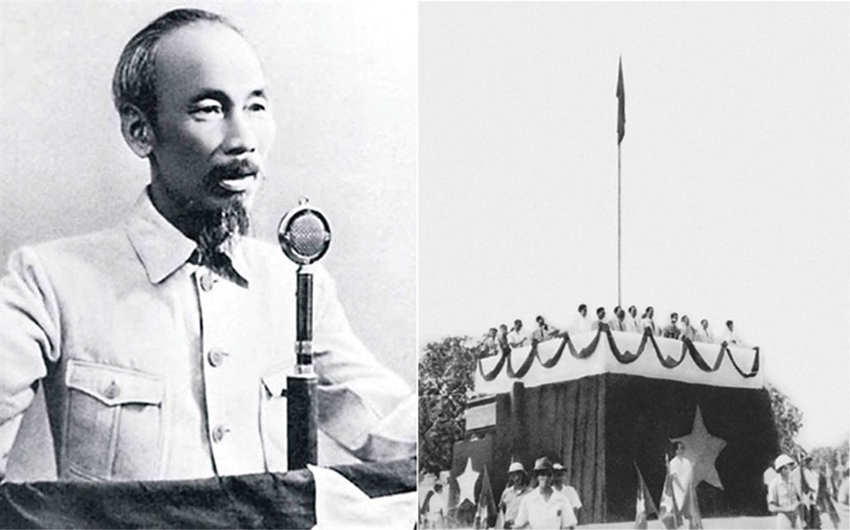 |
| On September 2, 1945, at Ba Dinh Square, Hanoi, President Ho Chi Minh proclaimed the Declaration of Independence, establishing the Democratic Republic of Vietnam and ushering in a new era in the nation’s history. Photo: Archives |
Profound humanitarian significance
On August 23, 1945, amid the soaring fervor of the General Uprising, the people of Hue, together with tens of thousands of people and self-defense forces from the province’s districts, poured into the city to seize power. The streets blazed with red flags bearing yellow stars and revolutionary banners held aloft. Wave after wave of people marched with armbands, flags, sticks, and spears. Their voices thundered with slogans such as “Long live an independent Vietnam!” and “Vietnam belongs to the Vietnamese!”
At 4 p.m. that day, tens of thousands of people from districts across Thua Thien, along with national salvation units, security guards, and self-defense forces, converged on Hue Stadium to join a historic rally. The Uprising Committee, led by comrade To Huu, advanced to the podium amid the thunderous cheers of the crowd. Chairman of the Uprising Committee, To Huu, delivered a speech highlighting the significance and scope of the uprising, declaring that the provincial government now belonged to the people.
On August 28, 1945, the people gathered at Hue Stadium for a rally to greet the Central Delegation. There, the delegation announced the nationwide triumph of the General Uprising and introduced the National Liberation Committee as the Provisional Revolutionary Government, headed by comrade Ho Chi Minh.
On the afternoon of August 30, 1945, the Viet Minh (League for the Independence of Vietnam) and the people of Thua Thien assembled with solemn discipline before the Ngo Mon Gate, witnessing the moment when Emperor Bao Dai abdicated the throne. He presented the golden imperial seal and the jewel-inlaid sword, symbols of royal authority, to the delegation of the Provisional Revolutionary Government. The people’s struggle in Thua Thien, together with that of the nation as a whole, had culminated in total victory.
The victory of the August Revolution of 1945 secured Vietnam's independence. On September 2, 1945, in Ba Dinh Square, President Ho Chi Minh solemnly proclaimed the Declaration of Independence, marking the birth of the Democratic Republic of Vietnam, today the Socialist Republic of Vietnam.
It can be affirmed that Emperor Bao Dai’s abdication contributed to the profound humanitarian value of the August 1945 General Revolution, as state power was peacefully transferred from the feudal monarchy to the revolutionary government without bloodshed. The uprising to seize power in Hue strikingly showcased the strength of the nation’s revolutionary will.