



 |
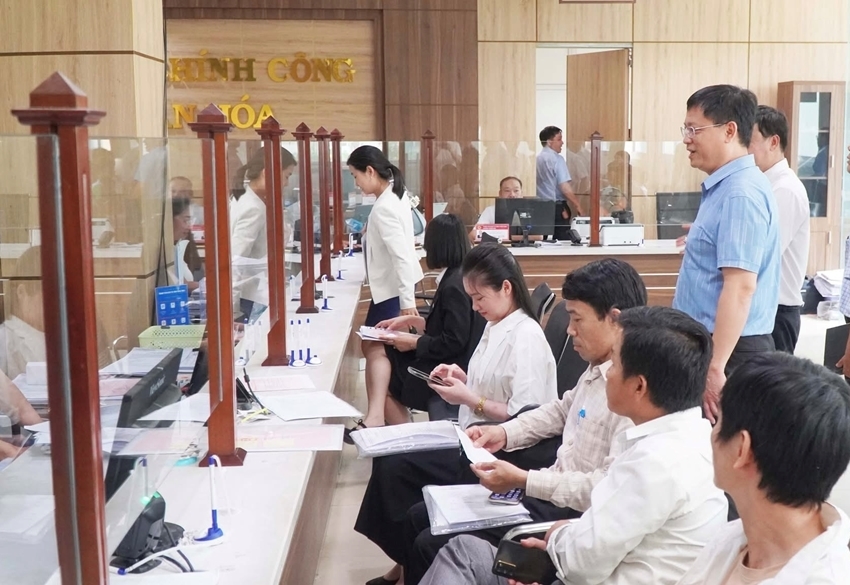
| City leaders inspecting the operation of the two-tier local government model in Thuan Hoa Ward |
On July 14th alone, the city processed 3.425 applications, with a remarkable 95% submitted online. Thuan Hoa Ward recorded the highest number of applications on the day (203 in total) with a 100% online submission rate.
Over the entire period, Phu Xuan Ward handled the most applications overall, totaling 1.758. Huong An Ward led in on-time processing rate with 91% (309 out of 338 applications), while Phu Vang Commune topped the chart in online submissions, with 99,59% (491 out of 493 applications).
With these impressive results, Hue City now ranks first nationwide, achieving 85% of the performance indicators outlined in Plan No. 02-KH/TW, which assesses local commune and ward-level governments.
Currently, Hue City has established 166 Public Service Agencies across its communes and wards to guide and assist citizens in using online public services. In addition, the city has maintained traditional application reception and result delivery systems at former administrative offices, helping residents save time and travel costs following changes in administrative boundaries.
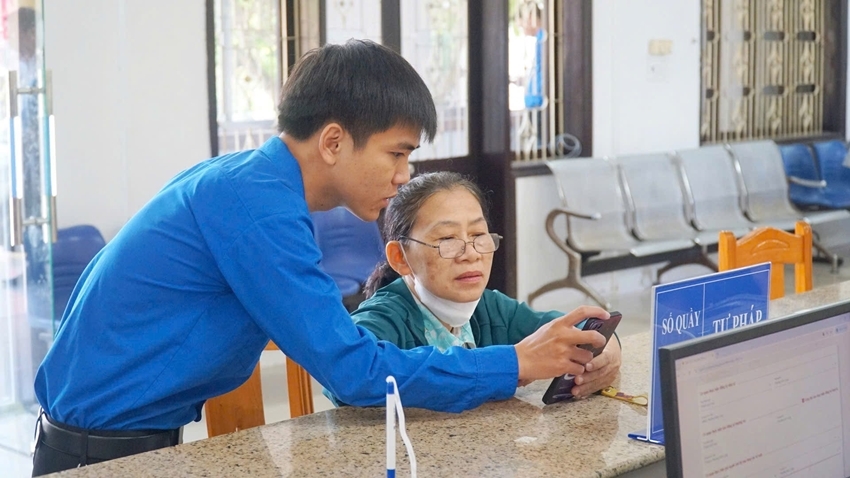 |
| Youth union members assisting residents with administrative procedures |
Moreover, the city has arranged for postal staff to be stationed at public service agencies to help digitize and process applications for the people. Notably, 891 youth union members and students home for summer break have been mobilized into Community digital technology teams, significantly enhancing support efforts during the early stages of implementing the two-tier local government model.
On technology side, Hue completed its integration with the National Public Service Portal on June 30th. The city now offers 2.006 online public services, including 572 end-to-end digital services. All information technology systems supporting governance, administration, and service delivery to citizens and businesses are operating in a stable, synchronized, and efficient manner.
The city continues to review and ensure the provision of sufficient funding, facilities, transportation, and official housing, while also advancing document digitization and addressing the policies and benefits of civil servants, especially part-time officials at the base level.