



 |
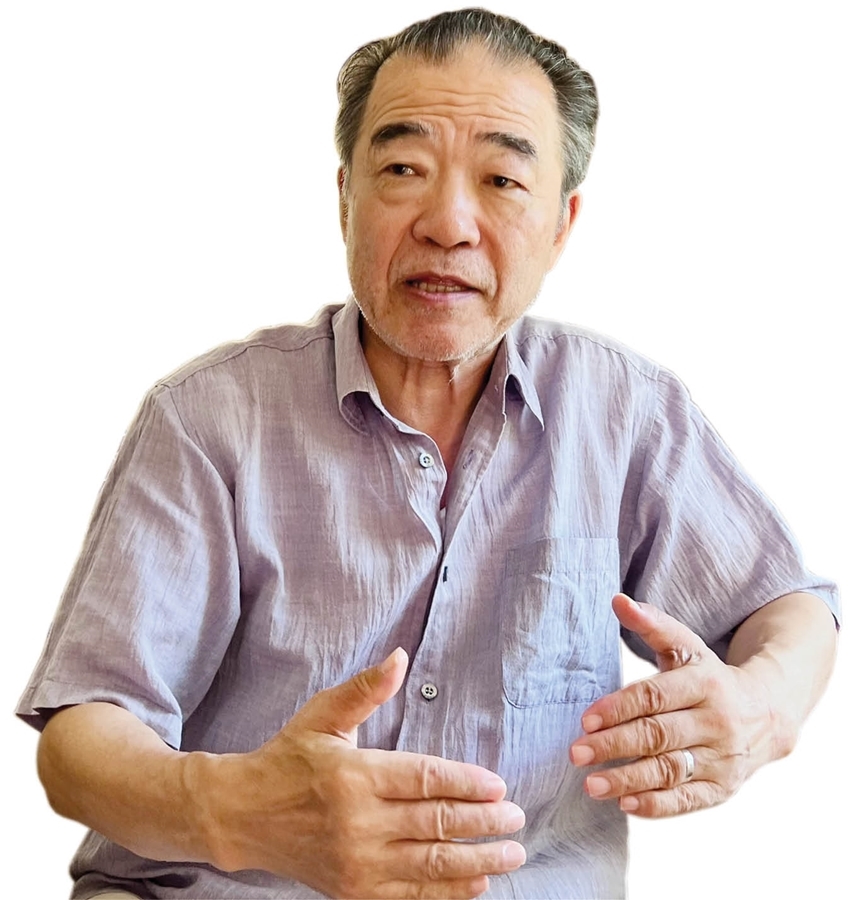
| Prof. Satoh Shigeru |
Hello Prof. Satoh Shigeru. Having traveled to various places in the world and visited Hue many times, what unique values can you find in Hue regarding heritage landscape and natural landscape?
Hue has very beautiful landscape where mountains, water and people live in harmony with one another. That’s wonderful. The Citadel of Hue and villages exist in harmony with nature. That’s very special too.
I’ve worked and done research in Hue for a quarter of a century since I was invited to an international conference in the Imperial Citadel in the summer of 1997. My findings can be summarized as follows. First, Hue, with the Citadel as the center, has been the world's best example of mountain-water landscape (shan shui). Surrounded by lust mountains with the gentle Perfume river flowing along the main axis, into rich lagoons, then the sea. In this area are many historical relics. Along with some traditional villages, the entire area is a realistic example of mountain-water landscape.
My second discovery is that on that mountain-water background, historical constructions, which have been recognized as World Heritage, integrate with residential areas to form a small “mountain-water territory". One typical example is the Thien Tho Lang area, where Gia Long Mausoleum and his family’s tombs are located, plus the Dinh Mon village and paddy fields. Emperor Gia Long might have employed such a model in constructing his own tomb. Communities and important national monuments share a mutual ecosystem, including the flood control system and the irrigation system, forming self-governing microcosms. These microcosms act as basic units of the cultural and landscape heritage.
Third, “small mountain-water territories" are connected with one another to form unity. The backbone of these territories is the water network “anchored” by the Perfume river. With water in front of each construction, different axes can be spotted from constructions to sacred peaks. It is the connection between each “small mountain-water territory” with the historical heritage that realizes a sustainable structure for cultural landscape.
In your study, you introduce a new concept, “Landscape culture is the Hue Heritage Complex itself", and say the complex needs enhancing so that it can be called “landscape culture”. This is foundation for submitting to UNESCO a proposal for recognition of the entire Hue landscape complex with the Perfume river being the core of the landscape heritage. Can you tell us more about this?
During my research process, I realize that constructions in Hue such as the Imperial Citadel, royal mausoleums, village communal houses, temples, etc. all have a river in front and look up to mountains. Take Gia Long Mausoleum for example. In front of it is a long lake and the mausoleum looks up to Thien Tho Mountain; his mother’s mausoleum faces Due Son Mountain (also known as Ke Mountain); Minh Mang Mausoleum is aligned with Kim Phung Mountain and Kim Ke Mountain; Hue Citadel has the Perfume river in front and faces southeast; the heart of Ngu Ha River and the Citadel form a line toward Truoi Mountain. Water surfaces combine with mountains to create very beautiful landscapes. That combination is so great. Rarely does a place in the world have mountain-water landscape like Hue.
This mountain-water combination plays a very important role. The entire landscape along the Perfume river obeys this principle and you can enjoy the urban landscape, the rural landscape, the heritage landscape, and the natural landscape at the same time. All the landscapes along the Perfume river are mountain-water landscapes, forming harmonious unity.
In more than 25 years of research on Hue, which discovery of yours is the most impressive and interesting?
The discovery that is greatly appealed to me is the fact that the Ngu Ha river lies on the axis of the Citadel facing Truoi Mountain, which can be spotted in the early morning. I told experts and many people about it, but they argued that it was Ngu Binh Mountain. But I think it’s Truoi. The main axis of the Citadel and the Imperial City leads to Truoi Mountain. It seems that no one notices that.
Truoi Mountain is located about 40km from the Citadel as the crow flies. We can't see it during the day, but in the early morning, standing on the axis of Ngu Ha River and the Citadel and the Imperial City or at the Imperial Flagpole, one can see the peak of Truoi Mountain. Emperor Gia Long designed his kingdom on purpose.
Hue landscape has many things in common with the castle city of Tsuruoka in Japan. This city was built in the 17th century with 300 castles. In front, people also dug a river looking up to Mount Fuji, just as the Ngu Ha river does to Truoi Mountain. I did participate in the project in Tsuruoka. So as soon as I arrived in Hue, I spotted the similarity. All were designed intentionally using mountain-water approach.
You said that almost all sacred important places in Hue have connection with mountain-water landscape and look up to mountains. Can you tell us more about this interesting feature?
Why does the Citadel in Hue not face south? Usually, citadels face south, but Hue Citadel doesn’t. Emperor Gia Long chose the southeast direction to take advantage of the curved section of the Perfume river with Truoi Mountain as the front of the Citadel. The same goes for Gia Long Mausoleum and other royal tombs. Temples and village communal houses obey this principle too.
At that time, people’ve known how to design based on mountains and water. Important constructions and places were designed accordingly on purpose. That observation is very important, but young generations now forget. We should recognize and rediscover it.
Thank you, Sir.