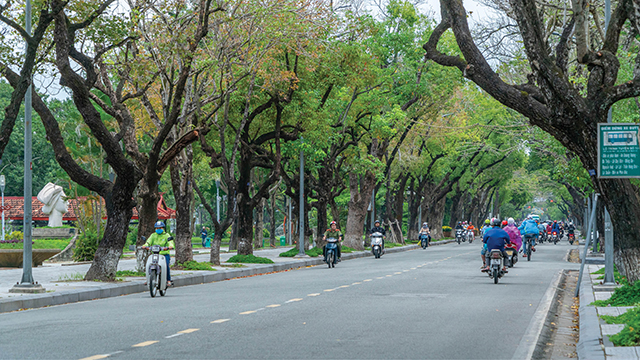
The peaceful scene on Le Loi Street
From my first time now, every time the plane lands on Phu Bai Airport in Hue, even when I do not look out of the window, I still “see” the green color of the Truong Son mountain range connected with the East Sea by the immense water of Tam Giang Lagoon.
I have the same feelings with other regions in Central and Central highlands such as Buon Me Thuot, Pleiku, Da Lat, Tuy Hoa, etc. And I often wonder which land is greener.
I wonder because once picking me up from Buon Me Thuot Airport, the taxi driver got excited seeing me admire the beauty of the 100-year-old trees or so on the way to the airport. “Our Buon Me Thuot has the largest number of trees in the country,” said he.
Just like that. One afternoon in the ancient capital, the cyclo driver from Kim Luong said softly: “No other places have more trees than my Hue.” Then “my Tuy Hoa,” “my Da Lat” … As always, I believe the pride of modest and shabby people in the greenness of their living places.
It is because of those lovely feelings about their hometowns, I do not want to find the exact answer to the question simply by searching on Google about the ratio between trees and men. In my mind, the thing that decides a green place is not always the amount of the green space, but the people and the culture of that land.
People often refer to purple as the typical color of Hue. I assume so too. But upon arriving in Hue as a youth, I was certain that the word da (yes,) as soft as a breeze, does have in it the green hue of the Perfume river reflecting trees in Hue.
From that imagination, I keep my own impression of the green color of this land. Take for example truc chi (bamboo paper,) which is the pride of the ancient capital. Truc chi is certainly of ivory color. But I cannot explain why I also “see” the green color in it. That color can be seen on the artifacts that Phan Hai Bang and his colleagues make such as paintings, lamps, hats, etc.
Amid the hustles and bustles of the city, in truc chi, it is as if bamboo blends in the modern life, bringing the bucolic peace into people’s soul. Only people who love Hue and the green color of life so much can do such a wonderful thing.
All visitors to Hue try different kinds of banh Hue which show the skillfulness of women in the former imperial city. Banh Hue is exquisitely beautiful and of different shapes and colors. But I do not know why I still again “see” the green color in that food as well as in the bowl of mussel rice in Con Village.
The green color in Hue is the shiny color which one cannot see with eyes, but feel with heart and all his senses. That color blends with the Perfume river from Tuan fork reflecting the tower of Thien Mu Pagoda, the green color at sunset in Chuong and Tam Giang Lagoons, and the green hue of the trees alongside Le Loi Street and in Bach Ma Forest.
That color appears and disappears in food, containers, costume, voice and walking posture, in the cuisine that is both simple and exquisite, and in beam houses hundreds of years old.
Believe me. One can see that modest but surreal green color even when admiring the golden colors at royal palaces, temples and mausoleums, the skillfulness of the artisans in Phuong Duc who made the Seven Dynastic Urns, which have been existing with the nation, and the Phuoc Tich brown pottery.
I think if there is a competition, Hue is one of the candidates for the top prize. It is because of the fact that Hue people have been green in the way they live, the way they eat, the way they talk, and the way they behave. It is because, as I feel, Hue is green from within.
Story: Ta Viet Anh
Photo: Moc Mien