At 25, I went into the Southern battlefield. After the liberation, I settled down in Da Nang and then moved to Quy Nhon. But I really love chilli peppers.
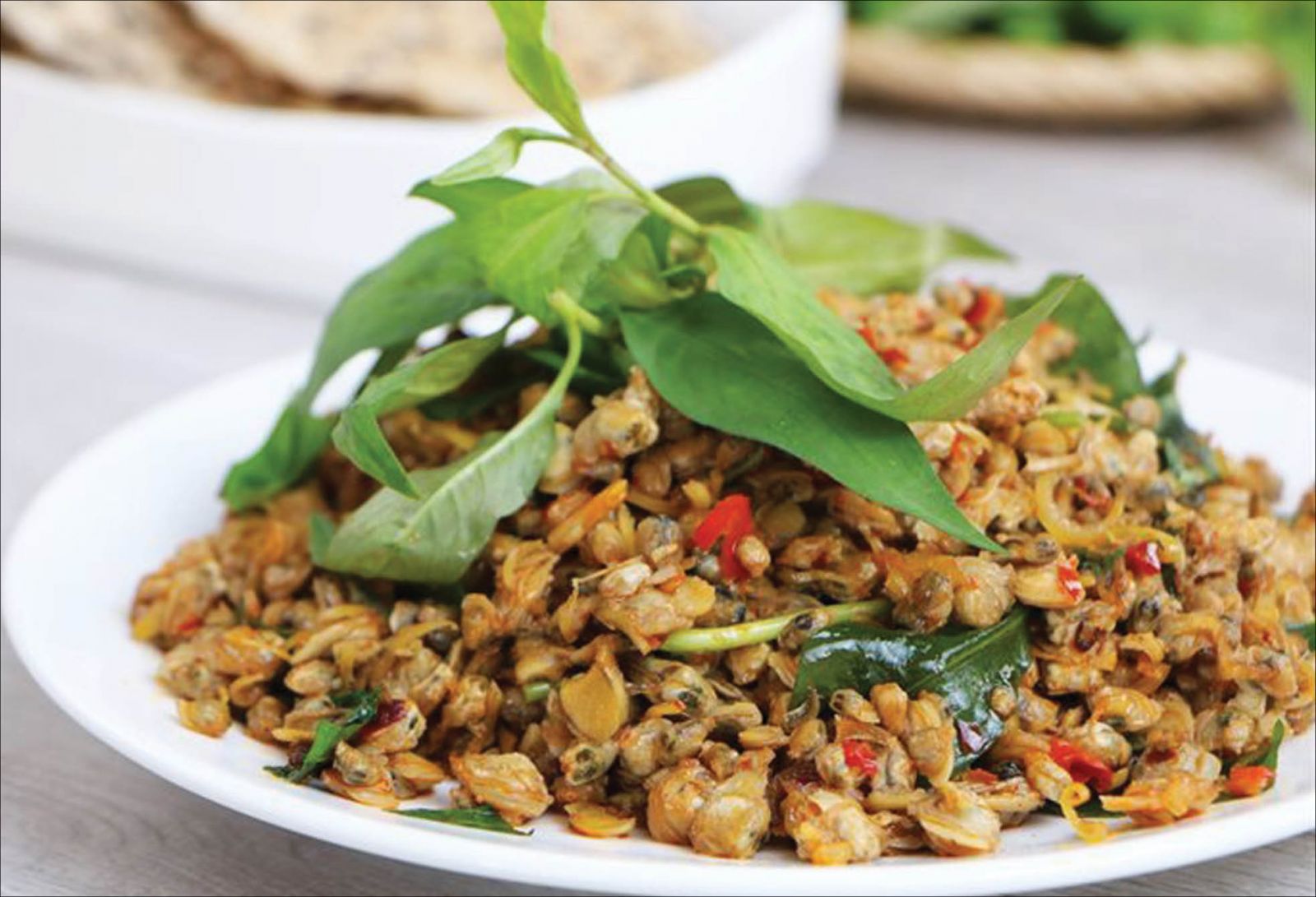
Stir-fried mussels with chilli, served with rice paper pancakes. Photo: TL
When I went to War Zone 4 in the South (My Tho) in 1972, it took us exactly one and a half months to pass through Dong Thap Muoi. At that time, I had malaria, with intermittent fevers every other day. I was completely exhausted, and it was very inconvenient as we were marching on. But I managed to cure myself just by… eating chilli and drinking alcohol, rice wine to be exact. I was completely cured. Apparently, chilli is more important to humans than we think.
In June 1975, Ngo The Oanh and I wandered from Saigon through the Central provinces and then came to Hue. When I first went to the battlefield, I wished, in my heart, when peace came, to be able to go to the North by Highway 1. Departing from Saigon and dropped by Hue; the two songs "Hue - Sai Gon - Hanoi" by Hoang Van, and another one by Trinh Cong Son, made me wanted to visit Hue before going to Hanoi.
My wish came true. Ngo The Oanh, Tran Vu Mai and I went to Hue from Danang on a local bus. A close friend of ours, Nguyen Van Dong, a writer, was living in Hue at the time. Dong was in my class at university and we were also in the same writing class organized by the Writers Association in Quang Ba with Tran Vu Mai and Ngo The Oanh. When Oanh and Mai went to the War Zone 5 and I went to the Southern War Zone, Dong went to the Tri Thien War Zone – where the fighting was most intense.
Dong stood firm five years in this battlefield, until the day Hue was liberated. At that time, we did not have telephones, but somehow, we found each other very quickly. When we arrived in Hue, we met Dong and he took us straight home. He lived by An Cuu River; I believe it was 65 Phan Dinh Phung Street. He shared a room with writer Nguyen Quang Ha.
When we got to Dong's place, the poet Tran Pha Nhac immediately appeared. After a brief conversation with Dong, Nhac immediately left to do a special task. The three of us, as guests, had nothing to do, so we all went swimming in An Cuu River.
Now that everyone knows Hue is the "food capital"; but at that time when peace had just been established, we had neither money nor the habit of eating out. So, we enjoyed Hue cuisine at Dong’s. Dong is an expert in the kitchen by nature. Since our university days, I knew that he was especially skilled at making delicious dishes.
After swimming, we went home just in time that Dong, with the help of Quang Ha, finished setting the table. Tran Pha Nhac, after completing his "special mission", had also came. It wasn’t really a special mission… Nhac just went to buy wine. It was a kind of medicinal wine from a famous inn in Hue at the time called Thien Tuong. It was a pretty cheap wine, but drinkable. We immediately sat down to eat, excited to raise our glass to celebrate our reunion.
The dish I remember most is stir-fried mussels with chilli. Mussels are a specialty of the Huong River, and chilli is a specialty of Hue. Talking about Hue dishes, firstly, we must mention chilli. If a dish doesn’t have chilli, it cannot be considered Hue food. Stir-fried mussels with chilli and shallots is quite a simple dish. Sliced chilli with chopped shallots – it’s such a simple but very tasty dish.
When Trinh Cong Son and some Hue artists like Buu Y, Le Van Ngan came to join us, they were surprised to see us eating fried mussels with chilli. "You can eat chilli peppers too?" We laughed: "What else can we eat?” Everyone had a good laugh. Hue people are good at eating spicy food. And us, though we’re not from Hue, we are… ‘Viet Cong’, so we can also eat spicy food very well.
During the war, chilli was not only a cheap way for us to increase our appetite with our poor meals, but also a means that helped us cure malaria. Curing malaria just by eating chilli – I dare say no one nowadays would believe us.
Trinh Cong Son was very happy to see that we enjoyed the stir-fry mussels with chilli. Later on, when we hung out with Son, we had many chances to try different cheap yet delicious Hue foods while getting tipsy with Thien Tuong’s cheap wine. But I still feel that Hue’s most iconic food is stir-fried mussels with chilli.
These years, every time I go to Hue, I have the opportunity to dine with Nguyen Khoa Diem and some of my friends at a restaurant by Vy Da river, opposite Con Hen. In our "menu", there is always the glorious "stir-fried mussels with chilli". It is truly glorious because the mussel flesh is light grey with a touch of purple from the shallots, and on the very top, the vibrant red of chilli peppers. Looking at the dish is a treat by itself, but eating it is a true prize.
In my hometown Quang Ngai, we have “don” (a type of small mussels) dish, which is also very special. But don is cooked in a soup and served with rice paper pancakes and chilli. Hue’s dish is stir-fried mussels with chilli (and rice paper pancakes are used like an eating utensil) and is one of those dishes that makes us drink a lot of wine. Oh! how I miss those first days of liberation! Just with a simple dish of stir-fried mussels with chilli but a piece of memory suddenly comes to life.
Thanh Thao