



 |
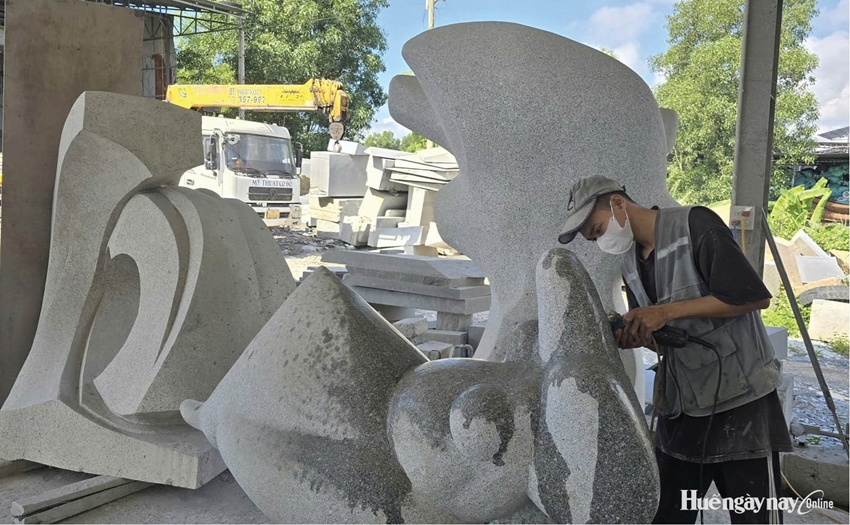
| Some of the sculptures are already mostly complete |
From blocks of stone to sculptures
At a workshop in Hue, teams of craftsmen are carefully refining the lines, proportions, and surfaces of granite blocks according to the artists' designs. Some sculptures are already largely complete, while others still require adjustments to ensure that their original forms and concepts are preserved as they are enlarged from small models to full scale.
According to Mr. Phan Thanh Hung - Director of Co Do Fine Arts Company, site commander, and one of the participating sculptors, the production process is now more than 80% complete. The work requires close and regular coordination between the construction team and the artists to ensure that the sculptures retain the original concepts of the designs when enlarged. “The greatest challenge is understanding and accurately conveying the spirit of each work when translating a sketch into the actual material. Some lines may look simple, but reproducing them in a three-dimensional form requires extremely meticulous handling of the material, proportions, and surface transitions,” Mr. Hung said.
Sculpture production began after the selection and evaluation of preliminary designs and scale models at 1:10 scale. Throughout the process, Mr. Hung has regularly consulted with the artists to reach agreement on materials, forms, and details. For artists based far away, particularly international participants, most discussions have been conducted online. According to the plan, the artists will arrive in Hue in early November to work directly with the construction team on the final adjustments.
Every sculpture is made from natural granite in a variety of colors. Mr. Nguyen Phuoc Hai Trung, Deputy Director of Hue Monuments Conservation Center and a member of the Sculpture Camp's organizing board, said that the decision to use a single material was a notable feature of this edition, unlike previous camps, which employed a range of different materials. Granite was chosen for its durability in outdoor settings and also suitable for Hue's weather conditions.
“We hope these works will be of high quality and contribute to beautifying the area along the Huong River. They will form a vibrant sculpture garden where residents and visitors can engage in cultural exchange and admire the sculptures in an open-air setting,” Mr. Trung said.
The 2026 Hue International Sculpture Camp is the sixth edition of the event, following the previous camp in 2016 after a 10-year hiatus. It brings together 29 artists, including 19 Vietnamese and 10 international participants from Laos, Thailand, France, Spain, India, Egypt, and Iran. The participation of artists from different countries brings forth diverse interpretations of the theme ‘Impressions of Hue,’ ranging from perceptions of the city's heritage to its local culture and people.
According to the organizing board, preparations have covered every stage, from inviting artists and receiving preliminary designs to selecting proposals and evaluating scale models before production begins. This process requires close coordination among art experts, artists, material suppliers, and construction teams.
Placing sculptures in harmony with the landscape
According to Dr. Nguyen Phuoc Hai Trung, each sculpture bears the distinctive imprint of its creator. However, when displayed in a public space, it must foster interaction with the community. This is one of the key considerations guiding the art council in selecting works and advising on their placement.
Dr. Phan Le Chung, Vice Rector in charge of the University of Arts, Hue University, and a member of both the organizing board and the art council, praised this year's preparation process, from the selection of preliminary designs and approval of scale models to the production of the sculptures. This approach helps maintain quality control and ensures that the artistic vision is preserved as ideas are translated into physical forms.
Mr. Chung believes that natural stone is well suited to the landscape along the Huong River, where the water, lawns, and open spaces create a sense of connection. However, the effectiveness of the sculpture garden will also depend on how the works are arranged within the overall setting. Each sculpture must have adequate space without disrupting the harmony of the surrounding landscape.
“When arranging the sculptures, the organizing committee should provide guidance to ensure that they are positioned in a balanced manner - not too densely or too sparsely. Their placement must also harmonize with the surrounding environment, ensuring aesthetic quality and safety in the face of natural disasters,” Mr. Chung noted.
From November 5th, the participating artists will gather in Hue to take part in the camp's activities and complete the final stages of their work. Once finished and installed, the 29 new sculptures will enrich the artistic landscape along the northern bank of the Huong River, complementing the display area featuring works from previous editions of the sculpture camp.