



 |
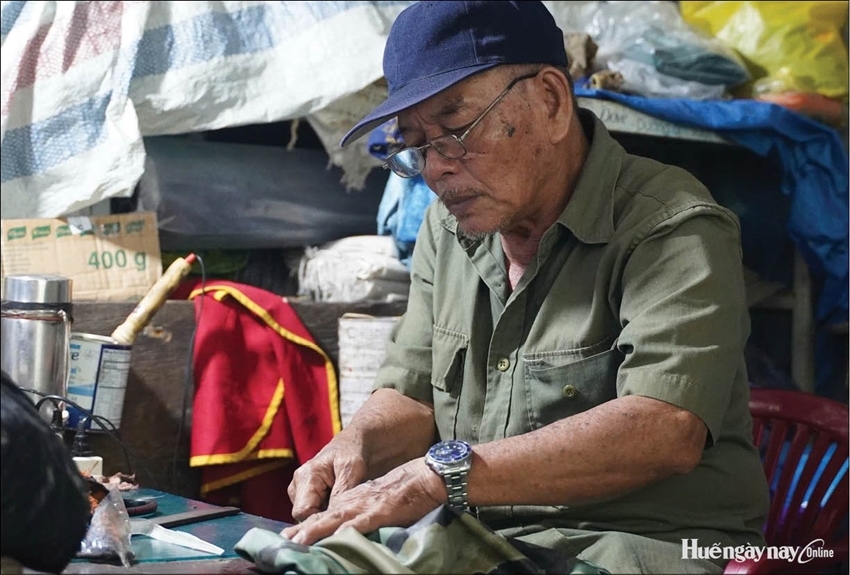
| Mr. Lam Thanh Ty has been patching raincoats for more than 40 years |
Preserving memories
Many times, I meant to get rid of the old watch my father left me, but I could never bring myself to do it. I took it to several large repair shops, and at every one of them the technicians shook their heads because replacement parts were no longer available. On a friend’s tip, I sought out Mr. Cong Danh’s watch repair shop on Tran Phu Street.
The Seiko 5 had a faded dial and had stopped running because of a broken mainspring. Mr. Danh leaned in close, put on his loupe, carefully examined every part of the movement and then gently explained: “With models from this era, you have to take the trouble to find parts salvaged from old movements to get a proper fit – you can’t buy new ones in the shops.” I came back on the appointed day. The watch was running, its ticking ringing out again after days of silence. The repair fee was not as high as I had expected. For me, what mattered was not only that the watch had been fixed, but also the feeling of having held on to a part of a loved one’s memory.
With more than 30 years in the trade, Mr. Danh has the experience to identify the faults of wind-up watches. He came to the craft out of curiosity and a love of watching while helping his father mind the shop. In his view, the work demands perseverance, care, sharp eyes and intense concentration. He once spent two days repairing a watch that had stopped running because it was a keepsake of a late relative that the customer earnestly begged him to save.
Age has also made the work harder. Mr. Danh says his eyes are no longer sharp and his hands sometimes tremble, while most customers come in for cleaning and oiling, or to replace a stem, a battery or a strap. There are fewer customers than before, but the work remains steady. That is why he can still make a living from his trade.
An affordable choice
It might seem that raincoat patching would have no place left as goods grow ever more varied and new items are sold everywhere. Yet raincoats with torn hems, split heat-sealed seams or holes worn through after use are still mended by Mr. Lam Thanh Ty, who has practised the trade for more than 40 years at Dong Ba Market.
For Mr. Ty, patching raincoats is not just about joining torn spots back together. It is work that requires experience and dexterity. He uses a hand-held soldering tip, relying on experience to set the right temperature so as not to damage the surrounding plastic. Each patch costs from 5,000 to 10,000 dong. Depending on the damage, the repair may cost more. At this price, people can keep using a raincoat that is still in good condition instead of buying a new one.
The trade is also affected by the weather. On days of bad weather, he can take in around 40 raincoats a day. When it is sunny, he mends shoes and sandals for extra income. This work once helped him raise six children. Although the trade is no longer as widespread as it used to be, he holds on to it because he loves the craft and wants to help poor working people save money.
For working people who must weigh their daily expenses, repairing a raincoat that is still usable is an affordable choice. For just a few thousand dong, they can keep using a familiar item instead of spending tens of thousands, or even a hundred thousand dong, on a new raincoat.
A watch ticking again, a raincoat patched watertight – these are small things, yet they require experience and patience. For craftsmen like Mr. Danh and Mr. Ty, keeping their trade alive is not only about sustaining a livelihood but also about continuing to meet people’s need for repairs, so that items still fit for use are not thrown away.