



 |
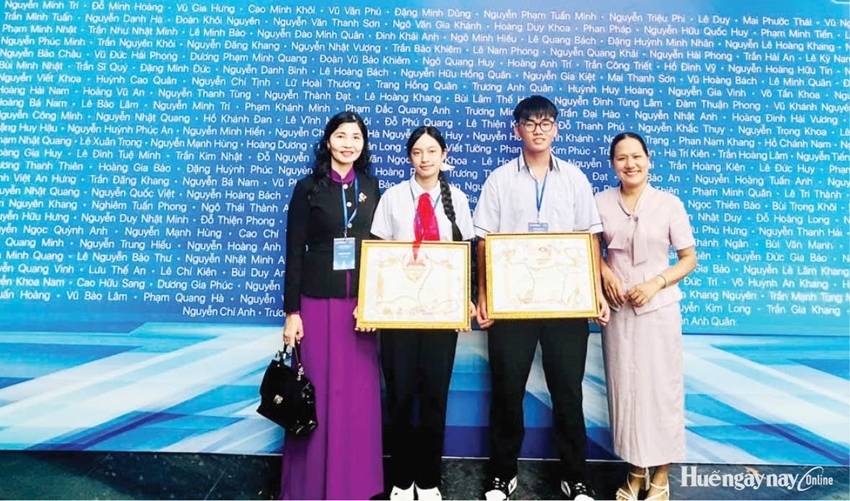
| Two students from Dang Van Hoa Secondary School received third prize at the 2026 National Young Informatics Contest |
The project, titled ‘Using Polycam to Design and Build a Digital Museum of Hue's Cultural Heritage’, was developed by Ho Duc Viet and Ho Ngoc Huyen Nhi under the guidance of Ms. Tran Thi Thuy Lan, an Information Technology teacher at the school.
The digital museum consists of multiple exhibition spaces, each dedicated to a heritage site. To create the museum, Viet and Nhi visited the sites in person, selected artifacts for digitization and used the Polycam app on their smartphones to capture images. They then processed the images, created 3D models, arranged them in individual exhibition spaces and added explanatory information.
Creating 3D models with smartphones makes digital digitization technology more accessible to students. Visitors, meanwhile, only need an internet-connected phone to access a link or scan the museum's QR code to explore the exhibition spaces and learn about the artifacts on display. The nearly 200 digitized artifacts vary widely in size and form. There are some small details such as the raised reliefs depicting Hue's scenic landmarks on the Nine Dynastic Urns, or the dragon-transformed plum blossoms and chrysanthemums carved into reliefs at Giac Luong Pagoda, a nationally recognized historical site. The collection also includes models of larger structures, such as the Lieu Coc Twin Towers, a national-level heritage site once described by the École française d'Extrême-Orient as an ‘ancient relic throughout Vietnam and Indochina’.
To Ho Duc Viet, creating each 3D scan has also been a journey of heritage discovery. Through these visits, he has gained more opportunities to explore, deepen his understanding of his homeland's culture and develop a stronger interest and pride in its values. Ho Ngoc Huyen Nhi likewise expressed her enthusiasm for using artificial intelligence to create useful digital learning materials for herself and the wider community. Technology has given her new ways to study, explore, and introduce heritage to a broader audience.
Before winning Third prize in the final round of the 2026 National Young Informatics Contest, the project had won First prize at the city-level Young Informatics Contest and first prize in the qualifying round of the National Young Informatics Contest of Central Vietnam region.
According to teacher Tran Thi Thuy Lan, the team chose this technology because it enables students to create 3D models more easily and use them to develop digital learning materials for teaching and learning. It also helps students strengthen their digital competencies and deepen their understanding of their local heritage. The project's value, however, extends beyond the number of artifacts digitized or the awards it has received.
Through the process, Viet and Nhi have learned to combine technology with the study of history and culture. The 3D models shared through the digital museum also offer a new way to bring Hue's heritage closer to younger generations.