



 |
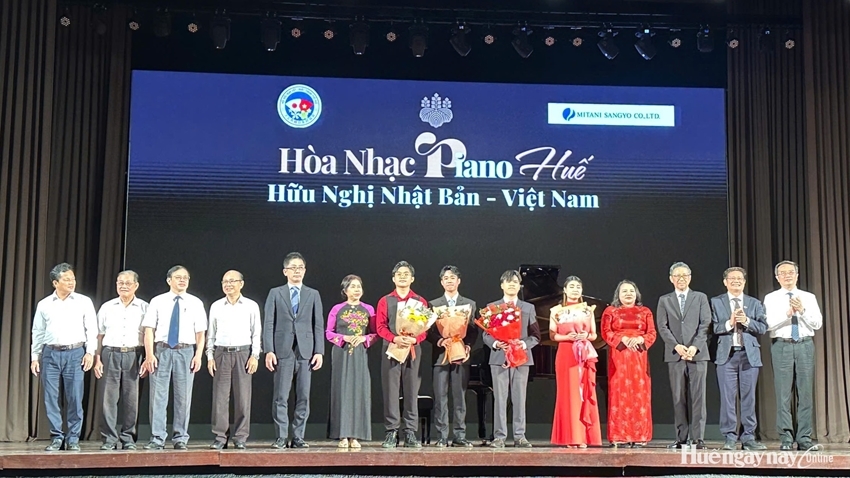
| The Organizing Committee presented flowers to congratulate artists performing at the concert |
In the artistic setting along the Huong River, the sound of the piano became a common language, connecting people from two cultures. This meaning was reflected in the structure of the program: European classics sat alongside Japanese melodies and Vietnamese music, while the guest artist shared the stage with young performers studying and developing in Hue. The encounter offered performers and audiences alike an opportunity to discover the beauty of each other’s cultures.
The first three pieces were performed by young artists from Hue Academy of Music, namely Phan Phung Thien Bao, Doan Anh Khoi, and Nguyen Trong Quy. Their selections demonstrated both technical proficiency and affirmed their connection to national music. Phan Phung Thien Bao performed Franz Liszt’s Étude de Concert: S.144 No. 2, La Leggierezza; Doan Anh Khoi performed Love Dream (Liebestraum), S.541 No. 3, also by Liszt; and Nguyen Trong Quy presented Ly ngua o by Nguyen Huu Tuan.
Liszt’s two pieces presented challenges of technique and expressiveness, while giving the young performers room to demonstrate their sensitivity and artistic finesse. Meanwhile, Ly ngua o brought Vietnamese musical elements into the dialogue on the piano. The concert concluded with Lang toi by Nguyen Huu Tuan, performed as a duet by Doan Anh Khoi and Phan Phung Thien Bao. The duet offered a beautiful image of young people expressing the voice of their homeland together through an international artistic language.
Next came four pieces by the gifted Japanese pianist ASAKURA Sumire, taking the audience on a richly varied musical journey from Chopin’s Fantaisie-Impromptu and Ravel’s Jeux d’eau to Sakura-Sakura by Kozaburo Hirai and Falla’s Ritual Fire Dance. While Chopin evoked a romantic inner world and Ravel conjured delicate impressions of water, the melody of cherry blossoms brought listeners closer to the Japanese soul…
The selection of pieces with such distinct characters allowed audiences to experience a wide range of expression in piano music. In particular, Sakura-Sakura added a distinctive cultural touch to the friendship concert. Through the sound of the piano, the image of cherry blossoms became a greeting from Japan to Hue, gentle yet evocative, a reminder of how music can transcend geographical boundaries, bringing national symbols to touch shared human emotions.
Speaking on behalf of the city’s leaders, Ms. Tran Thi Hoai Tram, Director of Hue City Department of Foreign Affairs, highlighted the concert’s role in putting into practice the cultural exchange and people-to-people diplomacy initiatives agreed upon by Hue and its Japanese partners at the Hue - Japan Connectivity Conference in early September. From cooperation commitments to an artistic encounter, friendship was strengthened through concrete experience, sharing, and affection between people.
For students studying Japanese language and music, the concert also offered an opportunity to broaden their understanding, nurture their passion, and appreciate the value of international exchange. Direct exposure to artists, musical works, and diverse forms of expression can add motivation to learning and creativity. The hope that young people will become ‘friendship ambassadors’ thus begins with simple things: a melody they come to love, a culture they seek to understand, and a friendship that takes shape.
Hue City affirmed that it will continue to facilitate cultural and educational exchanges and cooperation with Japanese partners. The concert at the Song Huong Theater added another link to that journey, where the sound of the piano carried friendship and opened more doors to partnership.