



 |
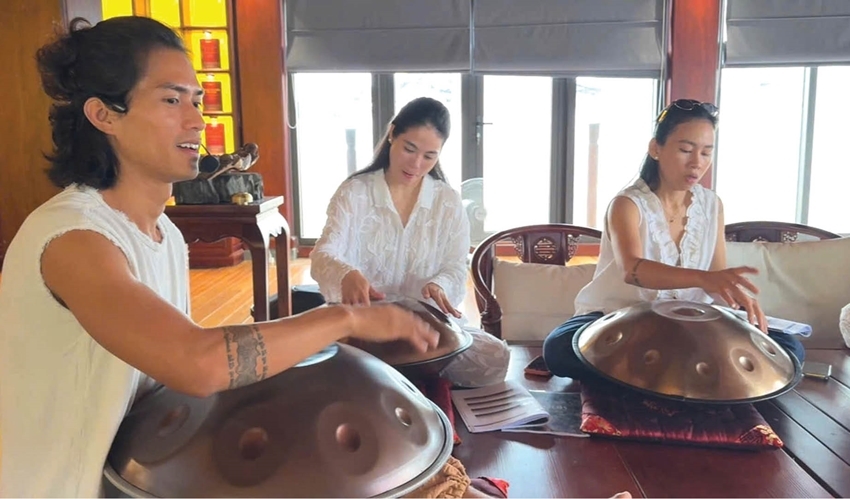
| Each handpan has its own unique tonal characteristics, requiring players to familiarize with each note and learn how to coordinate rhythms |
In harmony with the bowl’s resonance
I came across the workshop ‘Balancing Body, Mind, and Spirit with Himalayan Singing Bowls’ through a recommendation from a friend. Right at the time when work was often leaving me stressed, with my mind racing through a long list of unfinished tasks, I agreed to join in. I had heard of singing bowl meditation before and was curious to experience it, hoping it would help me ease some of the pressure.
The workshop took place in a peaceful and quiet space. Participants lay on mats, made themselves comfortable, and allowed their bodies to relax. I closed my eyes and tried to focus on my breathing as instructed, lying still and waiting for the first sounds.
A single strike against the singing bowl sent its resonant tones echoing throughout the room before gradually fading away. Just when the sound seemed to have disappeared, a faint vibration could still be heard. Then the next tone rang out, flowing into the lingering resonance of the previous one.
Himalayan singing bowl, also known as the Singing Bowl, is shaped as a metal bowl. Practitioners strike the bowl with a striker or run it around the rim to make sound and vibrations.
The first few minutes were quite challenging for me. Even after lying down and putting my phone aside, I found it difficult to quiet my mind. An unfinished task suddenly crept into my thoughts. I tried to bring my attention back to the sounds resonating through the room, listening from the moment each tone rang out until it faded completely. Gradually, over the course of 45 minutes, my scattered thoughts became less frequent, my breathing grew steadier, and my body began to relax.
When the final note faded away, I opened my eyes. The work-related issues that had been weighing on me were still there, but the heaviness in my mind had eased. I did not expect a single session to resolve the pressures I was facing, but those 45 minutes were enough to make me realize that, amid the constant demands of work, the body sometimes needs a chance to rest, too.
Mr. Ton Anh Duy, a meditation, yoga, and sound therapy instructor, explained that the tones of singing bowls and their vibrations can create a space where participants can relax and improve their focus. For him, sound meditation is first and foremost a time to rest, allowing participants to temporarily set aside their thoughts that caused their minds overwhelmed.
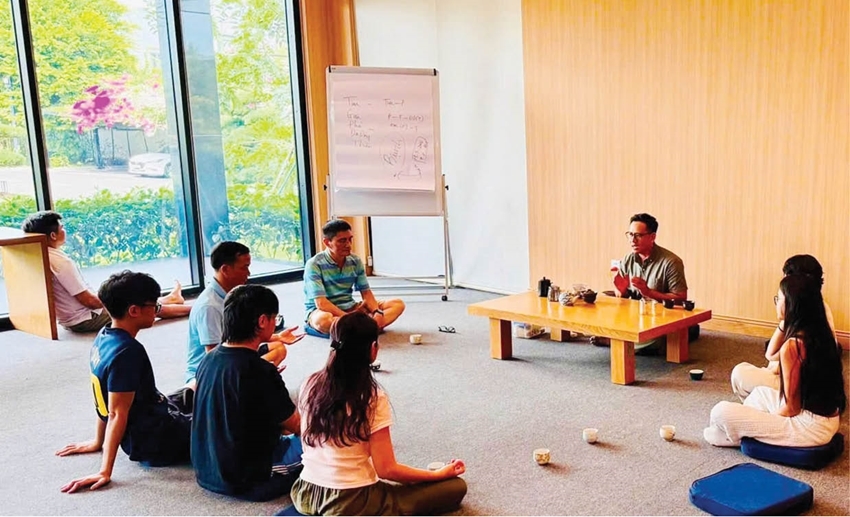 |
| Participants listen to each sound from the moment it rings out until it fades away, using it as a way to bring their attention back to the present moment. Photo: Anh Duy |
Melodies woven by hands
Unlike the singing bowl, which allows listeners to let themselves flow to the sound, the handpan calls for active participation, with each beat shaped by the hands. This steel instrument, featuring various notes arranged across its surface, is gradually making its way into classes, in music experience sessions, and spaces for meditation and relaxation.
According to handpan artist Nguyen Tuan Viet, the handpan first appeared in Switzerland in 2000. Compared with the piano or guitar, it is still a relatively new instrument. Each handpan has its own unique sound system, with a limited number of notes and a defined range of pitches. For beginners, one of the first challenges is how to produce the right sound. The hands must strike the correct spots on the instrument with just the right amount of force to achieve the desired tone. However, Ms. Viet said it is not the greatest challenge.
With practice, players gradually become accustomed to the techniques needed to touch the instrument and make sound. The greater challenge lies in developing a sense of rhythm, as the handpan is a percussion instrument. Players need to learn how to keep rhythms while controlling each touch so that individual notes flow to form a melody.
Curious about the handpan and drawn to its soft, soothing tones, Ms. Tran Thi Hong Anh, from Thuan Hoa Ward, Hue City, decided to give the instrument a try. She noted that producing a sound takes only a gentle touch, but playing a flowing melody requires a good understanding of the notes’ locations, as well as the pressure, and the way to maintain the rhythm. These challenges have encouraged her to learn more about the instrument.
Like the singing bowl, the handpan is often associated with the idea of ‘healing’. Explaining this perception, handpan artist Nguyen Tuan Viet said that in Vietnam, the instrument has become linked to ‘healing’ because listeners find a sense of gentleness and calm in each resonant note. For players, relaxing the body and channeling emotions, both joyful and sorrowful, into each beat can turn the sound into a way of expressing and releasing their feelings.
From the resonance of the singing bowl to the rhythmic beats of the handpan, ‘healing’ may not lie in any special properties of these instruments. Perhaps, first and foremost, it is about giving ourselves permission to slow down, step away from the noise around us for a while and listen more closely to ourselves. These gentle sounds may not make life’s troubles disappear, but they can create a moment of stillness, helping us feel more at ease as we return to our daily routines.