



 |
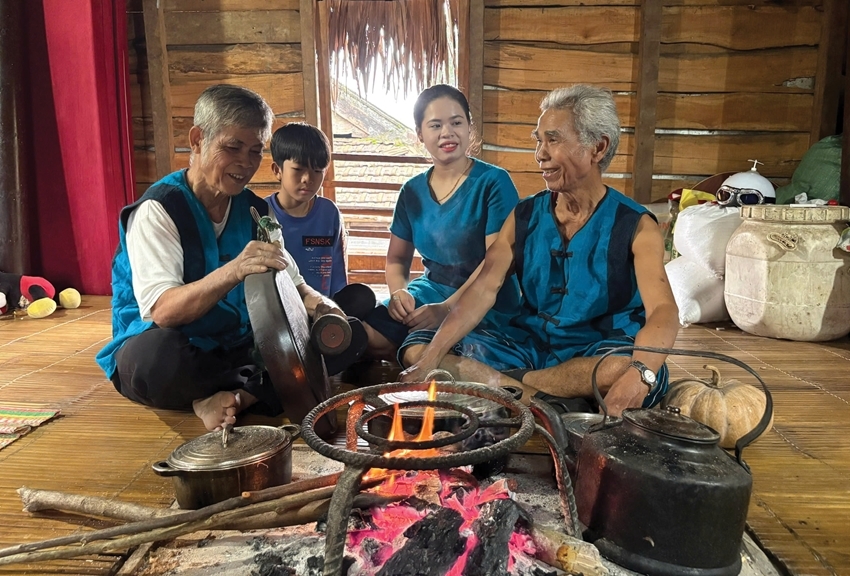
| Young Pa Hy people learn about the terel flute through stories told by their elders around the hearth |
Following the Traces of Terel
“To find the sound of the terel, you must find those who still hold its memory”. Following this suggestion from village elder Nguyen Van Cao, former head of the Pa Hy Traditional Folk Singing Club in Binh Dien Commune, we set out to trace an instrument once deeply entwined with the lives of the Pa Hy people.
In his small home in Hamlet 1, elder Nguyen Van Can slowly recounted the story of the terel flute. Though he has lived through more than 90 farming seasons, he still vividly remembers the melodies that once echoed throughout the village. “We Pa Hy people tend to be reserved. There are many things in our hearts that we struggle to put into words. So we often turned to the terel flute to express our feelings, convey our love, and share life’s joys and sorrows,” he confided.
“Back then, so many people knew how to make and play the terel. It wasn’t like it is now…” His voice grew subdued. Among the Pa Hy community in Binh Dien, elder Can is one of the few who still remember how to craft the instrument. He explained that the terel is made from a branch of a bung, a type of bamboo locally known as “lo o”. To produce a flute with the right tone, Pa Hy craftspeople usually select dark-green branches that have reached just the right maturity. In the past, village elders believed that cutting a bung toward the end of the month would protect it from termites and wood-boring insects and give the finished terel a clearer sound.
Working with a small piece of bamboo no thicker than a chopstick and roughly a handspan long, Pa Hy people have to use a very sharp a cau, or knife, to carve the finger holes and fashion a reed as thin as a cicada’s wing. For the terel to produce its clear, pure notes, every step requires patience and precision of the maker.
Elder Can learned to make the terel from his elder female cousin. “She played the terel beautifully. She was also very good at making it,” he recalled. As a little boy, he would tag along with her to the upland fields to select a bung, then sit on the veranda watching her carefully craft the flutes. Day by day, he gradually learned the craft himself.
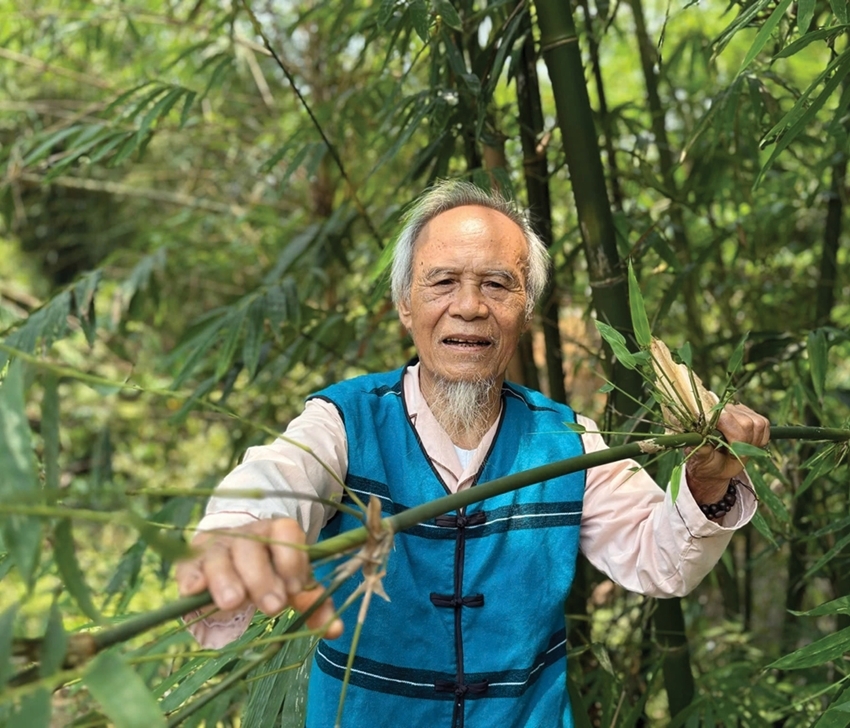 |
| Elder Nguyen Van Can demonstrates how to select a bung for making a terel |
Time has passed, and many memories of village life have faded into the distance, yet the elderly artisan still remembers the earthy scent of freshly split bung, the sound of a knife scraping along the bamboo, and the terel’s notes drifting through the village on sunlit afternoons. However, elder Can only master the making of the instrument; playing the traditional melodies of the Pa Hy is the specialty of other artisans. As the years drifted by like white clouds over the hillsides, those who could play the terel became ever fewer.
Keeping Terel Alive Beyond Memory
I followed Ms. Le Thi Ha, former head of the Fatherland Front Working Committee in Hamlet 1, to the small home of elder Hoang Thi Kut, in Hamlet 2. At 105, her hair was snow-white and her shoulders bowed by the weight of time, yet she was so enthusiastic at the mention of the terel. She recalled how the flute had accompanied her to the upland fields and through her days serving as a civilian wartime porter, carrying wounded soldiers and transporting ammunition. During those years, its melodies soothed many weary hearts and lent strength to every marching step.
Elder Kut explained that the Pa Hy learn to play the terel with their lips, their breath, their hands, and their hearts. Beginners often need many days before they can coax a clear, recognizable note from the instrument. Once they can produce a full tone, they must learn to maintain a steady breath and coordinate it with their fingers, allowing the melody to flow like a breeze through a grove of a bung. “Every terel has its own tone, and different players bring out different melodies. You must truly understand your flute before you can make it sing,” the old lady from the mountain shared.
In 2023, as part of a project to preserve, revive, and promote the traditional intangible cultural heritage of ethnic minority communities, local authorities organized a series of classes to pass on traditional knowledge and restore cultural practices at risk of disappearing. Among these was a class in terel making and performance, which was expected to give young Pa Hy people an opportunity to learn about their community’s traditional instrument.
Ms. Nguyen Thi Nganh, head of the Pa Hy Traditional Folk Singing Club, and Le Nguyen Kim Xuyen, its deputy head, still vividly remember the enthusiasm of the young Pa Hy people who signed up. Yet the class could not go ahead as planned. The reason was not a lack of interest among learners, but the precarious state of the terel tradition itself. Knowledge of the instrument now rests with two elderly artisans, neither of whom can fully pass on their skills.
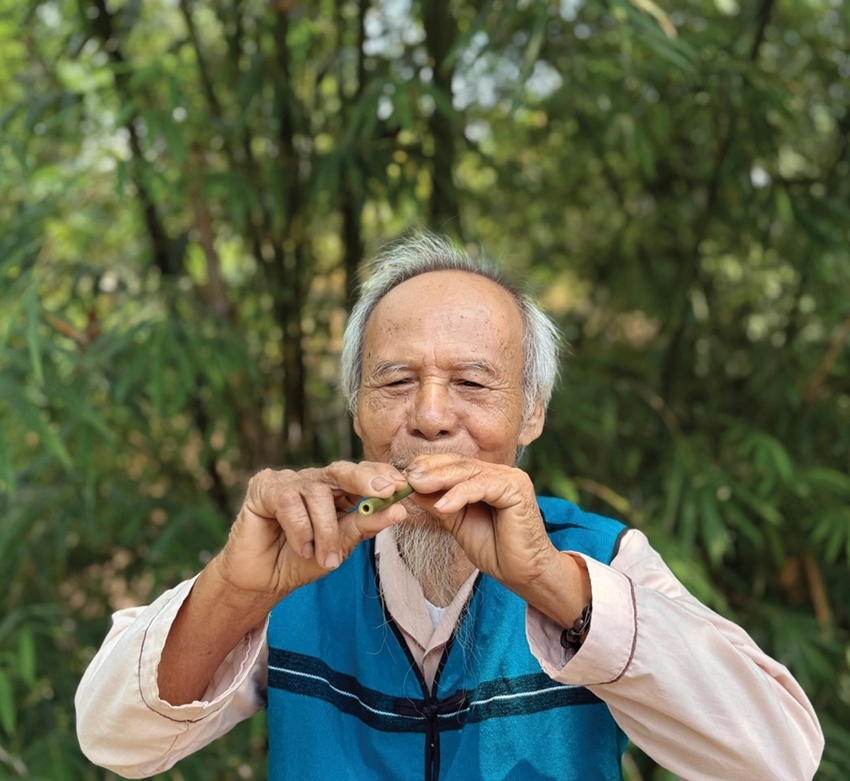 |
| Elder Nguyen Van Can, a keeper of the terel flute-making tradition |
Elder Hoang Thi Kut still remembers the Pa Hy melodies clearly. But after more than a century of life, her breath is no longer strong enough to draw the sounds of the vast mountain forests from the terel. Nguyen Van Can, meanwhile, still knows every knife stroke and every stage of the crafting process by heart, but his hands no longer have the dexterity to make a flute with the precise tone he once achieved. One remembers how to play; the other remembers how to make. Yet time has made the passing on of this heritage more difficult than ever.
Sharing these concerns, Mr. Dao Van Dai, head of Binh Dien Commune’s Culture and Social Affairs Office, said that preserving the knowledge of terel making, its performance techniques, and the cultural setting that has sustained it for generations remains a priority for local authorities. In the coming period, they will continue working with the artisans to document and digitize the crafting process and preserve the remaining traditional melodies. They will also establish connections with Pa Hy communities elsewhere that retain knowledge of the instrument, with the aim of gradually resuming classes once the necessary artisans and instruments are available.
According to Mr. Dai, the terel was once closely associated with upland farming, festive nights, and courtship among young Pa Hy men and women. As these traditional ways of life have changed, the flute has had fewer opportunities to be heard. Alongside teaching people how to make and play it, the most important task is, therefore, to create opportunities for the terel to return to the community’s festivals and cultural activities.
“Only when the terel is heard again in the villages, at festivals, and during the cultural activities of the Pa Hy people will this heritage truly live on,” Mr. Dai said.