



 |
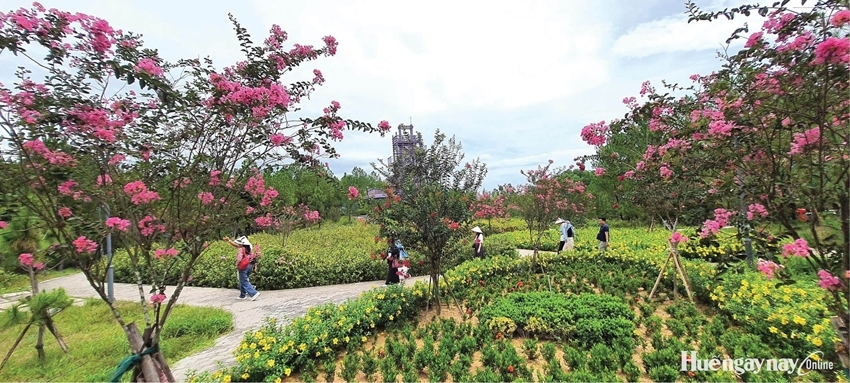
| Crape myrtle at Vong Canh Hill Park |
The crape myrtle was selected as one of nine flowers representing the myriad floral species of Dai Nam to be engraved on the Nine Dynastic Urns – a veritable encyclopedia of Vietnam inscribed on bronze urns, which have been designated as National Treasures, and recognized by UNESCO as Documentary Heritage for Asia and the Pacific. But why was the crape myrtle accorded the distinction of being the first flower represented on the Great Urn – the largest of the nine urns and the one occupying the central position?
An ancient flower that blooms for a hundred days
Botanical sources identify the crape myrtle as a flowering plant with the scientific name Lagerstroemia indica L. It belongs to the Lythraceae family and the genus Lagerstroemia. Being a small woody tree with a shrub-like form, it typically grows to a height of about three to five metres. Its native range extends from the Himalayas to southern China and East Asia.
The crape myrtle has a remarkably distinctive shape. Each blossom usually consists of six petals, with each petal spreading separately like a tiny flower of its own, its crinkled form resembling a sheet of delicate paper. The petals are attached by slender stalks to the calyx, making a single blossom look like an entire cluster of flowers. Only on close inspection does it become apparent that what looks like a cluster is in fact the six petals of one flower. At the center of the purple blossom is a cluster of stamens tipped with yellow anthers.
According to the Flora of China, crape myrtles flower continuously from June through September, remaining in bloom for more than three months, from summer into autumn. This has earned the plant the name bairihong, or “red for a hundred days.” It is among the relatively few plants on Earth with such a long flowering season. Its fruiting period also lasts more than three months, from September to December. The fruit grows in clusters resembling those of other Lagerstroemia species, though each fruit is only about the size of a rose myrtle berry. The crape myrtle is also exceptionally long-lived, with some specimens reportedly surviving for as long as 1,400 years. It has thus come to symbolize perseverance and enduring glory.
The crape myrtle also belongs to an ancient botanical lineage. Palaeobotanists have discovered fossilized pollen from Lagerstroemia cathayensis sp. nov., a species of the genus Lagerstroemia, in Miocene sedimentary deposits dating from approximately 5.33 to 23.03 million years ago in Zhejiang Province, China. The genus includes ornamental species commonly known as crape myrtles.
Chinese historical and cultural records further indicate that the plant has been part of Chinese life since ancient times. The earliest written record of crape myrtle cultivation is found in Shiyi Ji, written by the Taoist scholar Wang Jia during the Eastern Jin dynasty. Chapter 9 records that in the first year of the Yuanxi era, or AD 419, the Eastern Jin court ordered crape myrtles to be planted in imperial palaces and gardens throughout and beyond Luoyang in an effort to ward off the ill omen of ‘Mars encroaching upon the Ziwei Enclosure’. The Ziwei Enclosure was regarded as the celestial residence of the Ziwei Star, associated with the emperor’s destiny. This suggests that crape myrtle cultivation had already become widespread during the Eastern Jin period, more than 1,600 years ago.
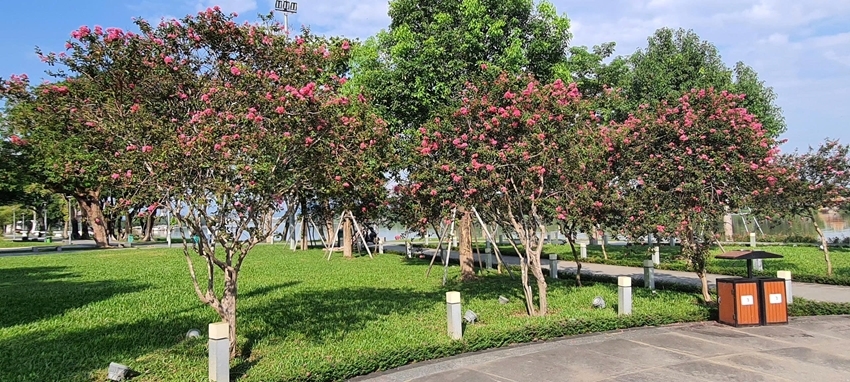 |
| Crape myrtles planted in Ly Tu Trong Park |
A noble flower, medicinal from root to crown
The ancient Chinese endowed this time-honoured flower with an exceptionally distinguished identity. Its Chinese name, 紫薇 (ziwei), originally referred to its appearance and colour. The character 紫 (zi) means purple, while 薇 (wei) denotes a small herbaceous plant. Wang Shimao of the Ming dynasty wrote in Xuepu Zashu (Miscellaneous Notes on Horticulture): ‘Crape myrtle comes in four varieties: purple, red, pink and white, but purple is its true colour’. Hence the name ziwei: a small plant bearing purple flowers.
Purple had long symbolized solemnity and nobility and had been associated with Chinese royalty since antiquity. During the Tang dynasty, particularly in the seventh and eighth centuries, however, the colour acquired special prestige. In the first year of the Kaiyuan era, AD 713, Emperor Xuanzong of Tang renamed the Central Secretariat – the foremost institution in the imperial administration – the Ziwei Secretariat. The title of its head, Zhongshu Ling, roughly equivalent to a chief minister, was likewise changed to Ziwei Ling. Large numbers of crape myrtles were planted within the Secretariat grounds. Thereafter, the flower became a common sight outside the residences of nobles and government officials, earning it the epithet guanyang hua – the “flower of officialdom.”
In traditional Chinese medicine, the crape myrtle is described as a plant whose ‘entire body can be used medicinally’. Vietnamese traditional medicine sources attribute a wide range of biological activities to the plant, including anti-inflammatory, anticancer, neuroregulatory, antidiabetic and antioxidant properties. Crape myrtle flowers can be steeped as tea and are traditionally used to relieve headaches associated with hot weather and bodily aches. The leaves and young branches are used for their antibacterial properties and in remedies for diarrhoea, boils and skin rashes. The bark, trunk and roots have traditionally been used for detoxification, promoting blood circulation, and treating joint and bone pain, sprains and injuries.
The crape myrtle possesses another unusual characteristic that seems to justify the old expression – ky hoa di thao (exotic flowers and rare herbs): the tree appears to be ticklish. Scratch its trunk lightly with a finger and its branches and leaves begin to tremble, almost as though the tree itself were being tickled. Stroke the trunk with the palm of your hand and the entire canopy seems to shiver, accompanied by a rustling sound reminiscent of laughter. This has earned the crape myrtle another nickname, pa yang hua – the ‘ticklish flower’. On June 12, 2018, the International Union for Conservation of Nature (IUCN) placed the crape myrtle on its Red List of threatened species, highlighting the need to protect this valuable genetic resource.
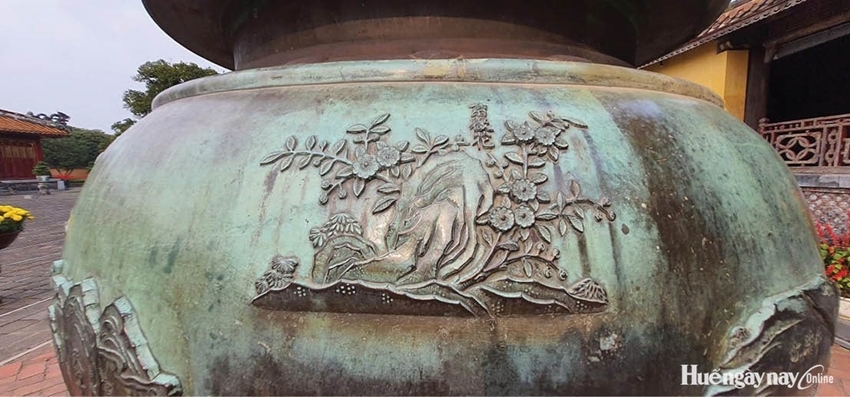 |
| The “crape myrtle” motif on the Great Urn |
Crape myrtle in Vietnam
Data from the Royal Botanic Gardens, Kew, indicate that Lagerstroemia indica L. is native to a region extending from the Himalayas through southern China to Indochina. The species was formally published by Carl Linnaeus in 1759. This suggests that by the mid-18th century, crape myrtle was already known to occur naturally in Vietnam and may well have been present long before 1759.
In Van dai loai ngu (Categorized Sayings from the Van Terrace), written by Le Quy Don in 1773 and regarded as Vietnam’s first encyclopedia, the author mentions the crape myrtle in China and says that it could then be found throughout Dai Viet. More specifically, in Volume IX, devoted to natural products, Le Quy Don cites an earlier work: ‘The flower known as bach nhat hong, which blooms in the sixth month, is called tu vi. It comes in two shades, pink and purple. The tree grows to about one zhang in height, with thin, pale bark. Its flowers bloom densely and are delightful to behold. Nowadays it can be seen everywhere’.
By the Nguyen dynasty, the crape myrtle had become firmly established in Vietnamese life. The Dai Nam nhat thong chi (Official Geographical Record of Dai Nam), compiled by the Nguyen dynasty’s National History Office during the reign of Emperor Tu Duc, records the flower as one of the natural products of Dai Nam: “Crape myrtle: the Qunfang Pu calls it the ‘hundred-day flower’ and the ‘ticklish flower.’ If its bark is scratched, the entire tree, from root to crown, trembles. During the Tang dynasty, many were planted within the imperial palace because the flowers remained fresh for a long time. Besides purple, there are two other colours, red and white; a deep bluish-purple variety is called thuy vi. In the 17th year of Minh Mang’s reign, its image was engraved on the Great Urn.”
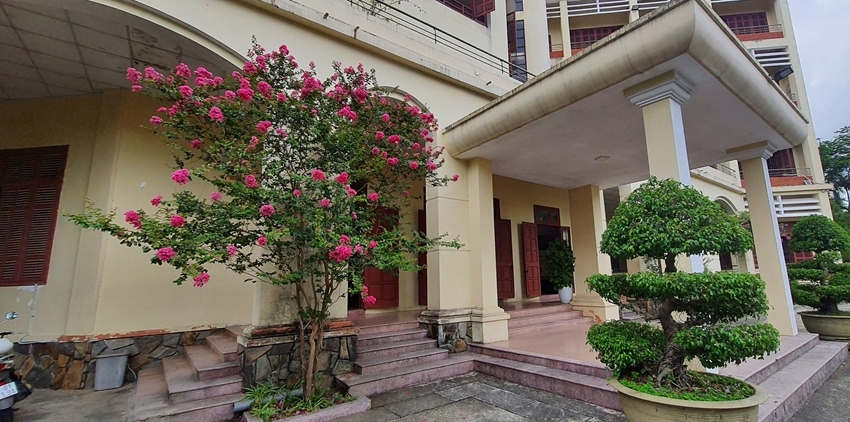 |
| Crape myrtles in the front yard of the city library |
In 1835, Emperor Minh Mang commissioned the casting of the Nine Dynastic Urns and instructed artisans to engrave them with images of mountains and rivers, plants and animals, and other products representative of the natural world and human life in Dai Nam. Each urn bears the image of one flower representing the floral kingdom as a whole. The crape myrtle was accorded the honour of being engraved on the Great Urn – the first and largest of the nine urns, positioned at the center and symbolizing greatness. On its surface is an elegant depiction of a crape myrtle tree, with graceful branches and leaves and flowers in full bloom, accompanied by the three Chinese characters 紫薇花: “crape myrtle flower.”
Why was the crape myrtle chosen?
Among the countless flowers found throughout Dai Nam, why did the Nguyen court choose the crape myrtle for the Great Cauldron?
Researcher Duong Phuoc Thu, author of Dat nuoc Viet Nam qua Cuu Dinh Hue (Vietnam through Hue’s Nine Dynastic Urns), explains: ‘The crape myrtle has highly unusual characteristics: it bears beautiful, fragrant flowers that remain fresh for a long time, while its various parts possess medicinal properties beneficial to human life. For these reasons, the ancients regarded it as a ky hoa di thao’. The plants, flowers, fruits, animals, and other products selected for depiction on the Nine Dynastic Urns had to be precious and representative. They were expected not only to embody auspicious meanings but also to provide substantial benefits to human life. The crape myrtle fulfilled all of these criteria.
We can now understand why the crape myrtle was accorded such an exalted position, as though it were a ‘saint among flowers’. It is, indeed, a distinguished guest – a visitor whose lineage reaches back into humanity’s prehistoric past, bearing the name of the central star in the heavens that emperors once regarded as the star of their destiny. Wherever this honoured guest appears, it brings with it an air of auspiciousness. Beneath the blazing summer sun, it smiles radiantly for a hundred days. At the slightest touch, its flowers and leaves tremble. Through summer heat and winter cold, it yields precious remedies for human ailments. Such a flower is truly a rare treasure bestowed by heaven and earth – a ky hoa di thao in every sense of the phrase.