



 |
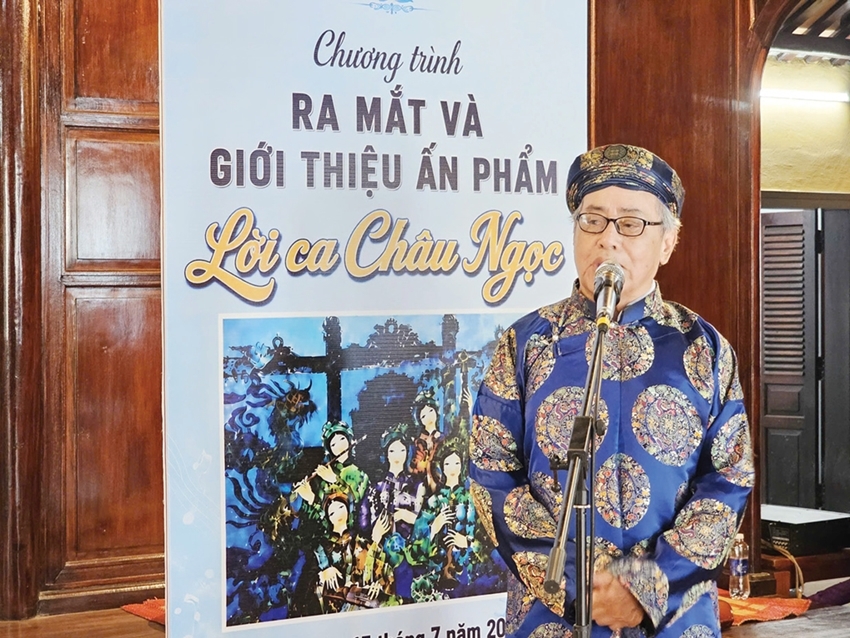
| Mr. Vo Que (poet) speaking at the book launch |
Alongside sustaining Ca Hue as a living art form through the Chamber Ca Hue Club, Mr. Vo Que, the club’s president, has also spent years collecting and compiling classical Ca Hue repertoire. Each piece he gathers and compiles represents not only effort and devotion but also a way to preserve and promote the value of this art form in contemporary life. “Loi ca chau ngoc” was born from that very aspiration.
The book’s launch carries added significance as it took place at the Ung Binh historical site at Chau Huong Vien, at the end of Nguyen Sinh Cung Street, Hue City - once a gathering place for the literati and poets of the renowned “Huong Binh thi xa” (Huong Binh poetry society). The location itself affirms that Ca Hue continues to be carried forward, both preserving tradition and blending into the rhythm of contemporary life.
One of the most prominent emotional wellsprings running through Ca Hue songs is love for the homeland and landscapes of Hue. From the gentle Huong River and the stately Ngu Mountain, to the ancient Thien Mu Pagoda and the solemn Hue Citadel, and on to peaceful countryside scenes. All of these appear not merely as picturesque, poetic landscapes but as symbols of cultural memory and the identity of this former imperial capital. Through each verse, readers can feel the deep love that the royal composers held for their homeland, the land that shaped the soul and character of generations of Hue people.
The songs selected for this book carry special historical and cultural value. The lyrics are cherished like pearls and jade, for within them lies the cultural essence of a land and an era. Lovers of Ca Hue will encounter once again renowned composers of the past such as Princess Mai Am, Ung Thieu, Ung Binh, Ung Thuyen, Buu Bac, Buu Huan, Buu Loc, and Ton That My, and so on.
Speaking about the origins of “Loi ca chau ngoc,” Dr. Tran Van Dung, Standing Vice President of the Hue Folk Arts Association, who specializes in research on the noble persons living in royal mansions of Hue as well as the art of Ca Hue, shared that what remains most striking about the book is not only the value of each song, but also Vo Que’s deep love for culture and heritage. It also reflects his devotion to preserving sounds that now stand at the crossroads of social change and the pace of modern life.
“We are of the generation that came after, and we have been fortunate to listen to his profound insights and to access Vo Que’s works on Hue culture, particularly on Ca Hue. We always regard these as a precious source of material on our research journey. Through him, we have been inspired with a love for heritage. Among researchers and those who cherish Hue culture, Vo Que, the poet, is respectfully known as ‘the keeper of Ca Hue’s soul’,” shared Mr. Dung.
For this reason, the book is regarded as an especially valuable resource for anyone who loves Hue, loves national culture, and wishes to preserve the cultural essence of this former capital amid the ceaseless tide of modernization.