



 |
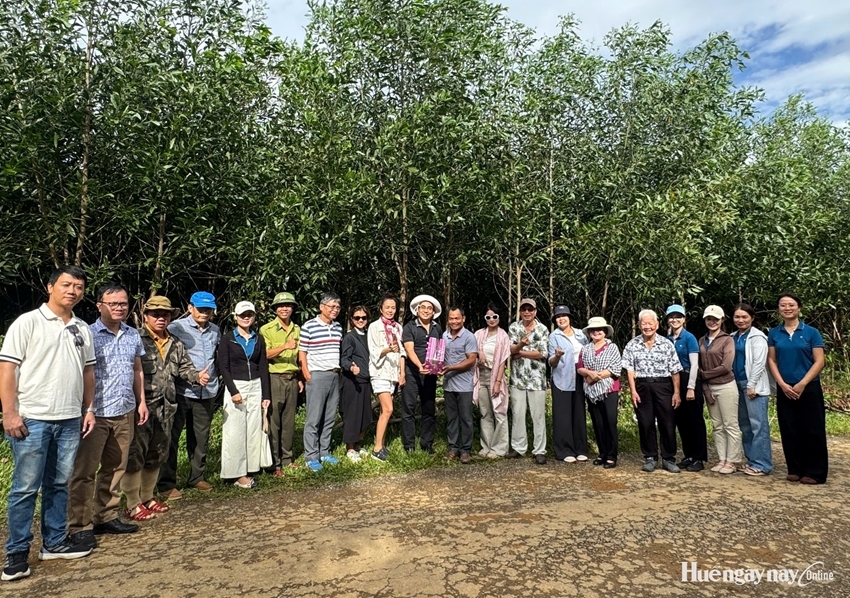
| Delegates visiting a forestry development model in A Luoi 2 Commune as part of the workshop |
Hue City currently has 205,458 hectares of natural forests, 77,496 hectares of plantation forests with timber reserves, and 23,393 hectares of newly planted areas that have yet to become established forests, with a forest coverage rate of 57.15%. The city has more than 14,000 hectares of large-timber forests, over 146,000 hectares of forests managed under sustainable forest management plans, and around 15,000 hectares certified under sustainable forest management standards. Hue is also home to the Tam Giang – Cau Hai lagoon system, the largest lagoon system in Southeast Asia, which has significant potential for blue carbon.
Despite its potential and achievements, Hue's sustainable forestry development towards Net Zero 2050 faces a number of challenges. These include complex terrain, extensive forest areas and limited resources, difficult livelihoods among local residents, the impacts of climate change, uneven application of technology and digital transformation, and a lack of databases and long-term financial resources for sustainable development.
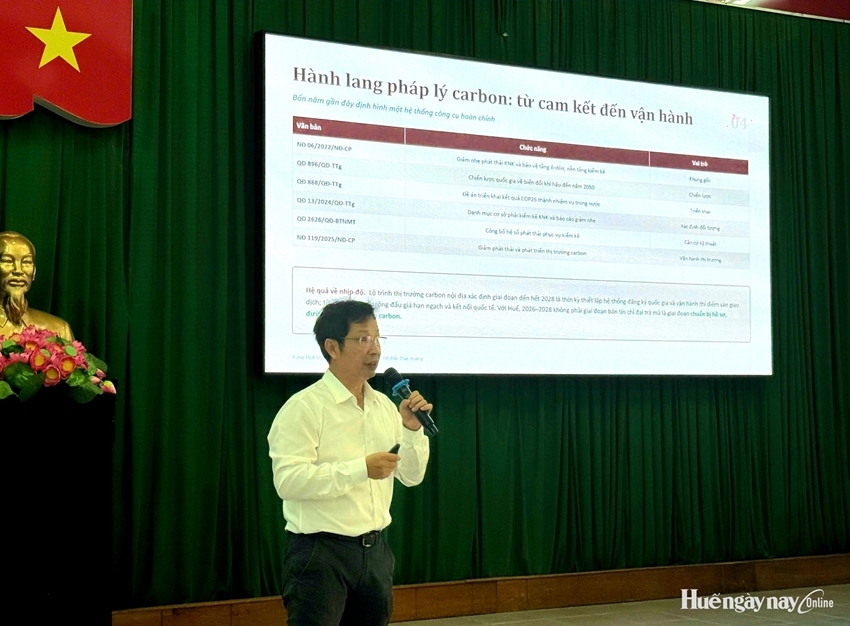 |
| Dr. Ho Dac Thai Hoang discussing ‘Forests in the Net Zero Architecture: From Forest Coverage to High-Integrity Carbon Assets’ |
At the workshop, experts, scientists, managers, and businesses working in forestry, climate change, and sustainable development discussed a range of topics, including practical experience and solutions from A Luoi 2 and across Hue to promote sustainable forestry development towards the goal of net-zero emissions by 2050; the transition from forest coverage to carbon assets in the Net Zero architecture; solutions to respond to climate change and promote emissions reductions towards Net Zero 2050; and approaches to finance…
The workshop also focused on key issues, including solutions to improve the quality of natural forests and convert plantation forests into large-timber forests linked to sustainable forest certification; mechanisms for integrating nature-based solutions into land-use planning, forestry, and water resource management; scientific and transparent methods and approaches to quantify and monitor carbon and access the carbon market; solutions that link conservation with sustainable livelihoods, ensuring local communities are placed at the centre of these efforts; and mechanisms for inter-sectoral coordination, data sharing, and long-term resource mobilisation.