



 |
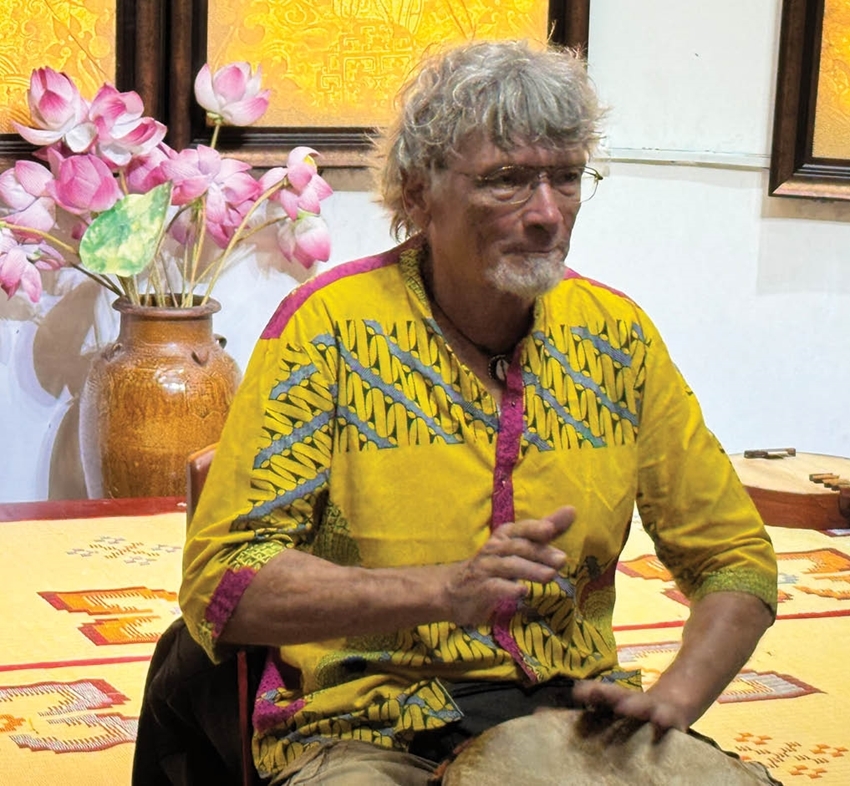
| Michael performing traditional West African music |
During the special cultural exchange, the vibrant beats of the Djembe resonated alongside the refined sounds of Hue Singing, creating a fascinating dialogue between two musical traditions from opposite sides of the world. In addition to performing traditional West African rhythms, Michael shared stories of his lifelong journey exploring folk music and spoke about his deep affection for Hue and Hue Singing art.
A Journey Inspired by West Africa
Michael Schmidt Kanté’s connection with music began through volunteer work. At the age of 18, he joined a French humanitarian organization, traveling to Senegal to help local communities search for water resources. What was intended to be a five-week mission ultimately became a turning point in his life.
“I met people in Senegal and fell in love with African music,” Michael recalled. From that moment on, he devoted many years to learning about West African culture, particularly the art of playing the Djembe, a traditional hand drum widely used in countries such as Mali, Guinea, Burkina Faso, and Niger.
Michael said he has spent around two decades traveling, performing, and engaging with musical communities throughout Africa and Asia. Among these destinations, West Africa has remained closest to his heart. “For the Djembe, West Africa is the most fascinating place,” he said.
Five years ago, political instability in Mali made it increasingly difficult to live and perform there; it prompted Michael to shift his focus to Asia. While searching for Djembe communities in the region, he happened to connect with a Vietnamese enthusiast in Da Nang who imports and distributes authentic Djembes from Africa.
That encounter marked the beginning of Michael's involvement in Vietnam's Djembe community. Since then, he has regularly led workshops and shared his knowledge with local Djembe enthusiasts in Da Nang.
Choosing Hue as a Home Away from Home
Driven by his curiosity and passion for traditional music, Michael eventually attended a gathering of the Hue Singing Club in Hue. There, he immersed himself in the elegant melodies that embody the cultural identity of Vietnam’s former imperial capital and had a chance to introduce audiences to the rich rhythmic traditions of West Africa through the Djembe.
Although separated by geography, language, and cultural background, the meeting of the Djembe and Hue Singing created a remarkable musical harmony. On one side were the energetic, community-centered rhythms of West Africa; on the other, the graceful, contemplative melodies that have long characterized the Perfume River region. Their differences became the very foundation for a meaningful cultural exchange, allowing audiences to gain a deeper appreciation of each other’s traditions.
Michael's affection for Hue extends well beyond music. Over the past five years, he has returned to Vietnam several times, often choosing Hue as his longest stop. Each visit typically lasts about six months before he continues to other parts of Vietnam or travels onward to Laos. “Hue is my favorite city,” Michael said.
According to him, the city’s greatest attraction lies in its tranquility. Unlike the bustling pace of Ha Noi or Ho Chi Minh City, Hue offers a peaceful atmosphere and a close connection with nature. “I love cycling. It takes only about fifteen minutes to leave the city center and reach the rice fields,” he explained.
Now 65 years old, Michael continues to cycle dozens of kilometers every day. Some days, he rides 50 kilometers, and occasionally as far as 100 kilometers, simply to discover new landscapes. On the day he joined the Hue Singing gathering, he had just completed a cycling trip to the coast to admire Hue’s newly built bridge spanning the Thuan An estuary. For the French musician, Hue is more than a travel destination - it is a place to embrace a slower pace of life, reconnect with nature, and build friendships.
Michael plans to remain in Hue for another six weeks before returning to Paris, where he hopes to continue exploring everyday life, reconnecting with friends, and experiencing the city’s cultural scene.
The meeting between the resonant beats of the Djembe and the delicate melodies of Hue Singing was therefore much more than a musical performance. It served as a testament to the unifying power of art, demonstrating how people from vastly different cultural backgrounds can find common ground through the universal language of traditional music.