



 |
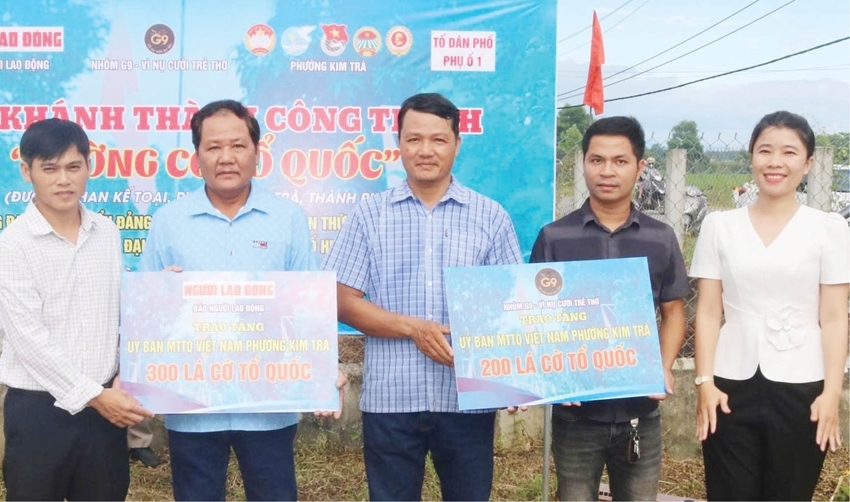
| Reporter Nguyen Quang Tam (far left), representing Nguoi Lao Dong (Laborer) Newspaper, presented Vietnamese national flags in Kim Tra Ward. Photo courtesy of the subject |
The night of October 27, 2025 remains an unforgettable memory for reporter Le Pham Nhat Linh of Tuoi Tre (Youth) Newspaper.
Hue was engulfed by a historic rainstorm that day. Water levels rose across the city, many roads were cut off, and low-lying residential areas began to sink beneath deep floodwaters.
To reach the Office of the City's Sub-Department of Irrigation and Climate Change at 2B Tran Cao Van Street, Nhat Linh had to wade through flooded roads before catching a boat ride through the An Van Duong urban area, which was encircled by floodwaters.
Along the way were unforgettable scenes: residents scrambling to lift furniture and move belongings; families watching anxiously as the water rose hour by hour; and entire residential areas submerged in a sea of water.
Yet it was only upon entering the flood-control command center that he truly felt the immense pressure of the battle against nature.
Phones rang incessantly. Screens provided minute-by-minute updates on rainfall, water levels and reservoir operations. City leaders, military personnel, police officers and irrigation officials scarcely left their posts. The atmosphere inside the room was taut with tension.
“It felt as though time had been compressed. Every passing minute could bring a new development. A decision delayed by only a few minutes could affect the safety of hundreds of thousands of people living downstream,” Nhat Linh recalled.
From the command center, he witnessed moments of immense pressure. One came when reports arrived that rising floodwaters were threatening Hue Central Hospital. Within minutes, a series of calls was made to mobilize emergency response forces. Behind the figures flashing across the screens lay the safety of patients, children undergoing treatment, and doctors and nurses striving to keep the hospital operating amid the floodwaters.
It was also a time when the authorities had to make crucial decisions regarding the operation of the Ta Trach Reservoir. The upstream area was under mounting pressure from the massive inflow of water, while downstream communities were already deeply flooded.
For hours, Nhat Linh took notes and photographs. He continuously verified information, updated developments and followed every meeting and every decision closely. In the midst of a natural disaster, inaccurate information could easily trigger public anxiety and confusion.
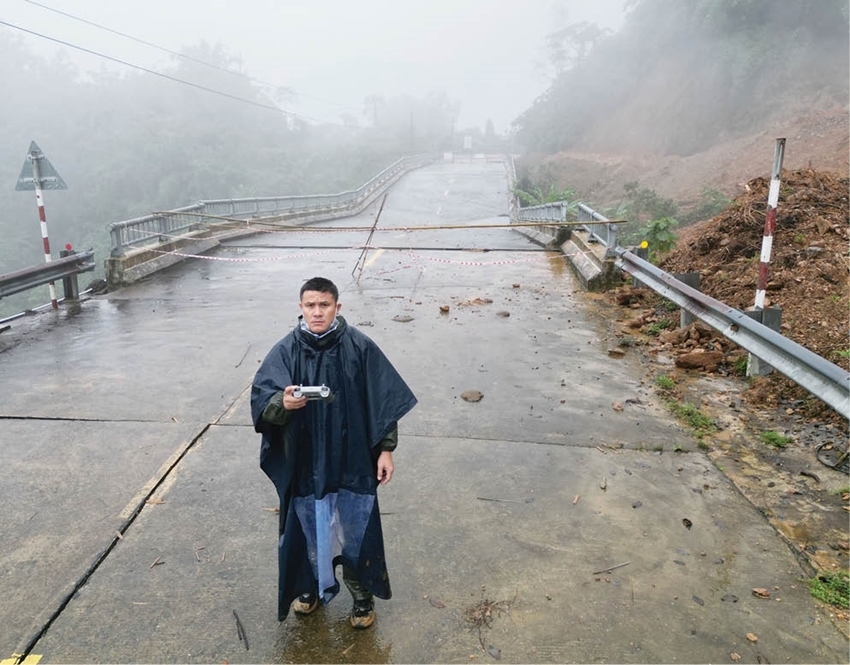 |
| Dan Tri (People's Intellectual) Newspaper reporter Vi Thao approached a bridge on the Ho Chi Minh Highway, tilted by prolonged floodwaters. Photo courtesy of the subject |
2. While Nhat Linh endured sleepless nights in the flood-control command center, Vi Van Thao, a reporter with Dan Tri Newspaper, carries memories of journeys through deeply flooded areas in search of the people behind the disaster.
During the flooding, he and his colleagues constantly traveled to disaster hotspots to report on the situation.
The prolonged rains made reporting extremely difficult. Cameras and mobile phones were sometimes dropped into the water or damaged by the relentless downpours. At times, even his own safety was not guaranteed.
Yet what remains most deeply etched in his memory are the stunned expressions of residents as their belongings were swept away, the tears of grief over lost loved ones, and the exhausted faces of people who had spent days living in floodwaters.
On the morning of November 17, 2025, after floodwaters had begun to recede in central areas, Thao decided to make his way to Sieu Quan Village on the lower reaches of the O Lau River, one of the lowest-lying areas of Hue.
At that time, the entire village remained cut off amid a sea of floodwaters. Leaving his motorbike outside, Thao spent nearly an hour wading alone through deep floodwaters to reach the village.
There, he met Nguyen Thi Huong. She said, “We have paddy at home, but we can't take it to be milled into rice because the rice mill is flooded as well.”
It was a brief remark, yet it captured the full paradox and hardship faced by people living in flood-stricken areas.
“Stories like these help the public fully grasp the devastating impact of natural disasters. And through reports filed amid the floods, bridges of compassion were extended. Thanks to the support of readers, hundreds of relief packages and many other forms of assistance were delivered to flood-affected residents in Hue,” Thao shared.
3. Journalists are not only present at the heart of disasters. They often embark on quieter, longer and equally demanding journeys. If every minute of delay at a disaster scene can make information outdated, then in investigative journalism, a hasty conclusion can distort the truth. That was precisely the experience of Nguyen Quang Tam, a reporter with Nguoi Lao Dong Newspaper.
According to reporter Quang Tam, it all began with reader complaints sent to Nguoi Lao Dong (The Labourer) Newspaper, flagging several clinics suspected of operating outside their licensed medical scope.
Most notable among them was a surgical clinic on Nguyen Sinh Cung Street in Vy Da Ward, which daily received a large number of musculoskeletal patients from Hue and neighboring provinces.
What prompted questions were word-of-mouth claims that the clinic could provide “quick cures” and that “even severe pain could be cured.” Yet after a period of treatment, many patients reported that their symptoms had returned, and some said their condition had become worse than before.
Simultaneously, the reporter continued to receive complaints about superficial medical examinations conducted at several general clinics for people applying for jobs or driver's licenses.
The topic was reported to the Editorial Board with a consistent requirement: every conclusion must be backed by evidence. Before field operations began, all operating licenses, medical scopes, and personnel records of the clinics were gathered and cross-checked against regulatory files.
“Only after we had thoroughly understood the legal framework and professional regulations did the field investigation officially begin,” Quang Tam said.
From August 2025, the reporter visited the facilities on multiple occasions, assuming different roles each time.
At one surgical clinic, the blood collection process for PRP therapy to treat musculoskeletal conditions took place right inside the examination area, sharing the same space with the administrative department. Meanwhile, a cross-check against its operating license revealed that the facility was only authorized for other medical activities and lacked approval for the aforementioned procedure.
In another line of investigation, posing as individuals seeking health certificates for driver's license applications or employment purposes, the reporter observed that many examinations were conducted very quickly, without all of the required steps, yet health certification documents were still issued.
Dozens of hours of covert filming were conducted over multiple return visits to the facilities to ensure objectivity and reduce the likelihood of the clinics altering their operations or taking countermeasures during the investigation.
After the verification process, all information and documents collected were submitted to the relevant regulatory authorities for on-site inspection.
In November 2025, the investigative series “Rapid Examinations, Instant Cures” was officially published.
Subsequent inspections confirmed that several facilities had committed violations regarding their licensed medical scope and health check-up procedures. The relevant units have been penalized in accordance with regulations.
According to Quang Tam, the greatest value of an investigative report does not lie in creating a public stir or provoking short-lived reactions. More importantly, it helps regulatory authorities identify shortcomings in practice, strengthen professional oversight and protect patients' legitimate rights and interests.
“That is also the ultimate goal of investigative journalism: to pursue the truth to the very end, but through evidence, caution and responsibility,” he shared.