



 |
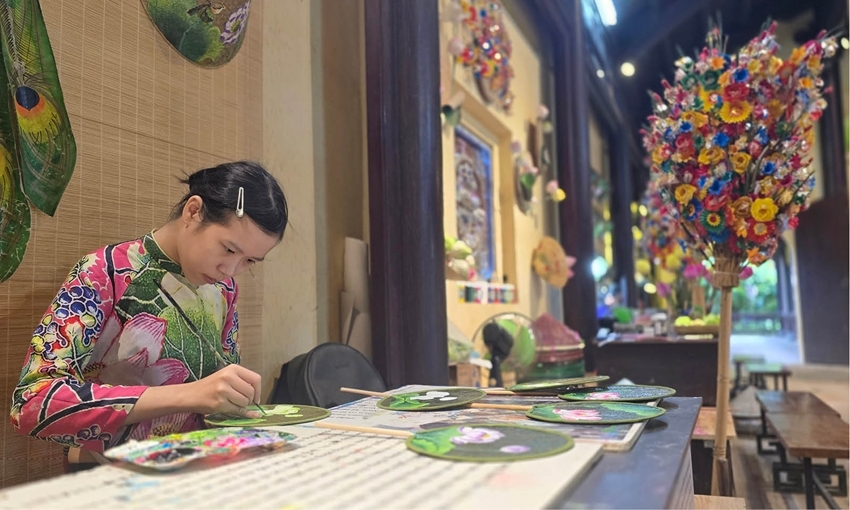
| An artisan paints lotus-leaf fans right at a heritage site |
Exclusive Products
In the past, visitors at many heritage sites could easily find generic souvenir items that lacked local identity, including mass-produced imported goods.
Today, at attractions within the Hue Imperial Citadel Complex, souvenirs inspired by imperial culture are displayed in carefully designed and cohesive spaces. Products such as jewelry boxes, trays, wooden vases, lacquerware, mother-of-pearl inlays, handcrafted gifts, lotus hats, embroidered items, ceramics, woven bamboo products, and toys for young people are all specially designed and bear the official logo of Hue Monuments Conservation Center (HMCC).
According to Mr. Le Cong Son, Deputy Director of Hue Monuments Conservation Center, the center’s goal is to remove all products lacking Hue’s cultural identity from heritage sites and replace them with exclusive items closely connected to imperial culture.
“Achieving this takes time because both our partners and we must change our mindset - from product design and manufacturing processes to the organization of service spaces. But once we move in the right direction, the results become clear. Visitors rate the service quality highly, and revenues have grown significantly,” Mr. Son said.
One of the models considered a successful pilot project is the imperial costume experience space at Huu Vu House inside the Imperial City. The center partnered with a renowned Ao-dai designer to upgrade the entire service, from costume quality to spatial design.
If the area was previously somewhat chaotic because visitors could enter freely, it has now been redesigned in an imperial style, with visitor numbers controlled through experience tickets. The space is cleaner, more culturally immersive, and the quality of the costumes has also been significantly improved.
According to the center’s leaders, this model will be expanded to other heritage sites, with the principle that each location must offer unique products to avoid duplication and create a distinct identity.
Selling for Experiences
The Hue Monuments Conservation Center is also pursuing a new approach: selling for cultural heritage experiences. Many international visitors are increasingly seeking personalized, private, and immersive experiences. Activities such as morning tea inside the Imperial City, afternoon tea in Thieu Phuong Garden, cocktails at Kien Trung Palace, royal banquets at Duyet Thi Duong Theater, or private tours of heritage sites are all being developed as premium offerings.
“Some cruise ship passengers spend only about 20 minutes enjoying cocktails on the veranda of Kien Trung Palace, and they are willing to pay tens of millions of VND for that private experience. Other groups wish to visit the Imperial City early in the morning before it opens to the public, followed by royal tea and traditional Hue pastries in Thieu Phuong Garden, with costs reaching several tens of millions of VND.” “These visitors often book services a year in advance, and the center is currently working with many international partners to bring high-end travelers to Hue,” shared Mr. Le Cong Son.
“What we aim for is not only increasing revenue for the center but also creating positive ripple effects for the local economy. When visitors stay in Hue longer and use additional services, the entire tourism ecosystem benefits,” Mr. Son emphasized.
The center’s strategy is to develop products and experiences that “cannot be found anywhere else”, namely, visitors must come to Hue to see a particular performance, purchase a specific product, or enjoy a unique cultural experience.
The Dream of a Nighttime Economy
During the April 30 and May 1 holiday period, the art program “Mystical Royal Palace” at Hue Imperial City attracted large crowds, helping create a vibrant nighttime heritage economy. However, according to Mr. Hoang Viet Trung, Director of the Hue Monuments Conservation Center, this is only the beginning of an experimental process.
“We are not focused on revenue at this early stage. Our priority is introducing the destination and gauging market response so that we can continue refining the product,” Mr. Trung explained. The center’s goal is to develop nighttime experiences that clearly reflect Hue’s identity while combining cultural depth with premium quality.
Although Duyet Thi Duong Theater is considered one of the most elegant historic theaters in Vietnam, Mr. Le Cong Son, who oversees the center’s service operations, acknowledged that its current performance has not yet met expectations.
Alongside product innovation, the center is also implementing several new service initiatives, including: Woodblock-printing experiences, traditional Hue cake-making workshops, royal cuisine experiences at the Royal Treasury Palace, opening additional commercial spaces at Thien Dinh Palace in Emperor Khai Dinh Mausoleum, and upgrading imperial-style photography services within the Imperial City.
These plans are being implemented under the center’s 2025 service innovation resolution, which aims to develop the heritage economy in a more professional, high-quality manner while preserving local cultural values.