



 |
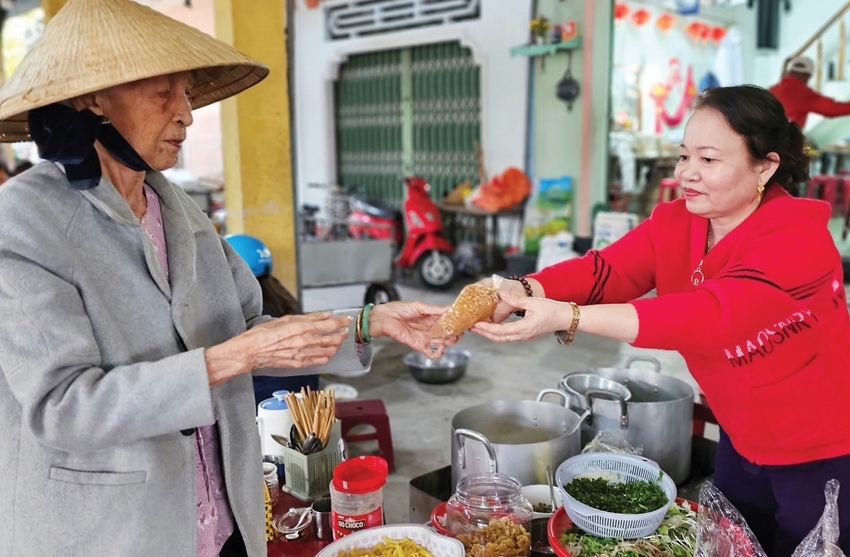
| Mrs. Nguyen Thi Nghien brought a package of homemade chili powder to pay for breakfast |
Before the sun had fully risen, Quang Xuyen Market (Phu Ho Commune) was already bustling amidst a thin mist. Baskets of agricultural products followed local women to the market, carrying the flavors of the once-renowned lagoon region.
Profit in vegetables... and affection
At 5:00 AM, Mrs. Nguyen Thi Phuong, 57 years old, and her son set up tables and chairs, lit the stove, and prepared to welcome customers. Born and raised in this land, after years of working far from home, she and her son returned to their hometown to make a living with the livelihood that once sustained their family.
After selling a few bowls of bun (noodles), Mrs. Phuong’s stall welcomed an elderly customer carrying a package of bright red chili powder, grown, ground, and sun-dried at home. It was Mrs. Nguyen Thi Nghien, a neighbor from the same hamlet.
Mrs. Nghien is 80 years old now, but she can still get around easily. Her children have moved out, some are fishers, others are farmers, so occasionally, when they have something delicious, they give it to her as a gesture of care, hoping to ease her hardships. With a package of chili powder weighing about 250 grams, she hoped to exchange it for a bowl of bun with pork and crab cake, and a bowl of banh canh (thick noodle soup). Without hesitation, Mrs. Phuong accepted the chili powder and served the food. The exchange happened as naturally as a long-standing habit.
While eating, Mrs. Nghien chatted cheerfully with others about the village, farming, and market prices. She said that she enjoyed eating at Mrs. Phuong’s stall partly because the food was of high quality, the place was clean, and partly because she could easily exchange goods.
According to Mrs. Phuong, in recent years, barter traded has become quite common in the market, especially at breakfast stalls. Her stall sells bun, crab banh canh, and com hen (mussel rice) to serve customers' needs. She personally buys pork and shrimp to make the crab cake to ensure the quality. The vegetables and produce people bring to exchange are either used to prepare dishes for the next morning, cooked for her family, sent to her daughter in the city, or given to acquaintances.
The stall owner confided: “I once fell ill and had to stay in the hospital for a long time because of unsafe food. Thinking of that, every time I cook for sale, I remind myself to choose fresh, pure ingredients, without additives. I am serving my neighbors, so quality must come first.” “People feel more secure when they see what they grew or produced appearing on the dining table; this also serves as proof of the quality of the food I sell,” affirmed Mrs. Phuong.
Beyond supporting those who want to exchange vegetables, Mrs. Phuong also supported those in difficult circumstances. For her, profit is not just measured in money. Some days, she earns little cash, yet her table is filled with vegetables, chilies, potatoes, and gourds… Her children tease her, saying she “sells for passion”, but she just smiled: “The capital is still there; the profit is vegetables and affection, that is enough!”
Give and take
Among those who often barter for breakfast, Mrs. Huynh Thi Chot is a frequent visitor to Mrs. Phuong’s stall. Mrs. Chot is 70 years old, and has been selling vegetables at the market for 8 years. Her family is in difficult circumstances, as her husband and children are often ill. Besides accepting the bartered breakfast by Mrs. Chot, Mrs. Phuong also buys extra vegetables to support her or gives her more generous portions than other customers.
 |
| Mrs. Huong exchanged a gourd for a banh canh |
In a corner of the market, Mrs. Le Thi Nho, a vegetable seller at Quang Xuyen Market, shared: “Farming is hard work; every day, I have to wake up early to harvest in time for the market. Here, I just pick a bunch of vegetables or a handful of green chilies to barter for a hot and delicious breakfast. At the end of the market session, if there are goods left, everyone proactively exchange food with each other to cook at home, reducing expenses. We save a little, and the goods get sold, it makes everyone happy.”
Nearby, the banh canh basket of 82-year-old Mrs. Nguyen Thi Huong is accustomed to this special form of exchange. Having been attached to the market for 50 years, in recent years, she has also flexibly exchanged banh canh for some poor laborers. “It is not worth much, but we share so that everyone can finish selling early,” she confided.
Quang Xuyen Market has about 70 households registered for stable business, along with dozens of street vendors selling home-grown produce. Although bartering is not the dominant form of trade, it carries its own meaning: placing people at the center and demonstrating the flexibility of rural social interactions.
In modern times, when the economy is usually measured in monetary value, direct exchange is quite useful for laborers with unstable incomes or small-scale businesses. The products used for exchange are mostly “homegrown”, and producers prioritize quality over quantity, contributing to promoting a green lifestyle and food safety. This gives Mrs. Phuong confidence in bartering. Even late in the day, people can still stop by her stall to buy fresh vegetables or gourds.
Many households, with home-grown products exceeding their consumption needs, turn their “surplus” into other households’ “necessity”, optimizing the use of agricultural products. Even without cash, some people still confidently go to the market and access food services, as Mrs. Nho shared: “Some days, we have too many ripe papayas to eat, so I bring them to the market to sell and exchange for food.”
Mr. Le Hoai, Deputy Head of the Economic Office of Phu Ho Commune, said that the former Phu Xuan area is well known for its fresh and delicious melons, gourds, sweet potatoes, and loofahs, which are highly favored by the market. Most people grow them for their families, and bring the surplus to sell at the market, ensuring quality and safety. “Paying with vegetables is not only a material exchange, but also a sharing between neighbors based on a spirit of reciprocity, creating a tight-knit bond in the community,” said Mr. Hoai.
Amidst the rhythm of modern life, where many shopping centers and large markets operate in a bustling manner, the village-style transactional ecosystem of bartering continues steadily, like a persistent flow in the lives of residents along the lagoon.