



The program drew the participation of 160 11th-grade students, along with teachers from both schools, creating a vibrant learning environment where history moved beyond dry textbook pages to become a direct and engaging experience.
According to the organizing committee, the activity was held to help students gain a deeper understanding of the content and significance of the reforms under the reign of Emperor Minh Mang, while nurturing patriotism and raising awareness of the importance of preserving and valuing the nation’s cultural heritage.
 |
| Excitedly cracking coded messages |
The program featured a series of thoughtfully designed experiential activities that combined physical movement with intellectual engagement. Notably, the game “Reviving the Nation” recreated key reform measures of Emperor Minh Mang through a sequence of interconnected challenges. Students engaged in physical activities while teamworking, solving problems, and decoding secret messages. Through these interactive tasks, they gained a clearer understanding of major administrative and governance reforms during the Nguyen Dynasty, enabling to explore history and cultural heritage more proactively and creatively.
A lively and enthusiastic atmosphere covered the program as teams worked together to overcome challenges, demonstrating strong teamwork, collaboration, and flexible thinking. Many students shared that this approach made it easier to retain knowledge compared to learning solely through classroom theory.
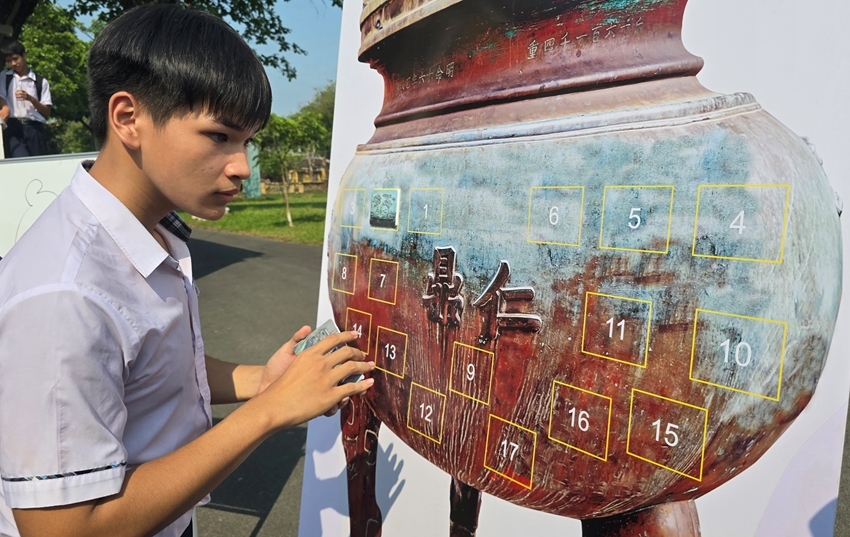 |
| Searching for puzzle pieces on the Nine Dynastic Urns during a physical challenge game |
Meanwhile, the intellectual game “Ring the Knowledge Bell - An Outstanding Reformer” presented interdisciplinary questions that required students to apply their knowledge of history, geography, and culture. Through each question, a clearer, more logical, and systematic picture of the Nguyen Dynasty and the reform efforts of Emperor Minh Mang gradually emerged.
Speaking at the program, Deputy Director of Hue Monuments Conservation Center Nguyen Phuoc Hai Trung noted that upon ascending the throne in 1820, Minh Mang faced the urgent need to consolidate the state apparatus following a period of territorial expansion. With a strategic vision, the emperor carried out comprehensive reforms across multiple sectors, most notably in administrative restructuring.
“It can be affirmed that the reform efforts under the reign of Emperor Minh Mang marked a significant milestone in Vietnamese history. Through this program, we hope the younger generation will recognize their responsibility to carry forward that spirit of innovation through creative thinking, a strong commitment to learning and self-improvement, and a genuine aspiration to contribute to the nation,” Mr. Trung said.
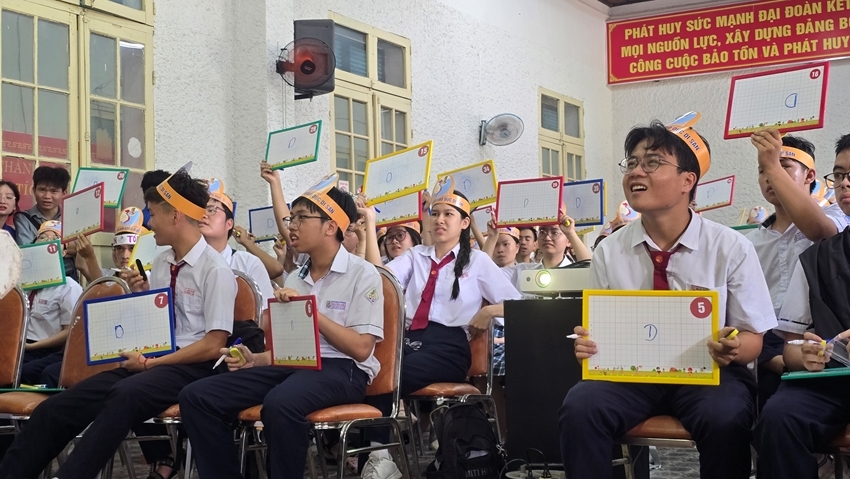 |
| A thrilling atmosphere during the “Ring the Knowledge Bell” intellectual challenge |
Emperor Minh Mang (1820-1841), the second emperor of the Nguyen Dynasty, is regarded as one of the most prominent reformers in Vietnam’s feudal history. His reforms have helped streamline the administrative system, strengthened central authority, and laid the foundation for the country’s stable development during that period.
Taking part in the program, Khanh Linh, an 11th-grade student at Hai Ba Trung High School, said she found the experience engaging and refreshing. “Learning history this way is really interesting. The reforms of Emperor Minh Mang used to be difficult to remember, but through the games, I now understand them more clearly and retain them longer. It also makes me more aware of my responsibility, as a member of the younger generation, to preserve and promote my hometown’s cultural heritage,” she shared.
With its creative approach that blends learning with playing, the program “Reforms of Emperor Minh Mang” left a strong impression on participating students, taking history closer to everyday school life.