



 |
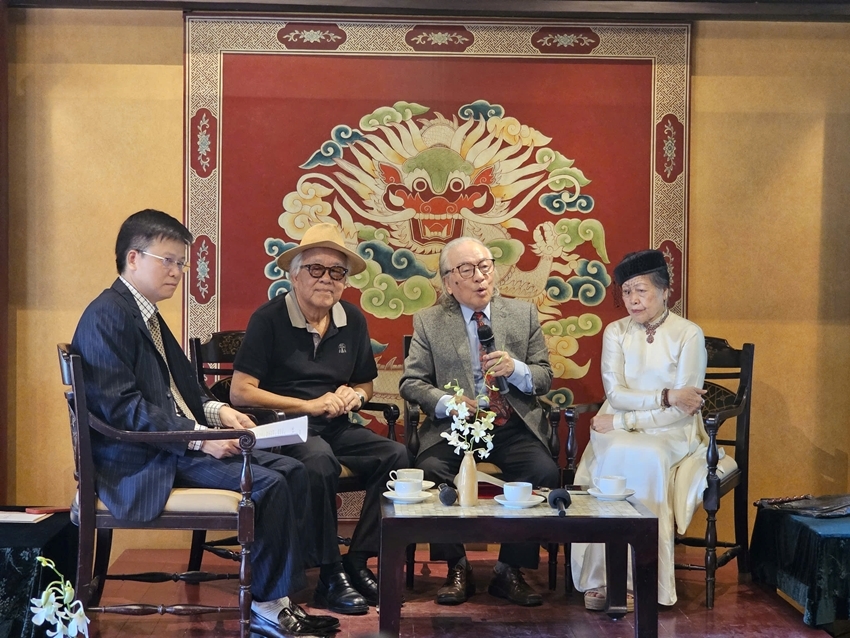
| Dr. Dinh Viet Nghia (first from the left) with friends of the late musician Trinh Cong Son at a seminar about the talented musician from Hue |
That person is Dr. Dinh Viet Nghia, currently working at the 108 Military Central Hospital (Hanoi). On a visit to Hue to attend a seminar on Trinh’s music, the doctor shared many interesting perspectives of his own. “It is somewhat related to my profession, and through it I can see the incredibly delicate perception the late musician had about eyes,” Dr. Nghia said.
Explaining the imagery of eyes through songs written in Trinh’s attic, Dr. Nghia first mentions the song Diem Xua, written in 1960. At that time, the young Trinh Cong Son stood in his attic, gazing intently at the figure of his muse (female student Ngo Vu Bich Diem) walking farther away each day along a street lined with camphor trees in the drifting autumn rain. As he continued to watch her silhouette, he felt his eyes growing deeper:
“Listening to autumn leaves and rain wearing down small footsteps / The long road stretches endlessly, making the eyes grow deeper.”
In this context, according to Dr. Nghia, the eyes are a beautiful and symbolic image, gently yet clearly expressing deep emotions mixed with sadness and longing. It is common for lovestruck young men to gaze endlessly at the one they love regardless of season or weather, but few recognize that their eyes themselves become “deeper” as described in the lyrics.
“It must be said that observing so intently that the eyes seem to deepen is a surprising discovery in its subtlety, not only artistically beautiful but also biologically accurate. Indeed, when focusing for a long time on a distant point, the eyes appear deeper. However, no one seems to have described this before, nor has there been scientific literature explaining the mechanism of this interesting phenomenon,” Dr. Nghia noted.
 |
| Musician Trinh Cong Son. Photo: Duong Minh Long |
After leaving Trinh’s attic and Hue, the talented musician continued to write many songs with fascinating lines about eyes. For example, Nhung Con Mat Tran Gian reflects all aspects of human life, from the eyes of lovers to those of the unfaithful, from eyes of hatred to “green eyes like young grass / green like the fruits of paradise,” from passion to silence... but above all, it seeks to “restore a bright faith.”
Then: “Bow down / Look deeply into the eyes / And hear the storms dissolve into the ocean” (Cui Xuong That Gan), or “Two eyes remaining, one to cry for a person” (Con Mat Con Lai, inspired by Bui Giang’s poetry) ... all very intriguing.
Especially in Nang Thuy Tinh, the eyes of a young girl are vividly portrayed: “Is it the color of sunlight or the color of your eyes?”, “The afternoon has entered the garden of your eyes…” The eyes of a young woman appear vibrant, radiant like sunlight, as if transmitting life to the world.
Not stopping there, Trinh Cong Son also wrote many songs expressing sadness through eyes, such as Uot Mi with the lines: “Sadness rises to the lips / Pain moistens someone’s eyelashes,” or “A mother lulls her child with weary tears, grieving her life” (Ca Dao Me), and “One morning has come / Stopping in the town / The mother hugs a pumpkin / Her eyes still bewildered” (Ba Me O Ly).
“I am particularly impressed with the line ‘Clouds descend to surround a drop of sorrow’ in Con Tuoi Nao Cho Em, which Trinh Cong Son wrote in 1964 for Dao Anh. Tears when one cries in sadness seem opaquer, as if covered by clouds, no longer clear and sparkling,” Dr. Nghia shared.
According to the doctor, Trinh Cong Son is one of the rare artists who described phenomena accurately, while science only came later to explain why they are correct. What is interesting and rare here is that poetry and science meet, enriching each other and making life more meaningful.
“Perhaps due to his severe near-sightedness, Trinh Cong Son did not have very good vision, yet he perceived extremely subtle details that even people with good eyesight might miss. He observed life and ‘the eyes of the world’ with great delicacy. He achieved what is essential for an artist: creating a unique identity, leaving a deep impression on audiences, and helping art blend with science, making life better, more meaningful, and more interesting,” Dr. Nghia concluded.