



The night-time economy is not simply about keeping a few additional services open after 10 p.m. At its core, it involves creating a sufficiently compelling ecosystem of experiences to extend visitors’ length of stay, increase tourism spending, generate more jobs, and bring renewed vitality to the urban environment. For Hue, this development must follow a more refined path and cannot pursue noisy or disorderly models. What Hue needs are night-time experiences with depth - where visitors can encounter “another Hue”: still contemplative, but not static; still gentle, yet not monotonous.
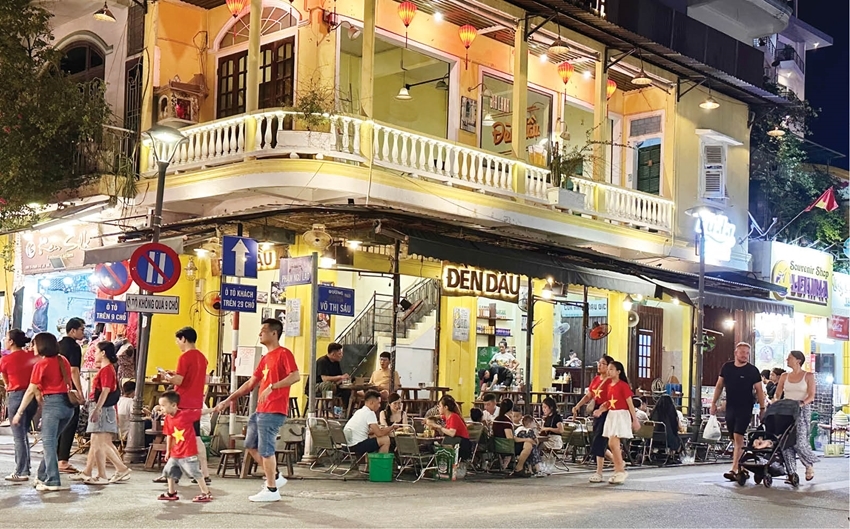 |
| Western quarter at night (illustrative photo). Photo: Bao Phuoc |
Advantages for creating distinctive night-time products
Among the spaces that could form nighttime highlights, the Imperial Palace - Hue Citadel stands out as an option that is both well-grounded, aligned with the city’s identity, and capable of generating a breakthrough. The imperial citadel is not only a 36-hectare architectural complex with clearly defined zones, but also the symbolic “heart” of the Ancient Capital. If developed in a methodical and cautious manner, it can fully become a “living museum” at night.
From Ngo Mon Gate to Thai Hoa Palace - the center of the royal court area - activities could be organized to reenact court rituals such as the changing of the guard, grand court assemblies, and ceremonies to receive envoys... With appropriate lighting, restrained sound design, measured narration, and a well-trained team of artisans and performers, visitors could experience the solemn and majestic atmosphere of the imperial court.
On both sides of the court area is a system of important ancestral temples, including Thai Mieu - Trieu Mieu and The Mieu - Hung Mieu. These are particularly suitable spaces for nighttime cultural and spiritual experiences. Hue has long been a land of rituals and cultural depth, so creating gentle yet meaningful night time experiences in these areas is not only feasible but highly appropriate.
Deeper inside the inner palace, the Dien Tho Residence and Truong Sanh Palace areas could be developed to recreate aspects of royal daily life: the life of the Dowager, family customs within the palace, and thematic exhibitions combined with subtle interpretation.
Within the Forbidden City, particularly at Kien Trung Palace - a symbol of the final period of the Nguyen Dynasty - stories could be told about the everyday life of the last emperor and a dynasty navigating a turbulent historical transition. At night, historical narratives tend to resonate more deeply, and it is precisely this emotional engagement that creates a distinctive experience.
Spaces such as Nhat Thanh Pavilion, Thai Binh Pavilion, Thieu Phuong Garden, and Ngoc Dich Lake… offer opportunities for more tranquil activities such as strolling, reading, tea appreciation, and light dining. This, too, reflects the “Hue character”: refined, unhurried, gentle, yet leaving a lasting impression.
Notably, Duyet Thi Duong Theater could become a focal point with performances of royal court music, dance, and classical opera, combined with the introduction of Hue’s imperial cuisine. A well-designed sequence of cultural, artistic, and culinary experiences would create high-value nighttime products, contributing to increased tourism spending while maintaining luxury and civilities.
For the nighttime economy within the Imperial Palace to operate effectively, a key condition is the coordinated opening of all four gates: Ngo Mon, Hien Nhon, Chuong Duc, and Hoa Binh; along with the organization of visitor routes in sequences to avoid congestion at a single point.
Extending to surrounding areas of the Imperial City and the north Bank of the Perfume River
The night-time economy within the Imperial Citadel would become even more appealing if it were connected with the surrounding areas of the Imperial Citadel, particularly along its Western – Northern - Eastern sides. In these areas, efforts should be made to encourage the renovation of houses in the style of traditional townhouses and ruong houses; to organize lantern displays and artistic lighting; and to promote the sale of OCOP products, Hue specialties, and distinctive local cuisine.
When residents become direct participants, the benefits for livelihoods will become more evident. A heritage city not only is beautiful in its monuments but must also be beautiful in its community life, especially at night.
On the northern bank of the Perfume River, from Thuong Bac Park to Dong Ba Market, extending to the Gia Hoi - Dinh Market old quarter, there is strong potential to develop night-time tourism and service activities based on existing advantages. Dong Ba Market - the largest commercial hub in Hue could serve as an “wharf-and-boat” connection point for visitors. Meanwhile, activities such as listening to Hue folk singing on the Huong River and waterway tourism linking the Perfume River - Ngu Ha - and Dong Ba would create distinctive experiences for “Hue at night”.
In need of a dedicated mechanism
For these ideas to move beyond conceptualization, intersectoral coordination is crucial. The tourism sector should take the lead in product development, operations, and promotion. The culture and sports sector plays a “gatekeeping” role in safeguarding values, ensuring that development aligns with Hue’s cultural spirit and does not harm its heritage. Hue Monuments Conservation Center should proactively develop detailed plans for nighttime operations, piloting them by zone and by product on a scientific and sustainable basis.
In terms of policy, Hue should boldly introduce a dedicated framework for developing a heritage-linked night-time economy: allowing controlled pilot openings of heritage sites at night; commissioning public services for traditional art performances in the initial phase; and allocating seed funding to attract businesses to invest in and operate such activities. At the same time, clear coordination mechanisms must be established to avoid overlaps in responsibilities among heritage management, event organization, and service operations.
Ultimately, developing the night-time economy is not about making Hue “stay up later,” but about enabling Hue to “tell its story for longer” through cultural experiences, beautiful spaces, refined services, and a civilized approach.
Nighttime utilization of the Imperial Palace - Hue Citadel, if implemented methodically, will not only create distinctive tourism products but also help reposition Hue’s image: an Ancient Capital that is contemplative yet not static; a heritage city capable of renewal without losing its identity; and a destination that can engage visitors throughout both day and night.