



Credit growth remains positive
In 2025, the State Bank Region 9 completed the restructuring of its organizational apparatus and began operating under a new structure in line with the policy of administrative reorganization and consolidation. The merger and integration of State Bank branches in five provinces and cities were finalized, enabling State Bank Region 9 to operate safely and effectively. Regarding the network of credit institutions, the city currently has 29 first-tier branches, 100 transaction offices and seven people’s credit funds. In the first two months of the year, total mobilized capital at credit institutions in the area reached VND 92,262 billion, up 0.88 percent compared with the end of 2025.
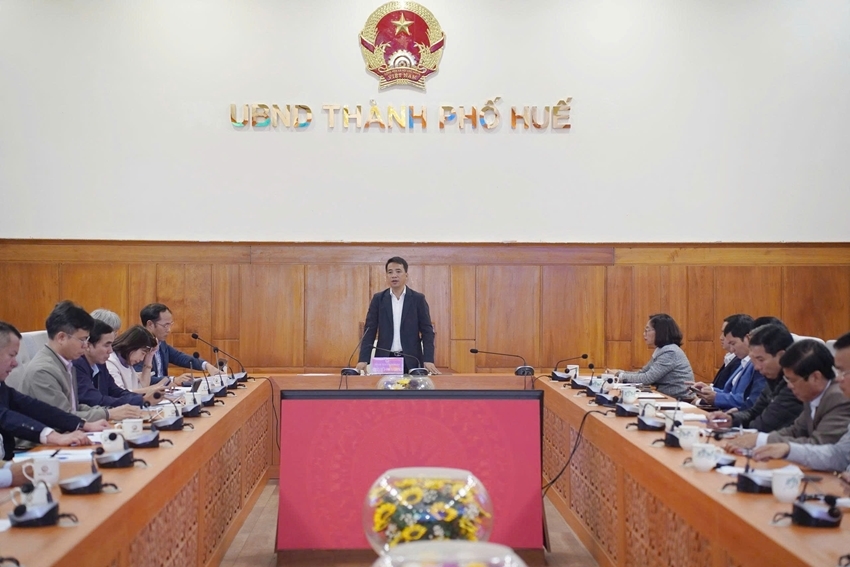 |
| Vice Chairman of the City People’s Committee Tran Huu Thuy Giang speaking at the meeting |
Credit institutions in the city have expanded lending in a safe and effective manner, directing capital flows toward production and business activities and priority sectors. By the end of February 2026, total outstanding credit in the area reached VND 97,645 billion, up 1.92 percent compared with the end of 2025. Credit growth was recorded across the three key sectors. Lending to agriculture, forestry and fisheries was estimated at VND 6,000 billion, up 10.1 percent compared with the end of 2025; credit to industry and construction reached about VND 25,700 billion, up 1.65 percent; and credit to trade and services totaled VND 65,800 billion, up 1.13 percent.
Credit institutions have also prioritized lending to sectors encouraged by the Government. By the end of February 2026, credit for agriculture and rural development reached about VND 18,400 billion, up 2.42 percent; lending to small and medium-sized enterprises totaled VND 17,500 billion, up 1.56 percent; export credit reached VND 6,000 billion, up 4.11 percent; while loans for supporting industries were estimated at VND 1,600 billion, down 4.4 percent compared with the end of 2025.
 |
| Pham Ba Nam, Deputy Director of the State Bank Region 9, shares related insights |
The City Social Policy Bank has also implemented 24 policy credit programs targeting poor households and other policy beneficiaries. By the end of February, total outstanding loans under these programs reached VND 5,975 billion, an increase of 5.2 percent compared with the beginning of the year.
Pham Ba Nam, Deputy Director of State Bank Region 9, noted that credit institutions in the city have actively deployed measures to meet the economy’s demand for credit capital, particularly for economic activities and consumer demand toward the year-end and the Lunar New Year of Binh Ngo 2026. Credit flows have been directed toward production and business sectors, priority areas and key growth drivers in accordance with the Prime Minister’s directives, while credit to high-risk sectors, especially real estate, has been strictly controlled.
Removing obstacles in capital flow
At the meeting, credit institutions shared several operational challenges. Participants highlighted limited access to information on projects and investors entering the city. Although the non-performing loan ratio remains within a safe range, debt recovery and the handling of bad debts continue to face difficulties. Certain administrative procedures were also reported to be affecting the operations of credit institutions in the area.
Speaking at the meeting, Vice Chairman of the City People’s Committee Tran Huu Thuy Giang emphasized that the banking system serves as one of the key channels supplying capital to the economy. In the current context, ensuring smooth credit flows and directing capital to the right sectors, particularly priority industries and key development projects, is critically important, especially as the city aims for double-digit growth and seeks to build a solid foundation for Hue’s sustainable development in 2026 and beyond.
 |
| Staff of the Social Policy Bank survey residents’ actual demand for loans |
The Vice Chairman acknowledged the contributions of banks operating in the city, particularly their role in social welfare programs and in channeling capital into priority sectors and key economic growth drivers. He also called on departments, agencies and local authorities to strengthen coordination with the banking system to promptly resolve obstacles arising in the process of capital transfer. This would help create favorable conditions for credit institutions to accelerate capital flows into production, business activities, priority sectors and projects with strong spillover effects for the economy. At the same time, banks were encouraged to continue supporting enterprises and residents in accessing capital, improving credit quality and controlling risks, while accompanying the city in promoting sustainable economic growth.
City leaders also affirmed their commitment to working closely with credit institutions to address related difficulties and improve the investment and business environment. This will enable credit institutions to fully perform their role as financial channels for the economy while contributing to the city’s overall economic development.