



 |
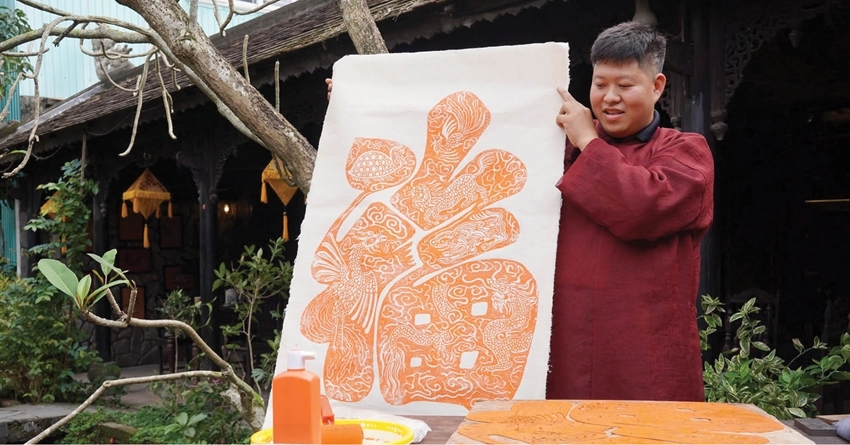
| Demonstration of printing traditional decorative scrolls at the launch of the project “Reviving the Craft of Making Chuon Village Scrolls”. Photo: Bach Chau |
A fateful connection
Recently, at forums on culture and heritage in Hue, there has appeared a young modest man of small figure, who observed and absorbed in silence any valuable information possible about the heritage. That humble young man is Ngo Quy Duc, aged 40, from Hanoi, currently the founder of the Ngu Ha Vien project.
Ngo Quy Duc is also the founder of “Phuong Bach Nghe,” a cultural space in Hanoi, which has just been recognized by Hanoi Bureau of Culture and Sports as a “Member of the Creative Cultural Space Network” of the capital city.
Originally Ngo Quy Duc is an engineer in IT. But with his passion for heritage, he has been spending nearly two decades traveling extensively to various traditional craft villages across the country.
In early 2025, he arrived in Hue on his journey guided by his passion for heritage and found “Ngu Ha Vien,” a complex of ancient nha ruong (beam houses) at 181 Xuan 68 Str., Phu Xuan Ward, Hue City, built by late artisan Duong Dinh Vinh, a researcher and collector of ancient beam houses in Hue.
The tranquil atmosphere in here evokes the refined beauty of the royal gardens of the Nguyen Dynasty, and its name reminds of the Ngu Ha river, an essential part of the soul of the Imperial City of Hue. “Ngu Ha Vien” fell into oblivion after Duong Dinh Vinh passed away in 2020. With his deep devotion to cultural heritage, Duc convinced Vinh’s family to lease Ngu Ha Vien to him. Since then, the space has been revived to continue the flow of culture and heritage.
In Hue, Quy Duc traveled to different villages to learn about them. He happened to drop by Chuon Village (i.e. An Truyen Village, Phu An Commune, Phu Vang District, now My Thuong Ward, Hue City). There he learned the sad news that the last artisan of the Chuon village scroll, artisan Huynh Ly, had passed away more than 15 years before, bringing with him the craft. No one in his family continues the career.
“Everyone knows the ancient imperial capital once boasted three renowned crafts of folk paintings: Sinh village paintings, Chuon village decorative scrolls, and Tay Ho village paintings. But time and the harsh historical turns have caused the Tay Ho village painting, once so brilliant, to vanish completely. Chuon village decorative scrolls have suffered the similar destiny since the last artisan passed away. Only the Sinh village painting luckily remains. But that is fragile too,” said Ngo Quy Duc.
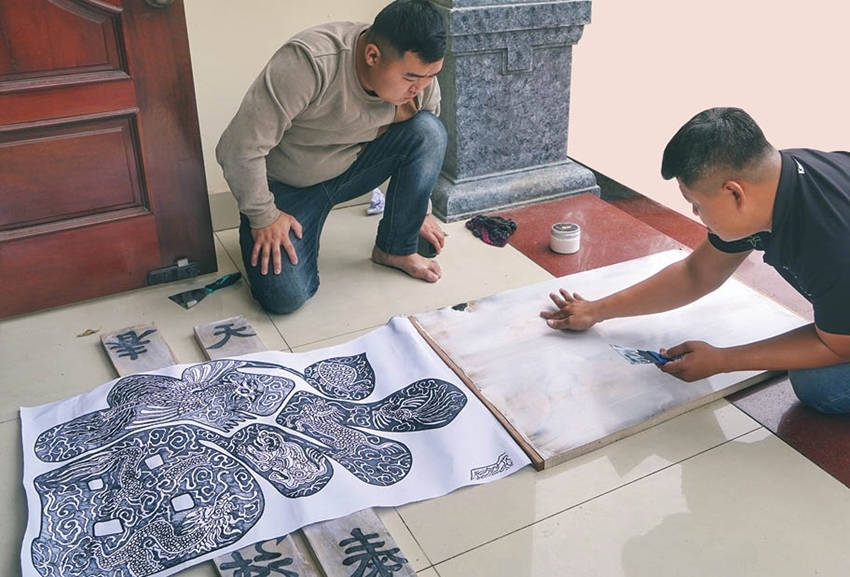 |
| Young artisan Nguyen Cong Dat (right) and his colleagues are working on a woodblock for the Chuon village scroll. The first set of scrolls are restored during the Lunar New Year of Binh Ngo. Photo: Duc Quy |
Piecing together “fragments of memory”
Regretting the disappearance of the Chuon village scroll, Ngo Quy Duc embarked on researching it. From “fragments of the past” and collected materials, he launched a project to revive the Chuon village scrolls.
Many times we visited Ky Huu Phuoc, the last “fire keepers” of the Sinh village painting. Sitting at the porch watching his bony hands carefully coloring, and listening to his stories about the time when he had to hide his woodblocks underground to avoid bombs during wartime, and to protect them from being forgotten with time, we came to understand the true cost of “keeping the craft.”
“It seems that our predecessors, who founded this kind of painting and scrolls, are still watching over their descendants. Valuable information and materials, and photos, which had been preserved and hidden among the people for so many years, suddenly found their way to us at the most important moments. Thanks to that “sacred guidance,” we were able to access the lost “fragments of soul,” and grasp the golden key to reopen the door to the treasure of heritage that once seemed permanently closed. That is our luck, but also a mission entrusted to us by founding masters,” recalled Ngo Quy Duc.
From documentary photos of the Sinh village scroll, Ngo Quy Duc pieced together “memories” and successfully developed a process to restore the precious Chuon village scroll. “Specifically, to make a set for the Lunar New Year as in the past, we first needed to remake the woodblocks. Next, we must find the traditional “do” paper used for printing, and rediscovered the method of making the traditional “so diep” pigment still preserved at such craft villages as Sinh, Tay Ho and Hang Trong. If we can restore the woodblock, have the right paper and colors, then we can bring the Chuon village scroll back to life,” said Ngo Quy Duc.
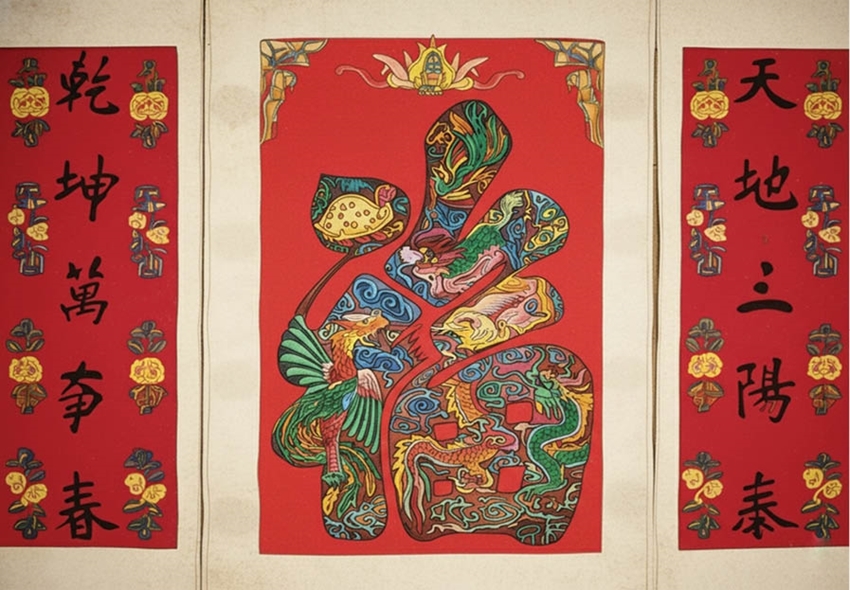 |
| Finishing the woodblocks for the Chuon village scroll, and the first set was revived right on Binh Ngo Lunar New Year. Photo: Duc Quy |
Gathering the quintessential parts of the people
Since the last original set of woodblocks belonging to Mr. Huynh Ly’s family no longer exists, Ngo Quy Duc went to northern Vietnam to meet artisans from Thanh Lieu (formerly Hai Duong Province, now part of Hai Phong City), a craft village which is nearly 600 years old, to collaborate on restoring the woodblock for the first parallel sentence set. Artisans from Thanh Lieu Village are those who had made well-known woodblock sets such as the Nguyen Dynasty woodblocks, the woodblocks at Vinh Nghiem Pagoda, and those at Phuc Giang School, all of which have been recognized by UNESCO as documentary heritage under the Memory of the World Program.
At the Thanh Lieu woodblock craft village, Quy Duc collaborated with Nguyen Cong Dat, the 17th-generation descendant of the craft lineage, to research and to restore woodblocks. After a long time looking for suitable timber, the most important well-carved woodblock bearing the character “Phuc” (“Happiness”) decorated with the four sacred creatures, dragon, unicorn, turtle and phoenix, was completed to the great joy of the whole team.
Then, on December 18th, the dual woodblocks of the parallel couplet “Thien dia tam duong thai. Can khon van su xuan” were finished, sharp, strong but soft on gold apple wood. This is the result of days of hard work by artisans in Thanh Lieu, transforming written calligraphy on paper into vivid printing woodblocks. Displaying this couplet at home during Tet conveys wishes for a new year in which “heaven and earth meet in peace and prosperity; everything full of vitality flourishes”.
“This is the first set of Chuon village scrolls which is revived right on the occasion of Binh Ngo Lunar New Year. In the coming time, we will restore such other sets as Loc (Prosperity), Tho (Longevity), Duc (Virtue), basing on the documents that we have collected. They are symbolic of wish for good things at the New Year,” said Ngo Quy Duc.