



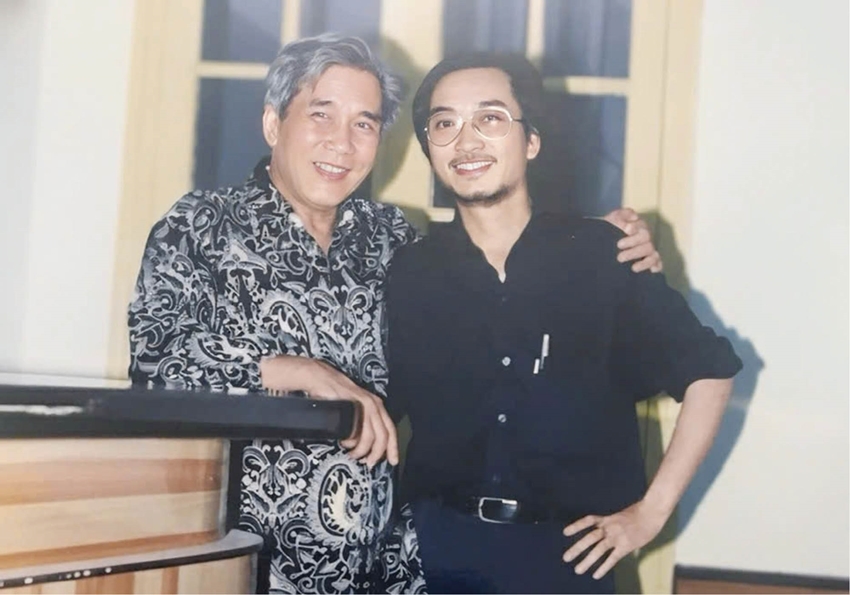
 |
| Tran Hoan (left) and Nguyen Viet (photo taken in 2000) |
Poetry and music
In his musical career, Tran Hoan successfully set many poems to music, including such well-known songs as “Mot mua xuan nho” (“A Little Spring”) with lyrics by poet Thanh Hai, “Loi ru tren nuong” (“Lullaby on the Ranch”), lyrics by poet Nguyen Khoa Diem, Giua Mac Tu Khoa nghe cau ho Nghe Tinh (“In Moscow Listening to Nghe Tinh chants”), lyrics by poet Do Quy Doan, and his song “Tinh ca mua xuan.”
Nguyen Loan was born in Nghe An. He was a policeman who had served as a guard at Hien Luong Bridge during the war years. In 1975, he was discharged and chose Hue to be his second hometown. The poem “Spring Love Song” was composed in October 1978 in Hue with the feeling of a soldier upon hearing bad news at the boundary. An even greater joy came to Nguyen Loan on the days of Tet of Ky Mui when poet Van Loi - then in charge of the Binh Tri Thien Culture Magazine - told him: “Tran Hoan really likes your poem ‘Spring Love Song’ published on the Tet issue, and he says he has already finished setting it to music.”
With its sweet, profound, and memorable melody and lyrics, “Spring Love Song” quickly won the hearts of many listeners. According to Nguyen Loan, not long after it was first performed on Hue Television, the song was broadcast on the Voice of Vietnam Radio, sung by the famous duet Kieu Hung and Thu Hien. In Hue “Spring Love Song” was also performed at music festivals and in outdoor concerts at Thuong Bac Park by Mong Thu and Trong Tin or Nhat Sinh and Bich Nga.
Musician Nguyen Viet and music lecturer Pham Thi Bich Nga still well remember the image of Tran Hoan on his bicycle to their home to show off his newly written song. “It was on a chilly day in early 1979. We husband and wife were cooking dinner when we heard Tran Hoan calling from outside. In his hand was a notebook containing the song “Spring Love Song.” I immediately picked up my accordion to accompany Nga singing the brand-new song. Though it was a new song, its melody sounded very familiar. In that small apartment at Dong Da Apartment Building, the song “Spring Love Song” was sung for the very first time - warm and sweet, as if spring itself were returning with the melody and lyrics,” recalled Nguyen Viet.
“Listening to his new song, Hoan was very happy. He asked for my comment. I suggested that he change “Dat cua minh sinh soi” into “Dat chuyen minh sinh soi” so that it would be easier for singers to sing. He nodded in agreement and made the correction. However later singers sang either way,” added Nguyen Viet.
According to Nguyen Viet, Tran Hoan composed the song in A minor. In the second section, i.e. the refrain, he modulated to A major, which makes the song brightened, symbolizing the vitality of spring, of young lovers, and of the dedication to the fight against invaders and to nation building. Most importantly, Tran Hoan, by skillfully combining music and poetry, created a beautiful melody.
As for music lecturer Pham Thi Bich Nga, she has many memories of Tran Hoan because whenever he had a new song, he often stopped by her home and asked her to sing it to see if any part needed improvement. “Spring Love Song” remains her most unforgettable memory. “I’m very happy to be the first person to sing “Spring Love Song” and to see the joy in the eyes and the smile of the musician I admired. The melody of the song brought the atmosphere of Tet to my family then,” recalled Bich Nga.
“The song of my youth in Hue”
Tran Hoan’s real name is Nguyen Tang Hich, a native of Quang Tri. He was born in Tam Ky, but Hue is the place he was most deeply attached to, first as a student at Quoc Hoc High School, and later as a leader in the field of culture of Binh Tri Thien Province. “Hue is always present in every of his songs. His Hue-themed songs are always full of affection, trust, and optimism, especially the song which he composed during the time when he lived and worked in Hue. Those songs are also closely tied to my youth,” said Dr. Nguyen Thi Hong Ha, his daughter.
During the war years, my father worked in the Tri Thien battlefield. Our family at that time lived in Hai Phong and never received any letters from him. Only when we heard a new song of his on the Voice of Vietnam Radio did my mother and we children know that he was still alive. After the war, the whole family moved to Hue to live and to study. Although our life then was difficult just like other people’s, my father remained optimistic with his songs. Every time he finished a new song, he grasped his guitar or mandolin to play for his children to sing along. He looked younger at those moments. No matter how stressful his work at the office was, at home he always appeared cheerful and optimistic with his guitar and his songs. It was music that kept his life in balance,” recalled Ha.
Tran Hoan employed all the nine stanzas of the poem. He only changed just a few words in the original poem. For example, he changed “Có màu xanh cánh lúa” into “Có màu xanh khoai sắn,” or “Đôi bàn tay em múa. Có lời dòng kênh xanh” into “Trong bàn tay xinh xắn. Có hình dòng kênh xa.”
“At that time, our country’s going through an extremely difficult period of time after the war. Probably my father changed the poem a little bit to suit the reality. I still remember in those years, we students had to go planting cassava in Binh Dien, Nam Dong, and pepper in Tan Lam, then worked on irrigation projects in Nam Song Huong and Nam Thach Han. Now some singers changed “khoai san” (“cassava and sweet potato”) into “mo uoc” (“dream”) when singing. I don’t agree with that because it makes the song lose its historical value,” said Nguyen Thi Hong Ha about that interesting detail.
Perhaps to many people living through those hard years of the country, every time the melody of “Spring Love Song” is heard, they recall their old Tet vacations, modest but warm.