



 |
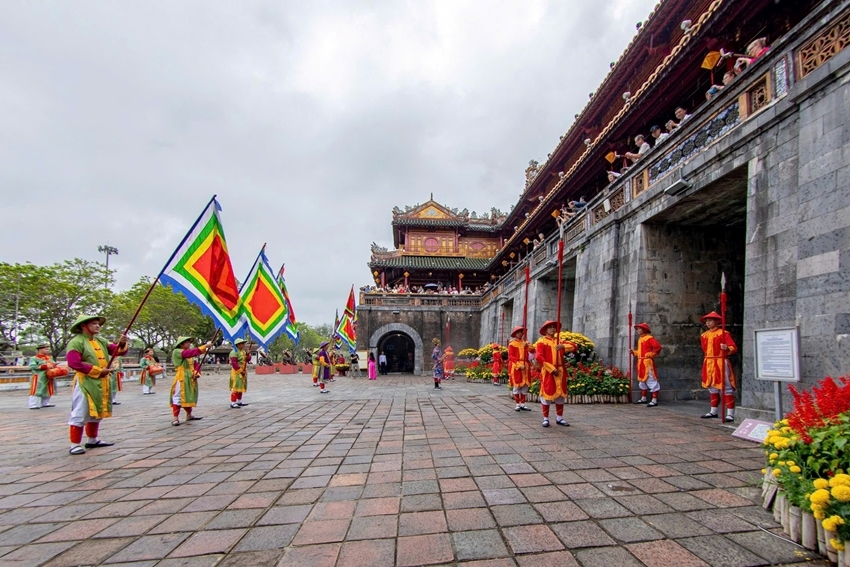
| The Guard-Changing Ceremony at Ngo Mon Gate. Photo: Xuan Dat |
In the gentle spring weather, Hue Imperial Citadel came alive early in the day. In front of Ngo Mon Gate, the sound of drums and ceremonial music marked the opening of the guard-changing ritual - a court ceremony solemnly reenacted.
Many visitors watched attentively, delightedly taking photos and checking in. The ancient setting seemed to awaken to the rhythm of the past, evoking the discipline and order of the former royal court. Immediately afterward, the firing of the royal cannons echoed through the space, creating an impressive highlight for the first day of the Lunar New Year.
Along the main pathways inside the Imperial Citadel, families and young visitors strolled leisurely, capturing moments of early spring.
Nguyen Thi Thu Ha, a visitor from Hanoi, shared that although she has visited Hue many times, this was her first time celebrating Tet at the Imperial Citadel. “The atmosphere here is very different, both solemn and peaceful. Watching the guard-changing ceremony, listening to royal court music, and joining court games with my family made me feel as if I were living in the Tet of the past. It’s a very special memory,” she said.
Hue Imperial Citadel also offers visitors many engaging interactive experiences. Behind Thai Hoa Palace, traditional court games once popular in the royal court are reenacted, attracting large numbers of participants.
In one corner, young visitors test their skills with “dau ho”, throwing small arrows into a vase, a game requiring dexterity and concentration. Nearby, the game of “do xam huong” creates an excited atmosphere, as each roll of the dice bestows titles such as “Trang Nguyen”, “Bang Nhan” or “Tham Hoa” - symbolic wishes for good fortune at the start of the year.
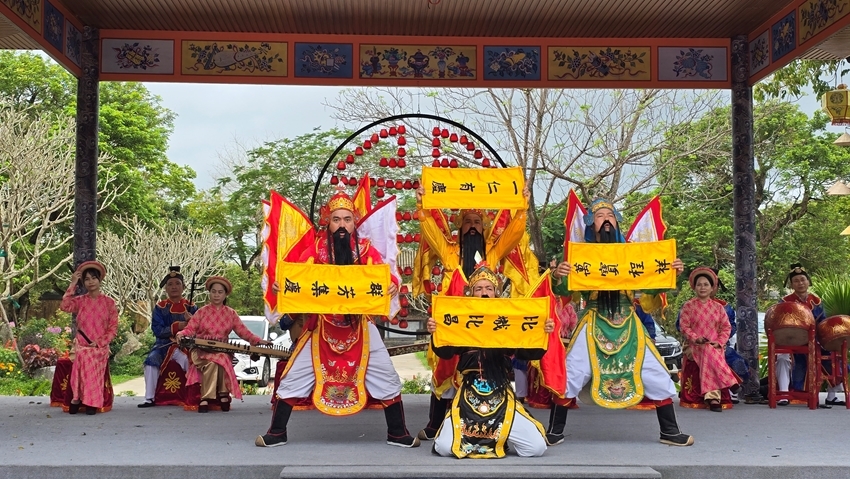 |
| The royal court dance “Trinh tuong tap khanh” performed by artists of the Hue Royal Traditional Arts Theatre at the Treasury Palace |
Alongside these activities are continuous performances of “Nha nhac”, “dai nhac”, “tieu nhac” and combined traditional arts throughout the day. The majestic sounds of grand court music, the profound melodies of “Nha nhac” (light court music), and the echoes of instruments and vocals resonate through the heritage space.
According to Nguyen Phuoc Hai Trung, Deputy Director of Hue Monuments Conservation Center, restoring royal Tet rituals and activities is not only to serve visitors but also to preserve and spread traditional cultural values.
Mr. Trung explained that during the Nguyen Dynasty, preparations for Tet began very early, starting with the “Ban Lich” ceremony on the first day of the twelfth lunar month, when the royal court distributed new calendars to localities, signaling the approach of a new year. This was followed by the “Hop Huong” ceremony, inviting former emperors to “celebrate Tet” with the court, and the “Phong An” ritual, which marked the temporary suspension of court affairs for the Tet holiday.
“We hope that through the restoration of rituals, court games and traditional music performances, the public can gain a deeper understanding of royal life in the past. Heritage is not merely silent architecture, but living cultural values that can be interacted with and felt,” Mr. Trung shared.
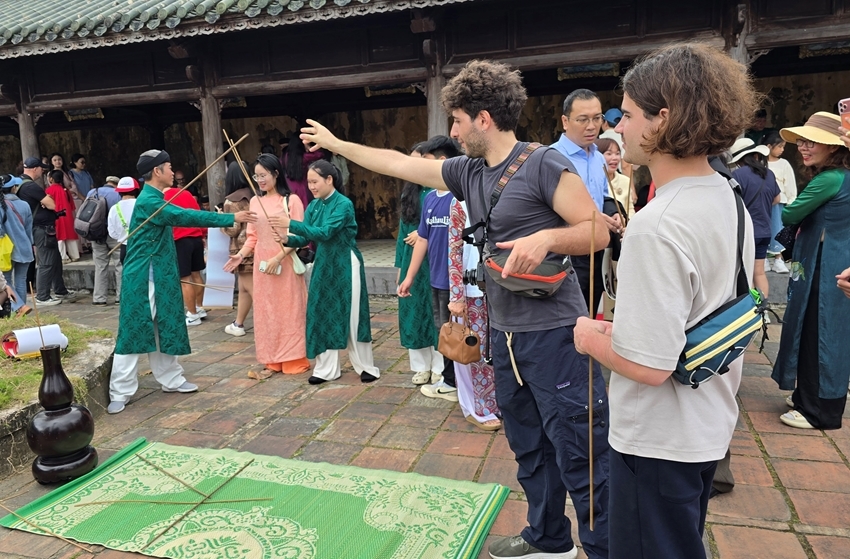 |
| Visitors enthusiastically experiencing the game of “dau ho” |
Mr. Trung also noted that incorporating experiential activities into heritage sites, especially during Tet, helps connect heritage with the public, particularly younger generations. This allows them to engage with heritage more closely, fostering affection and a sense of responsibility for its preservation.
Among the spring crowds, many families can be seen bringing young children to the Imperial Citadel. The children delighted in watching performances and trying traditional games. Notably, despite its royal character, Tet in the Nguyen royal court shares many similarities with folk Tet traditions - the temporary pause from work, rituals honoring ancestors, and wishes for a peaceful and prosperous new year.
Today, these rituals are restored and reenacted on special occasions, serving as a bridge between the past and the present.
Amid modern life, when Tet can sometimes be swept up in busyness, returning to the Hue Imperial Citadel, listening to drums and music and taking part in traditional games, helps many people rediscover a more complete and meaningful sense of Tet.