



 |
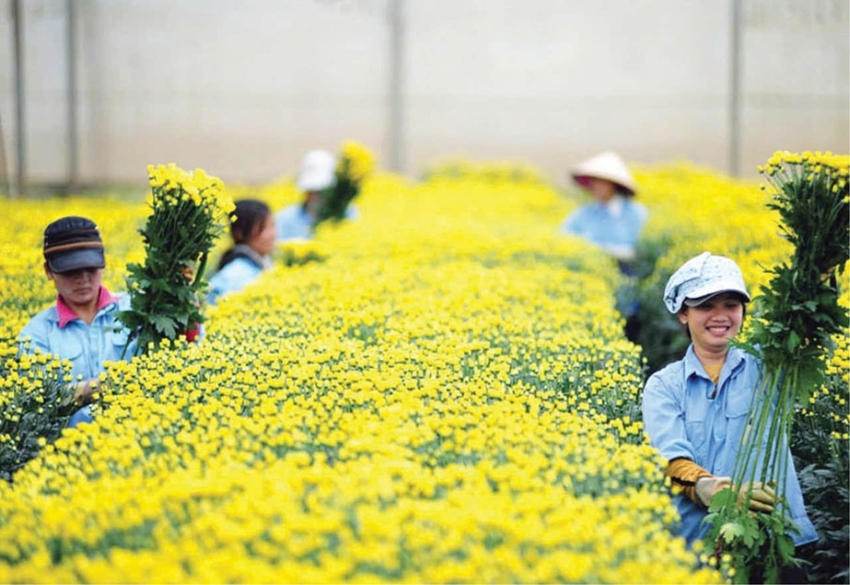
| Farmers in Thai Phien flower village selecting flowers for the Tet market |
Nearly a century ago, Hue people undertook arduous journeys across mountains and rivers to settle on the misty highlands. They carried deep longing and countless worries as they sought livelihoods in a distant land thousands of miles from their ancestral home. In those early days, they had to build houses, secure food and clothing, and ensure their children were raised and educated. More than anything, they feared that their descendants might one day lose touch with their roots. So they held tightly to one another, preserving the warmth of village bonds and the moral values painstakingly built by their forebears. Hue people living far from home always bow their heads toward their homeland. The older generation reminds the younger to preserve the character of their native land, to carry on the cultural lineage, and to safeguard the customs and traditions nurtured over generations in the old Imperial Capital.
* * *
Having visited many Hue-origin communities across the Central Highlands, I have felt that wherever people from the former Imperial Capital go, they carry with them their spiritual rituals, customs, and ways of life, shaped by the time when Hue was the capital of the Nguyen Dynasty. With a strong sense of clan solidarity and a deep love for their homeland, sometimes even to the point of conservatism, wherever Hue people gather, there is a communal house bearing the name of their original village, ancestral halls, ancestor worship, death anniversaries, and village festivals maintained according to the long-standing traditions of communities along the Huong River.
In Da Lat, I had the chance to attend communal-house rituals of villages originally from Hue such as Bao La, Thai Phien, Anh Sang, and Da Thien. During these festivals, the Hue communities in migrant villages felt little different from those back in their homeland. The ancestral prayers were recited as passed down through generations; royal court music was performed; bai choi chanting echoed; and, notably, the entire community conversed in the original Hue accent. It was a distinctly Hue space: warm, intimate, and full of affection.
The settlement history of Da Lat often mentions the formation of the first Hue-origin community here: Anh Sang Hamlet. Hue migrants arrived in the 1940s, and in 1952 the hamlet was named Anh Sang by then-mayor Cao Minh Hieu. This unique Hue enclave consisted mostly of people from Ke Mon Village (formerly Phong Dien District) and Phu Bai Village (formerly Huong Thuy Township). Old photographs often show the hamlet in its early days, with 36 identical houses built next to Cay Market and Ong Dao Bridge leading to Xuan Huong Lake.
Strangely enough, although they were latecomers, Anh Sang Hamlet was settled right in the city center. At the time, Da Lat was still largely wilderness. The Hue people living far from home immersed themselves in the transformations of this highland city through countless misty seasons and cold months. To this day, the community is still regarded as a “Hue enclave,” a distinct cultural current within the mountain city.
It is a famous commercial and culinary area, filled with the unmistakable Hue accent and, at times, the sounds of sanh tien clappers and the rhythmic tapping of cups blending with the melodies of mai nhi, mai day, and ho khoan folk chants. The Hue people of Anh Sang still preserve many customs and ways of life imbued with Hue character. Many descendants continue their grandparents’ trades of jewelry making, commerce, food businesses, and gardening. I am particularly fond of the beef noodle soup at Auntie Hoa’s and Auntie Lanh’s, as well as the banh beo, banh nam, banh loc, and banh khoai at Grandma Buoi’s and Auntie No’s stalls, or the sweet corn sticky rice sold by Grandma Tu in this Hue hamlet. Sometimes, simply missing the flavor of fermented shrimp paste or pickled eggplant made by the elderly women, or just wanting to walk again on the time-polished blue stone paths, draws me back to Anh Sang for a visit.
The Hue village in Da Thien near the Valley of Love, mostly settled by people from Da Le Village (formerly Huong Thuy Township), is another distinctive community. This area is famous for vegetable farming, supplying large quantities of produce to Ho Chi Minh City, the central coast, and the Mekong Delta. About six kilometers from Da Lat’s center lies Thai Phien Village, where more than two-thirds of the residents are of Hue origin. The villagers proposed naming it after a renowned anti-French patriot, in remembrance of his steadfast spirit and the Duy Tan uprising of the past.
Thai Phien is now one of Da Lat’s three famous traditional flower villages. Hue descendants here are already in their fourth and fifth generations. They still retain the diligence and resilience of people from Vietnam’s harsh central region. Many have become successful farm owners, growing vegetables and flowers in this fertile highland land. At every communal-house ceremony, village elders look toward their ancestral home and recount stories of the old villages of Van Duong and Thuy Van (formerly Huong Thuy Township) for their descendants. Village traditions remain intact, family values endure, and the longing for the old homeland here never fades.
Bao La Village is another Hue community established in Da Lat in the 1960s. Most residents came from Bao La Village in their homeland (formerly Quang Dien District). When they first settled here, the people of Bao La joined hands to build a communal house so they could gather as a community and turn their hearts toward their distant roots. Situated in a bustling urban area, Bao La has still preserved strong community bonds and Hue-style ways of life rooted in their original homeland.
* * *
As Tet approaches, I return once more to the Hue communities of Thai Phien Flower Village, Bao La Village, Da Thien Village, and Anh Sang Hamlet, once again immersing myself in their distinctive cultural atmosphere. Strolling leisurely through these Hue villages in the heart of Da Lat, I encounter unmistakable traces of Hue everywhere. Their landscapes carry a refined elegance reminiscent of the old Imperial Capital. Houses with airy fences, gardens with shaped trees and ornamental stones exude a subdued Hue aesthetic, and above all, the aroma of Hue cuisine wafts from every home.
Carrying Hue far from home, Hue people never let go of their deep love and longing for their ancestral land. They also deeply cherish the new land that has sheltered them. The Hue diaspora has shed sweat and tears on these new fields and gardens, building prosperous and well-ordered communities. Most importantly, in every Hue village on the highlands that I have witnessed, they continue to pass down the sacred values of morality and human bonds sown and nurtured by their ancestors since ancient times.