



 |
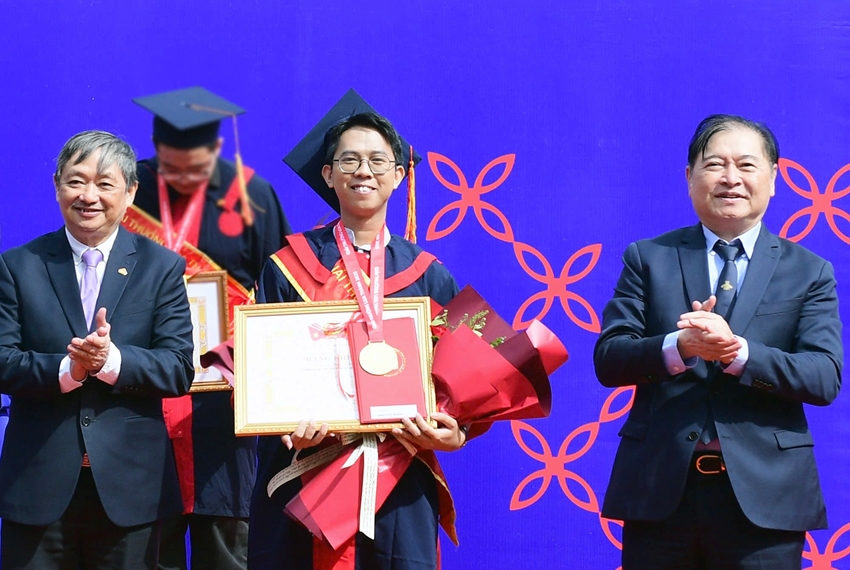
| Dang Duy Khoa’s joy upon receiving First Prize at the 2025 Loa Thanh Awards for his project “Hue Imperial Capital Heritage Museum” |
The project titled “Hue Imperial Capital Heritage Museum” by Khoa genuinely surprised many people with its fresh perspective, as a young person breathes modern life into ancient values. More than just a graduation project, “Hue Imperial Capital Heritage Museum” surpassed hundreds of projects nationwide to be honored with First Prize at the 2025 Loa Thanh Awards – a prestigious award for architecture students across the country.
“Mountain leaning – water facing”
Growing up in Long Xuyen (An Giang) and studying at the Ho Chi Minh City University of Architecture, Dang Duy Khoa’s love for heritage culture led him to travel through many regions of the country. In culture, there is architecture, which is one of the elements that has shaped heritage values passed down from ancient times.
Besides the southern localities and his Mekong Delta homeland, Khoa made great efforts to conduct field trips in many northern provinces and also spent a long time in Hoi An ancient town. However, when he stopped in Hue, he was truly captivated. In the eyes of the student, Hue is a deep reservoir of heritage, with a distinct identity and sufficient documentation and artifacts to build a museum of world-class scale.
Along with professional knowledge and real-life experience, Khoa also studied many materials to realize his dream. At the beginning of the design process, Dang Duy Khoa determined that he had to make something truly practical and meaningful for Hue, rather than simply satisfying the artistic ego of an architecture student.
Choosing the site was considered the most important assignment for the project. “At first, a large, open suburban site was considered because of its flexibility in design, ease of creating highlights, and freedom for ideas to soar. However, this option would break the visiting route and separate the museum from the existing heritage ecosystem,” Khoa reflected.
After much deliberation, the hypothetical site chosen to build the museum was a plot located within the Citadel. Proposing this idea meant the designer had to face limited land resources, planning constraints, and height restrictions imposed by the Heritage Law.
Calculating how to apply the aesthetic values of Hue’s architectural heritage was equally important. The scale of the building must not dominate or overwhelm but should harmonize with human perception. At the same time, there must be a close connection with nature, where architecture and landscape enhance one another. Another aspect is layered beauty, inviting visitors to explore from the overall form down to the details.
After resolving the site conditions, the building’s structure also became a challenging problem. Through research materials and fieldwork, the principle of “mountain leaning – water facing” was ultimately prioritized by Khoa. If “mountain leaning” takes inspiration from the gentle slopes of Hue’s hills, using curved, grass-covered roofs to form a second ground plane that helps the building blend into the landscape, then “water facing” refers to the surrounding water bodies combined with underground water storage.
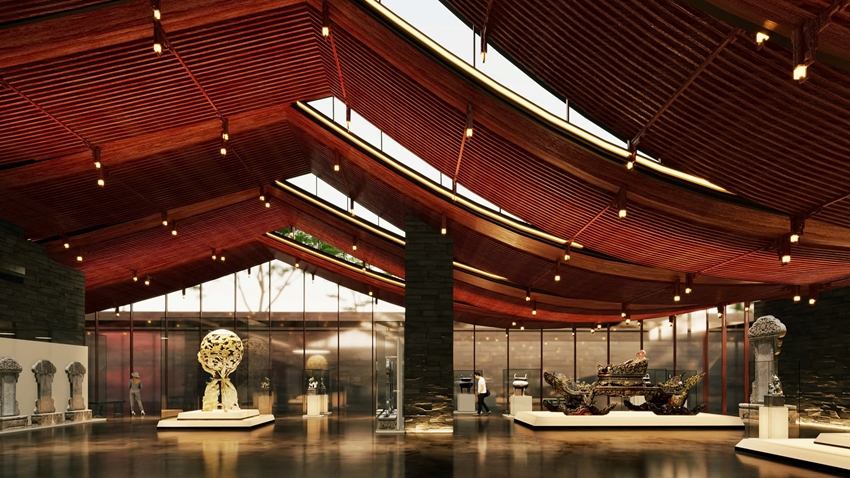 |
| Interior perspective of the “Hue Imperial Capital Heritage Museum” – where the journey of a heritage will be recreated |
Highlighting heritage values
One of the interesting points of the project is the way Duy Khoa learned from and applied the ancient water-management thinking used in the monuments of the Hue Imperial Citadel Complex. From there, the project is designed like a “machine” for managing water circulation. The entire basement of the museum is left empty and designed as a water reservoir for the whole complex, capable of storing an amount of water equal to the average annual rainfall of the area. This body of water not only passively regulates temperature, but is also reused to supply the water-cooling system and create a rain-screen system surrounding all four glass facades and the four underground sides. This solution turns the region’s distinctive climate into part of the building’s aesthetics and climate regulation.
If the exterior solutions are highly appreciated, the interior exhibition functions are also outlined with an engaging scenario. Throughout the exhibits, the journey of a heritage civilization is recreated and likened to the life cycle of a culture or dynasty: there is a beginning, a period of prosperity, a phase of decline, and then new continuations.
This journey is divided by Khoa into three main themes: from primordial times – when nature, terrain, and layers of indigenous civilizations laid the foundation for the imperial land; the Imperial Capital period – when heritage reached its brilliant peak of power and art but also inevitably went through upheavals and decline as a historical rule; heritage today and tomorrow – not only to look back at the past, but also to think about how to preserve and extend its vitality into the future.
Nguyen Dinh Vinh (Architect and Lecturer at the Ho Chi Minh City University of Architecture) – the supervisor of Dang Duy Khoa’s project – commented that this was a bold idea. “Not only does the project aim to revive heritage, it also addresses challenges in urban planning, especially flood prevention in the rainy season, water storage for cooling in the summer, and creating mist-like effects that highlight Hue’s dreamy atmosphere. I believe the project is practical and has the potential to be realized to help revive heritage,” Mr. Vinh shared.
Although highly appreciated, Duy Khoa remains humble when talking about this “brainchild” accumulated over more than five years of studying architecture. “There will still be certain technical gaps before it can be put into construction. However, I hope this project can serve as a foundation and a strong enough reference for managers and senior architects to consult, from which practical projects can be developed to help Hue solve preservation challenges in the future,” Khoa expressed.
The Loa Thanh Awards are among the most prestigious awards for outstanding graduation projects by students in architecture and construction nationwide. The awards have been jointly organized annually since 1988 by the Vietnam Construction Association, the Vietnam Association of Architects, the Ho Chi Minh Communist Youth Union Central Committee, and the Ministry of Construction. Over more than three decades, the Loa Thanh Awards have become a launching pad for many generations of talented young engineers and architects, contributing to affirming the quality of education and scientific research at universities across the country.