



 |
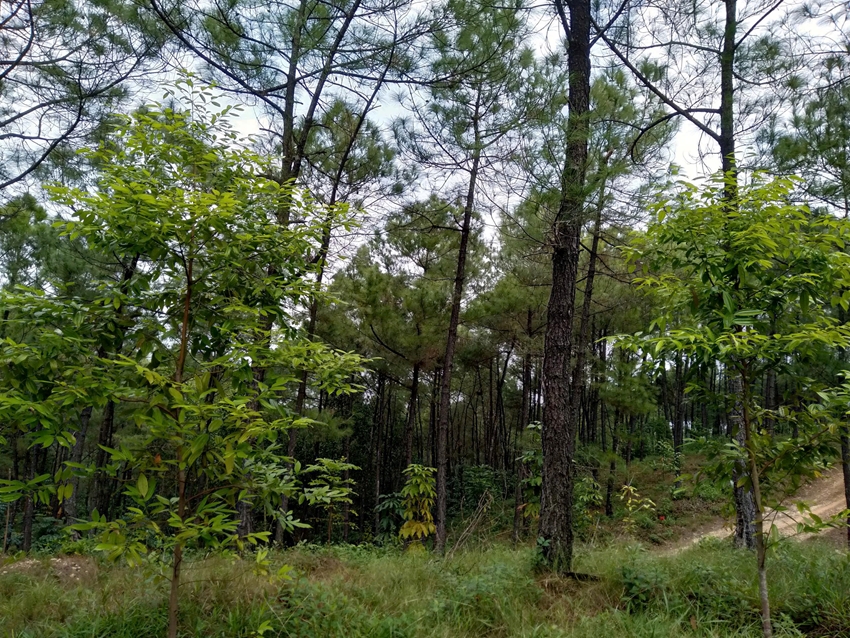
| The tropical rainforest belonging to the Central Coastal Natural History Museum, located 10 kilometers southwest of Hue city center in Thuy Xuan Ward |
After a 15-minute motorbike ride, the tropical rainforest belonging to the Central Coastal Natural History Museum, located 10 kilometers southwest of Hue city center in Thuy Xuan Ward, comes into view. The first impression upon entering the forest is the presence of native tree species such as hopeas and resin trees growing interwoven with pine trees, forming multiple layers and strata of a truly magnificent landscape. Around Chau Chu Lake, rows of bamboo and rattan covering a relatively large area have been planted, creating a cultural landscape characteristic of tropical rainforests and becoming a highlight within the Central Coastal Natural History Museum complex. Going deeper into the tropical rainforest, species such as Sindora tonkinensis - Tarrietia javanica, and Siam hopea, with tall and massive trunks interspersed throughout the forest, exhibiting the distinctive and representative features of the tropical rainforest ecosystem. Some species bloom with brilliant red flowers, blending with birdsong and the fragrance emanating from dense shrubs, further attracting visitors.
Mr. Ngo Thanh, Deputy Director of Tien Phong One-Member Forestry Limited Liability Company (Tien Phong Company), while guiding visitors through the forest, shared that Hue City lies in the Central Coastal region, where hills and mountains account for three-quarters of the natural area. This is a region rich in forest fauna and flora resources of Vietnam. However, due to both objective and subjective reasons, forest ecosystems have been shrinking, accompanied by the loss or decline of rare animal and plant species.
In response to this situation, through implementing Decision No. 86/2006/QD-TTg dated April 20th, 2006 of the Prime Minister approving the Master Plan for the Natural History Museum System in Vietnam, including the Central Coastal Natural History Museum in Hue, since 2013, the People’s Committee of Thua Thien Hue Province (now Hue City) has carried out detailed planning for the Central Coastal Natural History Museum, comprising components such as specimen exhibition halls, a comprehensive natural history museum, a zoo, and a tropical rainforest. Among these, the construction of the tropical rainforest is a key component of the museum, aimed at conserving representative tropical rainforest assemblages of the Central Coastal region while preserving rare plant species in the area.
From 2016 to 2018, more than 48 native tree species characteristic of the Central Coastal region, belonging to four assemblages: Sindora tonkinensis - Tarrietia javanica, Siam hopea, Vatica subglabra, and Red lauan were planted by Tien Phong Company across more than 67 hectares of the planned tropical rainforest area (including 1,3 hectares of bamboo species planted along Chau Chu Lake). Each assemblage includes approximately 16 to 18 species, with one or two dominant species in particular. Mr. Ngo Thanh stated that most seedlings were sourced from natural forests inside and outside the locality, then further nurtured at Tien Phong Company’s nursery to meet standards before being planted in the tropical rainforest. As a result, collecting a wide range of endemic, rare, and characteristic native plant species of the tropical rainforest ecosystem has not been an easy task. Moreover, the standards for trees used for planting require them to be over two years old, with a minimum height of 80 cm for slow-growing species and 120 cm or more for medium-growing species. These relatively stringent standards require a long waiting period from seed sowing until the seedlings meet the required criteria.
Currently, the planted native tree species have developed beyond the shade-tolerant stage and entered a light-demanding phase, requiring adequate space for growth and development. However, due to their limited ability to compete for nutrients and space with pine trees, native species have been growing very slowly. Therefore, thinning of pine trees must be carried out using silvicultural thinning methods to open the canopy and create appropriate nutrient space for native species to grow and develop more effectively.
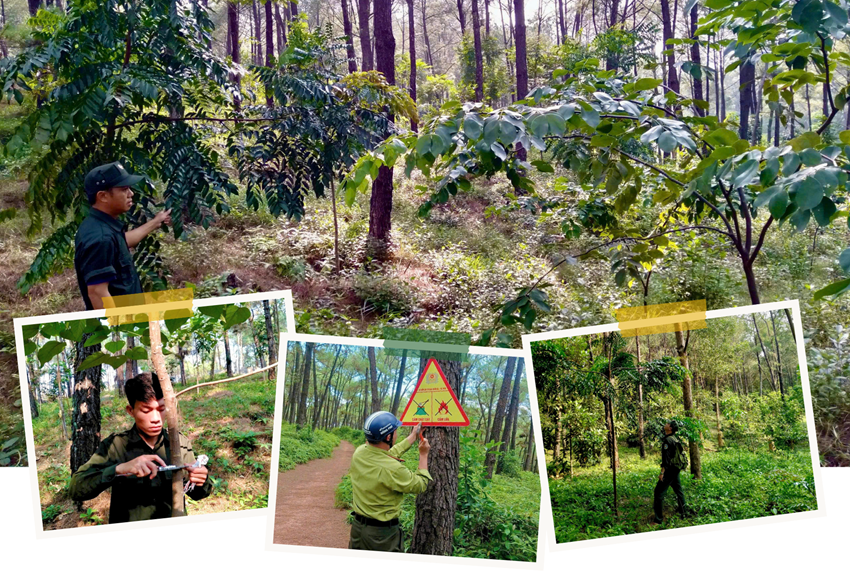 |
| Caring for endemic native plant species in the tropical rainforest |
A question arises as to whether, once the tropical rainforest has been fully formed, the pine forest area will be “eliminated”? Mr. Thanh explained that tropical (native) forests must be planted under an existing forest canopy, so during the initial period, the pine forest is retained intact and only understory shrubs are cleared. At present, as the trees have grown larger, pine trees are thinned only in areas where canopy opening is necessary, in accordance with approved plans, designs, and supervision by competent authorities, thereby ensuring no adverse impact on the pine forest landscape and environment.
While attentively measuring the diameter and size of native tree species, Mr. Le Hai Doai, a tropical rainforest management staff member of Tien Phong Company, stated that the forming tropical rainforest gradually will contribute to relatively intact conservation of the common forest assemblages of natural forests in the Central Coastal region. Not only does it conserve the natural forest ecosystem, but this tropical rainforest also effectively preserves endemic and rare plant species of the area, contributing to improved forest quality and mitigating natural disasters in the southwest of Hue City. Activities related to planting and tending the tropical rainforest will attract local labor participation, contributing to socio-economic development in the region. The economic value of the rainforest can also be exploited through the provision of seeds for future afforestation activities.
Also visiting the tropical rainforest, Mr. Vo Van Du, Chairman of the Hue City Forest Owners Sustainable Development Association (HUE-FOSDA), said that the tropical rainforest will provide an important and unique product that complements the formation of the Central Coastal Natural History Museum. The site is considered a miniature model simulating a natural forest, bringing together many valuable plant genetic resources of the tropical rainforest ecosystem along the Truong Son Range across Central Coastal provinces and cities, and will become a “home” for many animal species. In addition to its conservation function, the tropical rainforest will serve as a site for studying natural forest dynamics, ecological characteristics, and growth potential of tree species, and for supplying native plant species for future afforestation projects.
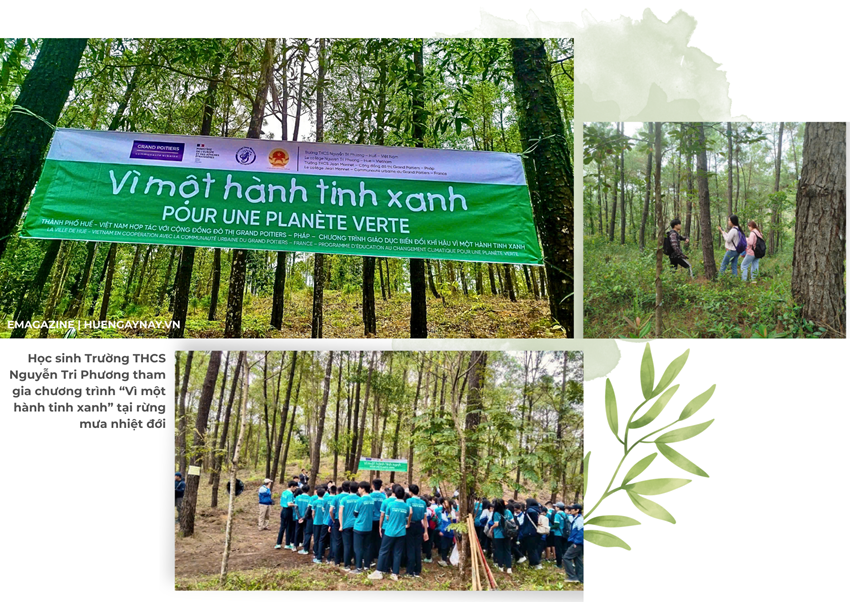 |
| Students from Nguyen Tri Phuong Secondary School participate in the “For a Green Planet” program at the tropical rainforest |
Investment in silvicultural projects within the tropical rainforest is a highly important and necessary direction, considering multiple aspects including environmental, economic, social, and cultural factors. The development of native tree species helps restore ecosystems, enhance resilience to climate change, and provide habitats for local fauna and flora. In addition, native species improve soil quality and prevent erosion.
This tropical rainforest is not only a form of green investment, but also a comprehensive strategy delivering sustainable benefits to the environment, local communities, and society, contributing to the realization of sustainable forestry development goals and nature conservation alongside economic growth. In particular, it provides favorable conditions for developing eco-tourism and resort tourism through products such as native forest exploration, butterfly and wildlife gardens, flower gardens, forest parks, and meditation forests,… combined with Hue’s characteristic historical relic sites, thereby creating new destinations for Hue tourism.