



 |
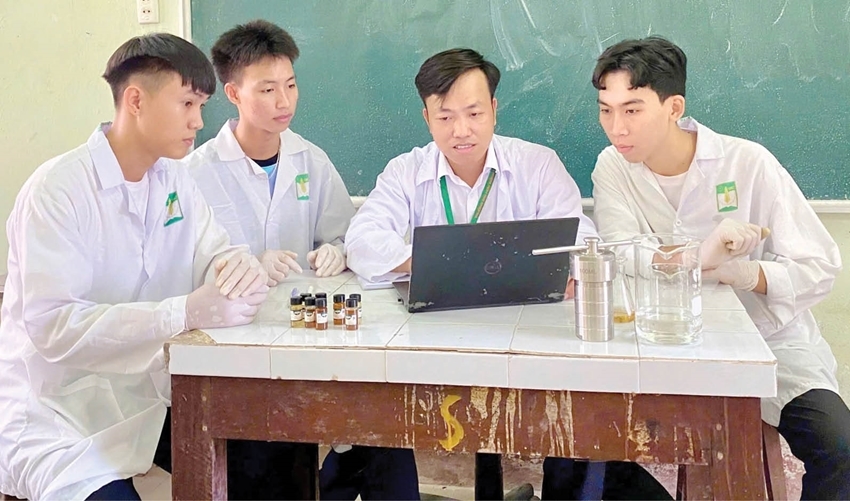
| The student research team |
The research student team includes: Tran Duc Loc (team leader), Tran Quang Vu, Nguyen Van Hai, Nguyen Van Phong, and Pham Thi Bao Uyen. The research idea was formed from practical reality: the amount of rice husk by-products in Vietnam is very large, but they are mainly burned or used with low value, causing resource waste and environmental pollution. Moreover, in the current agricultural context, improving photosynthetic efficiency and crop productivity is a highly focused research direction. The team posed the question: Could rice husks - an inexpensive by-product - be transformed into a high-tech material that is environmentally friendly and helps plants develop better? From there, carbon quantum dots became the chosen solution as the research direction.
Carbon Quantum Dots (CQD) are very small carbon nanoparticles, only a few nanometers in size. The special feature of this material is its ability to luminesce, absorb ultraviolet rays, and convert them into blue-red light - the light spectrum that plants use efficiently for photosynthesis.
In agriculture, CQDs are of interest because they can act as “artificial light antennas,” helping plants utilize light better and increase photosynthetic efficiency. This promotes growth and increases plant biomass, while having low toxicity and being environmentally friendly.
The novelty of the project is exploiting the carbon component in rice husks, rather than focusing on extracting silica (SiO₂) as in many previous studies. Additionally, the team uses a simple hydrothermal method without using toxic chemicals, making the process environmentally friendly, low-cost, and suitable for long-term application in agriculture.
The study found that CQD from rice husks has a positive impact on the growth of dicotyledonous plants such as bean sprouts, water spinach, and mustard greens. At the same time, it opens up a new approach in nano-technology agriculture that does not rely on chemical fertilizers.
Compared to traditional research directions, the project has a clear interdisciplinary nature, combining nanomaterials, agricultural science, and environmental protection. The scientific value of the project lies in transforming agricultural by-products into nanomaterials with biological functions, contributing experimental data on the impact of CQD on dicotyledonous plants - a relatively new field in Vietnam.
The key factors to ensure CQD quality are hydrothermal temperature and time, filtration process, centrifugation to remove large particles, and control of the concentration of CQD solution when applied to plants. In the research, the team determined 200°C as the optimal hydrothermal temperature to obtain CQD with a small size and good optical properties.
The team conducted planting of crops such as mung bean sprouts, water spinach, and mustard greens in environments supplemented with CQD solution at various concentrations, in parallel with control samples not using CQD. Results showed that CQD helped plants develop faster, with longer stems and roots, and significantly increased biomass compared to the control. This is explained by CQD helping plants utilize light more efficiently for photosynthesis.
Compared to current plant support measures, this solution has outstanding advantages. First, no chemical fertilizer application is needed, thus less risk of soil degradation. Second, raw materials are cheap and readily available. Finally, it works indirectly by enhancing photosynthetic efficiency, making it a sustainable solution. Using CQD from rice husks increases crop productivity and reduces the amount of by-products being burned, moving toward green and circular agriculture.
The team’s biggest challenge was controlling the quality of CQD produced from a natural biomass source with non-uniform composition, like rice husks. Additionally, determining the appropriate concentration for plants was challenging: too low yields unclear effects, while too high can inhibit growth.
In the coming time, the team hopes to expand testing on many types of crops and research more deeply into the mechanism of CQD impact and the possibility of large-scale application. At the same time, they hope to receive support from science and technology programs, partnerships with enterprises, and agricultural production facilities for long-term testing under real conditions.