



 |
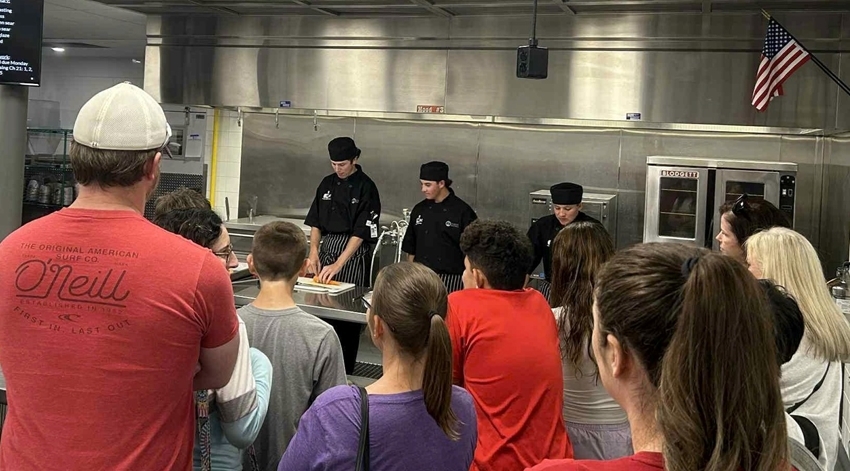
| The culinary practicum classroom at Byron Nelson High School where students are trained in professional skills within a modern environment |
When passion begins in the kitchen
Following the student volunteers who guided the program, our very first impression upon entering the simulated training kitchen was its professionalism, from the modern industrial kitchen system and gleaming stainless-steel workstations to large screens displaying lesson content.
On the screen, I saw the course content for introductory subjects in tourism and hospitality where students learn basic skills such as “What you need to know about the culinary profession,” “Knife skills (dicing, julienning, slicing),” to food safety certification. Students in the program also participate in the “Kids Teaching Kids Recipe Competition,” an event where they confidently instruct their peers in cooking.
Beyond cooking lessons, students also experience the “shadowing” method, learning real-world serving skills from upperclassmen. Notably, the program allows students to earn dual credit, completing high school while accumulating college credits in culinary arts.
Victoria Hooker, the lead instructor with experience in various educational institutions and restaurants, holding degrees in culinary arts and restaurant management, shared: “Byron Bistro is located on campus and operated by students. Advanced culinary classes handle the kitchen while younger students serve. The menu changes daily. Additionally, the restaurant caters events within the school or the community, all managed by students under professional supervision.”
What impressed me most was how teachers ignited passion. They do not teach the trade mechanically; instead, they let students experience, understand, love the profession, thereby shaping early career orientation. This combination of skill-based education and creative nurturing is something vocational training models in Vietnam could learn from.
Career orientation toward the dream of Vietnam’s Culinary Capital
In Ho Chi Minh City, from the 2025-2026 academic year, Bui Thi Xuan High School (Ben Thanh Ward) launched hands-on culinary classes for students. This is considered a positive innovation in education, allowing students not only to learn academic knowledge but also to acquire practical life skills, better preparing them for the future.
In Hue City, in previous years, Hue College of Tourism received “orders” from several language centers to jointly organize the program “Children explore tourism careers,” helping primary students become familiar with the “5Bs”: buong (housekeeping), ban (service), bep (kitchen), bar (beverage), and banh (pastry).
A decade ago, Little Italy Restaurant became the first culinary business in Hue to launch the program “Kids cook with Mr. Pizza,” introducing children to Italian cuisine. They learned cooking by making pizza with the head chef and playing with the program’s mascot, Mr. Pizza. Later, the restaurant expanded activities to include teaching children to prepare fruit juices for the family during summer or create culinary artworks through “focaccia art”, an Italian flatbread decorated with vegetables, herbs, and edible flowers resembling a painting or a small garden.
Hue ancient capital is renowned for both royal and folk cuisine and is widely called Vietnam’s “Culinary Capital.” From my experience at Byron Nelson High School, I immediately thought of the career-exploration programs that many educational institutions in Hue have begun implementing. Though small in scale and extracurricular in nature, these activities instill in students a love for culinary arts, a vital foundation for the future development of the local culinary industry.
Middle schools in Hue should be bold in introducing culinary career-orientation models through experiential lessons. Students can become familiar with basic kitchen skills, food safety, and learn about Hue’s culinary culture through activities similar to those at Byron Nelson High School.
Additionally, it is possible to consider establishing a “Hue Culinary Practice Center” in collaboration between the Hue College of Tourism and local culinary businesses, a place where students can both study and practice by serving real customers. With the support of Hue Culinary Culture Association and by involving these young trainees in national and local culinary festivals, this model would help narrow the gap between training and the labor market while also spreading the essence of Hue’s cuisine.
Developing a Dual Credit program for the culinary field would allow vocational students to accumulate credits toward a university degree in tourism or hospitality management. Conversely, hospitality-management students at the School of Tourism, Hue University should also obtain additional culinary certificates as professional preparation for entering the industry.
Lastly, a “Master Chef Kids - Hue Cuisine Through Children’s Eyes” competition should be organized. This would provide a platform for students to creatively craft dishes using Hue ingredients, nurturing hometown pride and developing international-style food-presentation skills. Children should be encouraged to use English when explaining their cooking methods, similar to the long-running “Young Tour Guide” English competition hosted by the city.
Hue possesses abundant potential, from rich local ingredients, royal and folk culinary heritage, and skilled artisans to the studious spirit of its young generation. If education, businesses, and the community can be effectively connected, transforming Hue into Vietnam’s Culinary Capital not only will be a matter of title but will be realized through generations of young chefs whose passion has been nurtured since childhood, those who will carry the soul of Hue cuisine to the world.