



 |
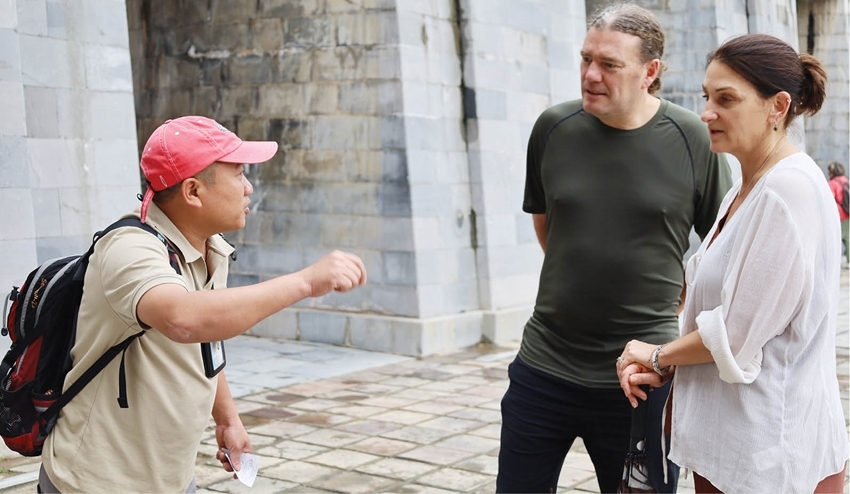
| Tourists visiting Hue Imperial Citadel on the morning of November 4 |
Tourism is a “vulnerable” sector
Taking advantage of the receding water, Century Riverside Hue Hotel mobilized all resources to quickly clean up, repair damage, and resume operations. Mr. Nguyen Huu Binh, Director of the hotel, shared that during the recent heavy rains, the first floor was flooded by about 30 cm. Twenty-eight rooms, including offices, meeting halls, and reception areas, were affected, with carpets, wooden floors, and furniture damaged. During the flood period, hotel occupancy dropped to 40-60%, an average decline of 20%.
According to Mr. Ho Dang Xuan Lan, Chairman of the Hue Hotel Association and General Director of Parkview Hotel Hue, although specific damage statistics for the hotel sector are not yet available, since most businesses are focusing on clean-up and recovery, many accommodation facilities were flooded, significantly affecting operations.
Ms. Chau Thi Hoang Mai, Vice Chairwoman of the Hue Tourism Association and Executive Director of Alba Spa Hotel and Alba Hotel Hue, said that due to concerns during and after the floods, many tourists postponed or canceled trips to Hue from late October until November 6–8. The impacts of natural disasters on tourism are not easy to quantify.
Travel activities were almost “paralyzed” during the flood days. Ms. Duong Thi Cong Ly, Director of the Tourism Corporation Vietnam - Hanoi, Hue Branch, said that ensuring tourist safety was the top priority. Therefore, in such weather conditions, postponing or canceling tours was unavoidable. This not only reduced company revenues but also affected travelers’ experiences.
From our observations, floods severely damaged many eateries, particularly restaurants and tourism businesses along beaches, rivers, and streams. A representative of a tourism cooperative in A Luoi Commune shared that every flood season, stalls and facilities near waterfalls must be rebuilt from scratch. This is a serious concern.
Not only Hue but also other famous domestic destinations such as Hanoi, Ho Chi Minh City, Da Nang, and Hoi An have recently faced extreme weather events such as heavy rains, floods, and waterlogging. This clearly demonstrates the increasing pressure of climate change on the tourism industry.
When storms and floods occur, damage goes beyond the destruction of tourism infrastructure, it disrupts the entire value chain. The most affected are coastal resorts, low-rise hotels, and transportation systems like roads and bridges in key tourist areas. Most tourism businesses in Hue are small or micro-sized, while repair and recovery costs are high and sometimes exceeding their financial capacity.
It is evident that floods and natural disasters not only cause short-term business interruptions and disrupt local livelihoods, but also create psychological barriers and loss of confidence that discourage tourists from visiting or returning.
Enhancing resilience and adaptation
Mr. Nguyen Huu Binh said that during the floods, power outages occurred at several points; when generators failed, candles were used instead. To “lift the mood” and keep guests entertained, the hotel organized various activities such as games, musical performances, and traditional entertainment. Regular meals were replaced with “royal-style” dining services, which helped make guests feel more cheerful.
“After natural disasters, many tourists worry about service quality, disease outbreaks, environmental hygiene, food safety, and potential social issues. Businesses must act quickly to recover, while local authorities should actively promote real images showing the speedy restoration of normal activities to help rebuild investor and visitor confidence,” Mr. Binh emphasized.
According to Mr. Lan, during floods when guests cannot go out, hotels must raise their in-house service quality to the highest level, from cuisine to massage, spa, and other on-site experiences. Ms. Mai added that after floods, it is essential to spread visual messages showing how local authorities, agencies, and businesses are working together to clean up, prevent disease risks, repair damage, and return to normal operations and to keep partners updated to restore confidence.
As a leading economic sector, tourism cannot remain passive in the face of natural disasters. It must adopt a resilience-based development strategy, not only recovering after disasters but also forecasting, adapting, and learning from each flood or storm event.
One key factor is the sector’s proactive capacity. Tourism planning and investment promotion must carefully consider climate change response scenarios, especially in coastal, riverine, and low-lying areas. The tourism sector should also strengthen coordination with travel agencies and hotels in forecasting, guidance, and mutual support. It is crucial to research and develop suitable products, especially distinctive rainy-season tourism experiences, and implement effective stimulus programs.