



 |
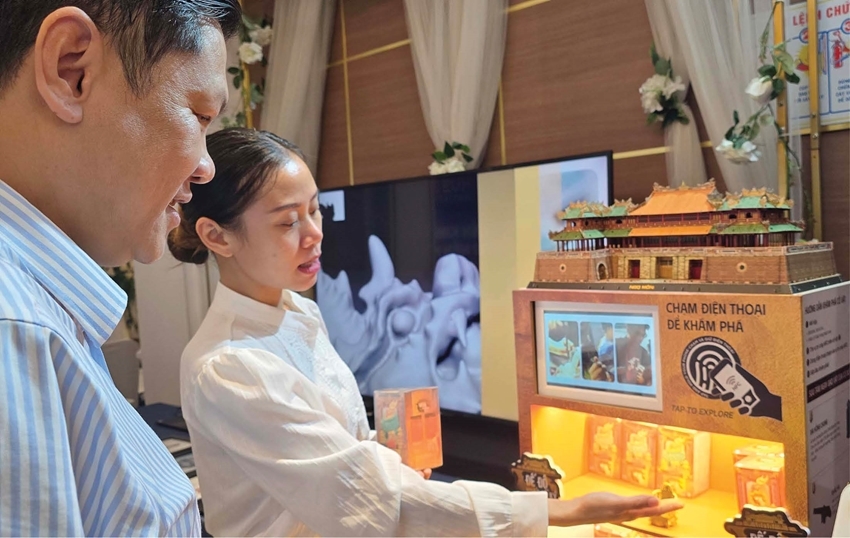
| Introducing a product of blind box art toy inspired by the Four Treasured Artifacts of Hue Ancient Capital |
Telling the stories of heritage through Hue products
In the framework of the forum on innovative economy, Mr. Nguyen Duc May, Chief Operating Officer of Kinh Do Specialty Joint Stock Company shared his startup journey which was deeply rooted by his hometown. After 15 years working in the field of technology in Ho Chi Minh City, he decided to come back to Hue with a desire to “inherit, develop, and spread the essence of Hue’s specialties” in the new ways.
According to Mr. May, heritage just really “comes to life” when it is transformed into familiar products with economic values. That is the reason Kinh Do Specialty Joint Stock Company, a young business that combines cuisine, culture, and technology was founded with an aim to tell the stories of Hue by experiences.
From there, the company collaborated with local authorities and farmers to elevate Truoi tea product, a precious local specialty of Hue. Starting from bundles of fresh tea leaves worth only a few thousand VND, Mr. May and his team has developed high-value products such as tea bags and fresh tea extracts that are both convenient and rich in local identity. “From local ingredients, we aim to create products with many times greater added value while contributing to the development of Hue’s rural economy”, shared Mr. May.
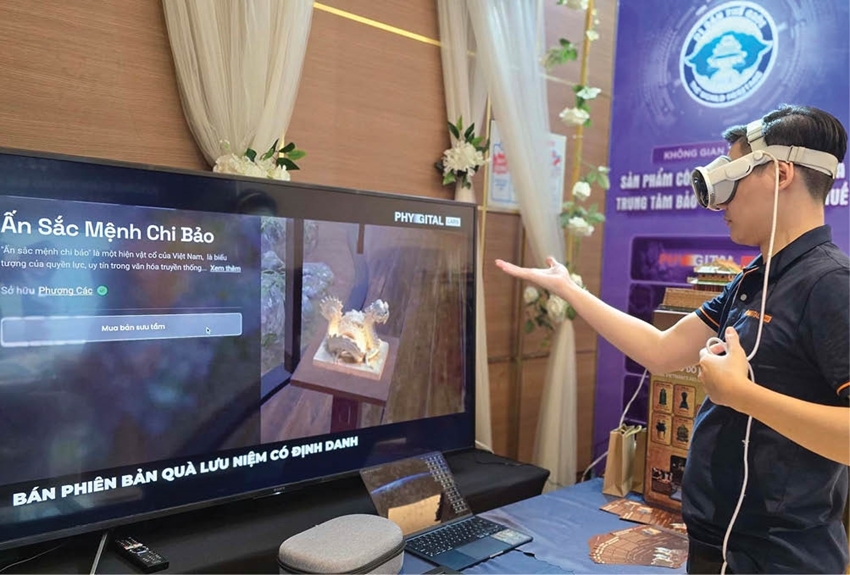 |
| Experiencing virtual reality technology at the forum |
After a year and a half of operation, Kinh Do Specialty has made its mark on Hue - Da Nang Heritage Train, serving more than 200,000 passengers in just the first 9 months of 2025. On this train, travelers can admire Hai Van Pass while enjoying Hue’s specialties and listening to traditional Hue music performed by local artists. Mr. May revealed that in 2026, the company is going to expand similar services modeled after Hanoi’s “Five Gates Train”, connecting a chain of destinations, gifts, and cultural events.
Notably, Kinh Do Specialty, in collaboration with Hue One Food, has just exported the first 18 tons of Hue cakes to the U.S. market, opening new opportunities for local products. Although there are still many challenges in meeting international standards, Mr. May believes this is the first step toward “exporting Hue’s culture through each product”. Mr. May said: “To participate in the global economy, Hue must build up a sustainable production and farming system. The circular economy - green economy is the future of Hue’s heritage”.
Heritage - The Resource for Sustainable Development
From the perspective of a management agency, Mr. Hoang Viet Trung, Director of Hue Monuments Conservation Center, believes that it is time for Hue to transform all its heritage potential and values into a driving force for development. He emphasized: “We often talk about cultural values, but now is the time to take action. Heritage is not merely a memory of the past, it is a resource for the future”.
According to Mr. Trung, Hue currently possesses more than 24 types of heritage, both tangible and intangible, including royal architecture, fine arts, music, cuisine, lifestyle, and landscapes. Each form of heritage is a valuable material that businesses can transform into creative products with economic values.
From an urban planning perspective, the city is also orienting itself toward a heritage city model linked with the cultural industry and brand economy, with the expectation that by 2030, revenue from this sector could increase fivefold compared to the current level. Looking further ahead, by 2045, if Hue fully leverages its heritage advantages, it has the potential to become a leading cultural creativity hub in the region.
Hue Monuments Conservation Center is currently accelerating the application of digital technology in heritage management and promotion, including data digitization, multilingual automatic narration, virtual exhibitions, AI-based artifact identification, and online displays on metaverse platforms…
“Technology helps bring heritage closer to the public and opens up new opportunities for collaboration between cultural institutions and creative businesses. Heritage is the foundation, the private sector is the driving force, technology is the tool, public-private partnership is the method, creativity is the key, and connectivity is the lifeline. When these 6 elements come together, Hue will form a sustainable heritage economy ecosystem,” said Mr. Trung.
Towards a “Creative Heritage Ecosystem”
From an international perspective, Mr. Kieu Viet Cuong, Acting National Director of UN-Habitat, believes that Hue has the “right timing, favorable conditions, and harmonious human factors” to develop a creative heritage ecosystem led by the private sector. Heritage is “the infrastructure for innovation.” “Hue possesses rich cultural assets and a dynamic small business community, but it still lacks value chains and capital. The solution is to regenerate the city based on heritage, creating opportunities for all stakeholders,” Mr. Cuong suggested.
UN-Habitat introduced a five-pillar development model: Heritage assets and creative spaces; Creative value chains including crafts, design, cuisine, performance, tourism, and digital content; Finance and markets; Capacity and connectivity; and Institutions and open data. This model operates through 3 loops: Conservation, Creation, and Development, enabling heritage to be both preserved and actively integrated into contemporary economic life.
Hue has begun to materialize this vision through the Circular Economy Development Plan (Plan No. 284/KH-UBND, dated July 4, 2025), providing an institutional foundation for the cultural industry and creative economy. According to experts, the “creative heritage” model does not replace preservation but rather enriches its value, linking heritage objectives with employment, growth, and sustainable consumption.
“We do not promote heritage as a static product; we must create living products that are continuously renewed, enhancing the value and quality of Hue’s urban environment,” said Mr. Cuong.
From the stories of young entrepreneurs like Nguyen Duc May to the visions of experts, Hue is shaping its own path, a distinctive heritage economy model where the past and the present intertwine. When businesses, authorities, and the community work together, every product and experience will carry both commercial value and the spirit of Hue.