



 |
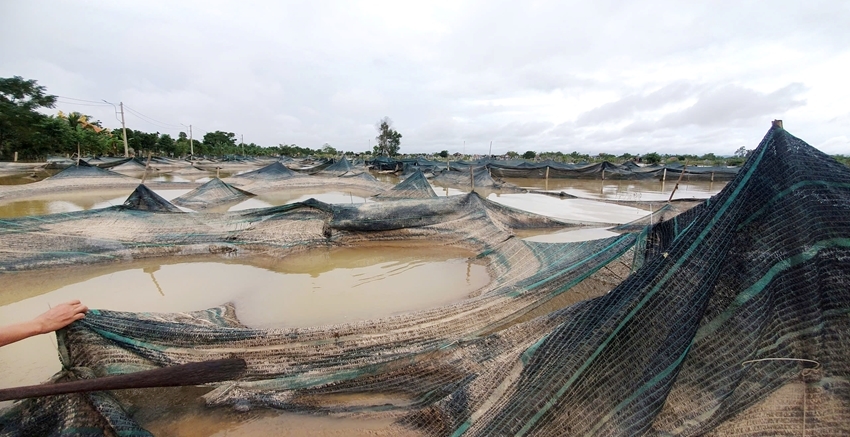
| The culantro fields submerged under water in An Thuan Residential Area |
As long as there are lives, there is hope
After the historic flood that lasted from October 26 to 31, we returned to Kim Tra as the waters began to recede. However, getting to this flood-stricken area was no easy task, most travel still depended on small wooden boats.
This ward was one of the most severely flooded areas in Hue during the prolonged rainfall. Of its 27 residential clusters, 26 were submerged under water levels ranging from 1 to 1.8 meters. By October 31, although water had receded in some places, over 10 neighborhoods remained deeply flooded, especially An Thuan and Van Cu, Nam Thanh, considered the “flood basin” of Kim Tra, where waters still exceeded one meter.
To reach these two neighborhoods, we had to wade and walk nearly 2 kilometers from National Highway 1A with some sections nearly a meter deep to the fishing hamlet of Giap Trung. From there, we switched to a small boat, guided by Mr. Phan Thanh Tuan, Deputy Commander of Kim Tra’s Military Command, and accompanied by “swimming companion” Tran Van Trai, a resident of the hamlet.
Speaking about the recent flooding, Mr. Tuan said An Thuan has 300 households with nearly 1,200 residents, but only four households (nine people) had to be evacuated. Meanwhile, Van Cu - Nam Thanh, with 570 households and 2,644 residents, saw only one family of four relocated to safety.
After about 20 minutes drifting downstream, our boat reached An Thuan. Amid the vast floodwaters stood rows of vegetable nets, which were once bright green, now brown and heavy with mud. They were all that remained of five hectares of culantro crops nearly ready for harvest, now completely submerged.
“Just last week, I was excited thinking I’d earn a bit extra for new purchases, but heaven had other plans,” said Nguyen Thi Hang, a Kim Tra resident, unable to hide her sorrow as she spoke of her fields of culantro now buried beneath the floodwaters.
Her sadness is shared by many local farmers, as the ward lost another 50 hectares of vegetables (mostly culantro), with estimated damages of around 1.5 billion VND. However, culantro can be planted year-round and harvested continuously, so with proper support and the resilience of the villagers, recovery should not be difficult. The most comforting fact remains: after the great flood, lives were spared - as long as there are people, there is still something left.
Adapting to natural disasters
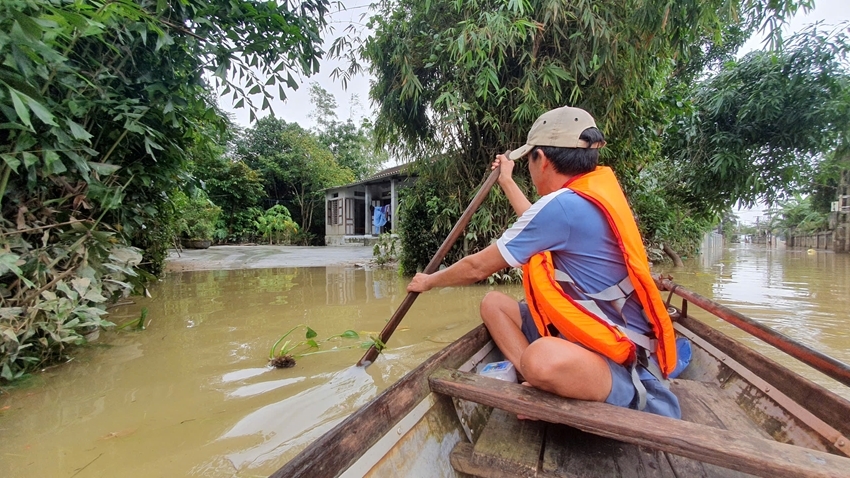 |
| Thanks to a sturdy house with a raised foundation and high yard, Mrs. Nguyen Thi Mui’s family did not feel too anxious during the days of rising floodwater |
Continuing our journey through the swift, muddy waters, Tran Van Trai steered us toward Van Cu – Nam Thanh. Not only a skilled boatman, Trai was also intimately familiar with the terrain. Though everything lay submerged under a vast sheet of water, he could easily point out where irrigation canals and tombs were hidden beneath the surface, or where floodwaters had engulfed the North - South railway tracks, deftly guiding the boat away from shallow and dangerous spots.
Arriving at Van Cu - Nam Thanh, we found perhaps one of Kim Tra’s least affected agricultural areas, as most locals here make rice noodles for a living and the summer - autumn rice crop had already been harvested. Like An Thuan, the roads in this area are low, but the houses are built high, a practical adaptation to Kim Tra’s seasonal floods.
Thanks to elevated foundations, when floodwaters peaked on October 29, submerging roads under 1.5 to 1.8 meters, most homes in these two neighborhoods saw only knee-deep water inside. By the time of our visit, streets were still more than a meter deep, but the water inside houses had already drained completely.
“Living in a low-lying area, everyone is aware of the need to prepare for flooding, even poor families try to raise their floors or build elevated foundations. Otherwise, it had to be head-deep water these past few days. As soon as local authorities issued flood warnings, people stocked up on food and essentials. It’s a bit inconvenient now with low water pressure, power outages, and difficult travel, but overall, we’re managing just fine.” said Nguyen Van Hoang, a resident of Van Cu - Nam Thanh.
Mrs. Nguyen Thi Mui, a poor resident of Van Cu - Nam Thanh, recently received assistance to build a charity house. Though modest, her single-story home is sturdy, with a high yard. “Water entered the house a few days ago, but thanks to the raised yard, it wasn’t too bad or dangerous. During those days, relief supplies from the local government, militia, and police arrived in time; so, although life was harder than usual, we managed to get by,” she said.
“In recent days, the ward People’s Committee has mobilized all forces to receive and distribute thousands of food and essential supply packages from the city government as well as local and external volunteer groups directly to residents. To prevent transportation shortages, we called on boat owners and formed a support team. Over the past days, everyone has worked tirelessly to deliver aid to people as quickly as possible,” said Ho Le Hoang Thinh, Chairman of the Kim Tra Ward People’s Committee.
Prepared and adaptive
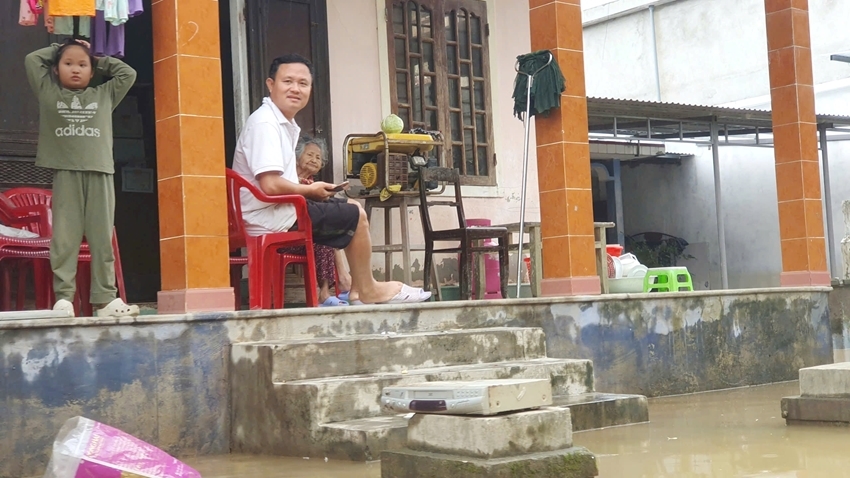 |
| Van Cu - Nam Thanh has very low roads, but most houses feature high yards and elevated steps |
As of November 1, residents of Kim Tra in general, An Thuan and Van Cu - Nam Thanh in particular, had been surrounded by floodwaters for a week. In the deepest areas, in addition to timely aid from local authorities, the military, and police, help also came from volunteer groups in Hue, Quang Tri, Hai Phong, Ha Noi, and Lam Dong. In higher areas, some people were even able to reach the local market to buy more food and supplies.
From these signs of resilience, it is clear that despite being surrounded by water for days, timely assistance from authorities and volunteer groups has kept life relatively stable; no one went hungry during the long floods. The most pressing needs now in still-flooded areas are electricity and clean water, but those depend on how quickly the waters recede.
In recent days, in addition to 55 hectares of damaged crops, Kim Tra Ward also lost six tons of red tilapia fish. The irrigation system, internal and inter-regional roads, and local transport networks have suffered severe damage, with total losses estimated at nearly 15 billion VND. There were also three reported fatalities.
Despite these losses and sorrows, optimism and reassurance remain evident even in Kim Tra’s lowest areas, which is born from the residents’ preparedness and the dedication of local authorities, military units, police, mass organizations, and volunteer groups who have stood by the people throughout the floods.
“According to the news, more heavy rains are coming to Hue. It’s likely we’ll face flooding again. Yes, it’s dangerous and inconvenient, but as long as we stay alert and cautious, we can get through the storm,” shared Mr. Nguyen Dinh Bang while shopping for extra supplies.
As dusk fell and we left An Thuan and Van Cu - Nam Thanh, we recalled the data provided by Tran Thanh Tuan (verified by the Kim Tra Ward Chairman) and the image of homes with raised yards and high floors. These two details are closely intertwined, serving as living proof of how residents in this flood basin have learned to adapt and coexist with nature’s challenges.